

We all listen to music; some less frequently, while others can’t function without it. Among hundreds of popular musical genres, hip-hop, rap, trap, and modern international R&B are among the most listened to and appreciated globally, especially among young people.
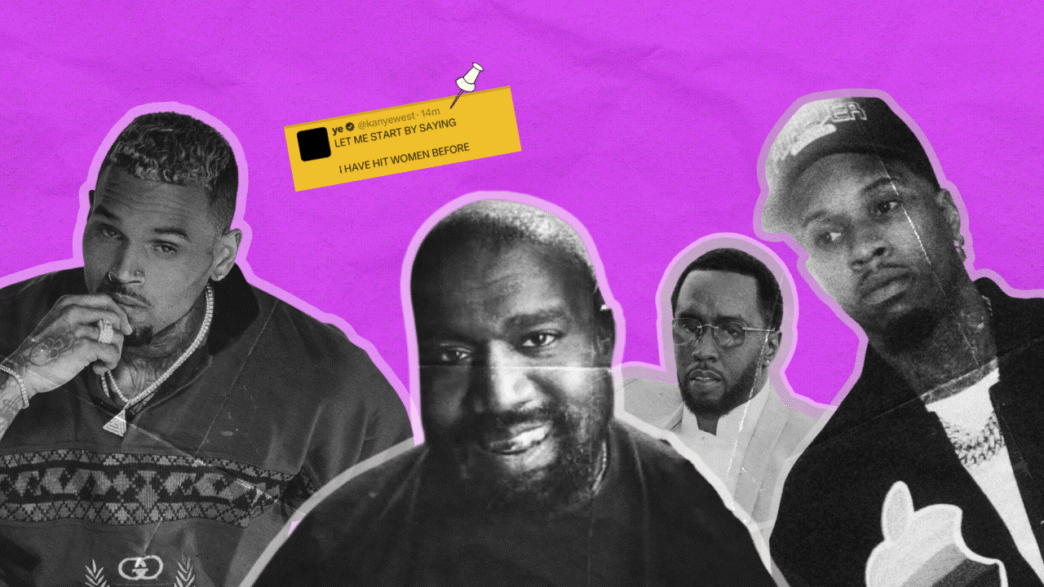
These musical genres are dominated by artists like Kanye West, Playboi Carti, Tory Lanez, Chris Brown, Tyler, the Creator, and A$AP Rocky. Many of them have been accused of aggressive behavior, both verbal and physical, towards women. Despite this, they have been „forgiven” by a large portion of their fans due to their successful music careers.
Chris Brown is known for physically abusing Rihanna in 2009 when they were a couple, as noted by Glamour UK. In addition to this case, Rolling Stone mentions that the artist has over 20 accusations of physical abuse against women in total.
Kanye West repeatedly verbally assaulted artist Taylor Swift since she was 19. Also, his former personal assistant accused him of sexual assault after leaving her position, according to information published by the BBC.

Singer Tory Lanez shot famous rapper Megan Thee Stallion in the foot in 2020 during an altercation at a party when the two were a couple. Playboi Carti and Lil Uzi Vert, two American rappers, were also accused of physical assault by several women, but the cases did not lead to consequences and they were quickly forgiven by their fans, according to The Guardian.
When do we draw the line between idolatry and abuse? Can we truly separate the person from their artistic creation?
„Musical messages with sexist content reinforce gender stereotypes, supporting the image of the dominant man and the submissive or sexualized woman.”
To better understand why society not only „forgives” controversial artists but also admires and promotes them, and instead of abandoning their music and support, ends up giving them even more attention, we spoke with Mihaela Rus, the president of the College of Psychologists from Romania, Constanța branch. She explained how artists manage to manipulate fans’ minds to remain relevant and how social media contributes to this.
Asked if she believes that problematic messages in music, such as misogyny and the promotion of toxic behaviors, are more frequent today than in the 90s or 2000s, Mihaela Rus states that such a comparison is difficult to make.
However, the visible difference lies in the accessibility of these messages. More precisely, the public is more aware today of the cultural and psychosocial implications of musical messages, and social media networks have amplified the spread of toxic discourse in songs.
Another difference from the 90s or 2000s is the existence of the „cancel culture” phenomenon (a boycott campaign, editor’s note), which offers the public the opportunity to hold accountable and „punish” artists who violate certain standards.
- „Sociologically and psychologically speaking, current generations (especially Gen Z) are more educated on themes of equality, diversity, and mental health. This does not mean that they don’t listen to music with problematic content, but that they are more aware of the contradictions between musical taste and assumed values,” the psychology expert also stated.
Regarding offensive or violent messages against women, conveyed by some artists, the president of the College of Psychologists from Constanța argues that this type of content, constantly disseminated by well-known artists, can influence public behavior and attitudes, especially when not accompanied by critical distancing.
She also explains that repeated exposure to a certain type of message can shape the public’s perceptions of reality until such behaviors come to be perceived as normal or acceptable in society.
- „If the artist is admired and popular, their messages, even if toxic, can become behavioral scripts for some fans. When the public is repeatedly exposed to lyrics that degrade women or present them as sexual objects or inferior beings, a desensitization effect can occur. This process reduces empathy for real victims of violence and favors a tolerant attitude towards misogyny. Musical messages with sexist content reinforce gender stereotypes, supporting the image of the dominant man and the sexualized or submissive woman. These messages can influence not only individual perceptions but also the social climate, especially in youth groups, where music plays an identity-forming role,” Mihaela Rus also argues.
The president of the College of Psychologists from Constanța emphasizes that while musical messages and artists’ misogynistic behavior can impact public perceptions, their effects are not uniform or inevitable.
Depending on individual, cognitive, and socio-cultural factors, messages are filtered through various protective mechanisms or, conversely, through mechanisms of vulnerability. In this way, the expert exemplifies the following factors:
- Degree of Exposure: People who frequently listen to such songs and consistently follow artists who promote problematic messages are more susceptible to internalizing this content. In contrast, occasional exposure, combined with a high level of critical awareness, has much reduced effects.
- Level of Education and Media Literacy: People with a high level of formal education, media education, and critical thinking are better able to analyze and contextualize toxic content. Media literacy allows them to identify manipulation strategies, gender stereotypes, and the symbolic implications of messages.
- Pre-existing Attitudes Towards Women: The impact of misogynistic messages is significantly influenced by the listener’s already internalized values. A person who already exhibits sexist attitudes or comes from an environment with patriarchal norms will be more inclined to resonate with musical messages that reinforce these perspectives. In contrast, people who support gender equality tend to reject or ironize such messages.
- Social and Cultural Environment: The social context in which the listener lives influences what is perceived as „cool” or, conversely, offensive. In environments where sexism is tolerated or even appreciated in the form of „traditional masculinity,” misogynistic music is better received and has a greater potential for influence.
„I like the music, not the artist”
One of the reasons mentioned by the psychologist for why the public overlooks an artist’s problematic behaviors, such as any kind of aggression against women, is the power of music, which activates deep emotional triggers.
Pop culture, in turn, contributes to the normalization of these behaviors in the name of artistic expressiveness, she says.
This phenomenon is supported by psychosocial mechanisms such as identification with the artist, separation of art from the author, social pressure, and cultural desensitization to misogyny.
In the absence of consolidated critical thinking, the public often prefers the pleasure offered by music at the expense of assuming moral responsibility.
- „In current pop culture, problematic behaviors are often reinterpreted as part of ‘artistic genius’ (e.g., ‘that’s just how he is, but the music is brilliant’), or as a marketing strategy. The public comes to perceive aggression, arrogance, excessive sexualization, or misogyny not as moral flaws, but as elements of a personal brand. Scandal and controversy become forms of cultural capital and bring visibility, and visibility is confused with value. Music produces immediate affective effects by activating brain areas associated with pleasure, reward, and dopamine. A song with a memorable rhythm, intense beat, and repetitive lyrics can create very strong emotional attachments, even if the messages are toxic. Thus, even if the listener is aware that the artist has committed reprehensible acts, the pleasant emotion produced by the song ‘beats’ critical reason,” the psychology expert further added.
Mihaela Rus also states that many consumers choose to adopt the principle „I like the music, not the person” to justify listening to a controversial artist without feeling moral guilt.
This separation between product and author is maintained by both the music industry and fan rhetoric, despite the fact that the artist’s financial success contributes to the support and perpetuation of their behaviors.
Added to this is the fact that current musical preferences are strongly influenced by social media platforms, through trends or algorithms, which can lead to situations where a song is listened to due to the herd effect, even if the listener does not necessarily agree with the message or the artist who created it, but does not want to feel excluded.
- „Listening to, watching, or promoting the work of an artist accused of serious deeds is not a neutral choice. Any view or stream generates profit, visibility, and influence. For some, this gesture can be perceived as symbolic complicity, especially when the victim is ignored, and the aggressor is glorified.”
Social media, in this context, does not just represent channels for promoting music, but true ecosystems that influence how the public perceives, supports, or rejects an artist.
These platforms, which offer the public a voice and the possibility to criticize and sanction, often contribute to consolidating the fame of artists with toxic behaviors, such as misogyny, violence, or any kind of aggression, according to the psychologist.
„Many fans develop a form of emotional attachment to the artist”
From a psychological perspective, social media operates on the basis of the mechanism of cognitive salience: what is visible, repeated, and emotionally charged captures attention and is perceived as important. In this sense, any scandal, shocking behavior, or controversial statement becomes a source of traffic, comments, and interactions, Mihaela Rus also says.
In the online environment, visibility equates to power. Thus, an artist can get millions of views not for their music, but for the conflicts generated by their behavior. Basically, negative notoriety transforms into social and monetary capital.
Even if an artist is known for misogynistic or abusive behaviors, Mihaela Rus explains that many fans choose to say: „He’s just a character,” „It has nothing to do with the music,” or „we all make mistakes.” This attitude reduces social pressure on the artist and allows them to remain in the spotlight.
- „Therefore, even when the public criticizes an artist, they do so on platforms that generate income and visibility for them. Practically, a system is fed where controversy becomes a marketing strategy. Also, many fans develop a form of emotional attachment to the artist, a parasocial relationship. From a psychological point of view, this type of one-way relationship creates the illusion of a personal connection, something like: ‘I know him, I understand him, he’s part of my life’,” the psychology expert further added.
The expert also adds that in the face of evidence that an artist exhibits toxic behaviors, cognitive dissonance arises between what fans feel and what they know. To reduce this internal tension, many choose to ignore, minimize, or justify negative behaviors, thus contributing, again, to the perpetuation of the artist’s fame.
In this context, the internet offers the public both tools to sanction an artist’s problematic behaviors and a framework which, through the algorithmic logic of visibility and through psychological consumer mechanisms such as moral disengagement, parasocial attachment, or cognitive dissonance, amplifies the fame of toxic artists.
In the absence of an ethical framework for cultural consumption and collective critical thinking, scandal is no longer a shame but an effective strategy for survival and growth in the digital music industry, concludes Mihaela Rus, president of the College of Psychologists from Constanța.
In detail, about the most well-known abuses on the international music scene
- Kanye West: from Nazism to sexual assault accusations

For young people passionate about modern music, especially hip-hop, trap, or rap genres, Kanye West, known as „Ye,” is considered a „genius” of modern music.
With albums boasting hundreds of millions of listens, such as „Graduation,” „My Beautiful Dark Twisted Fantasy,” and „The Life of Pablo,” and numerous songs that have surpassed a billion streams on Spotify and YouTube, Ye has been considered one of the best artists since the 2000s.
What’s worth mentioning is that besides his musical career, appreciated by tens of millions of young people worldwide, he has engaged in numerous controversial acts that could have instantly destroyed his career. But his fans have remained loyal regardless of the controversial things he’s done.
Among the first controversial acts Kanye committed throughout his career is the feud between him and pop artist Taylor Swift. It all began at the 2009 MTV Video Music Awards, where the 19-year-old won the award for best music video. During her acceptance speech, Kanye West spontaneously got on stage, holding a bottle of alcohol, and interrupted the artist’s moment to say that Beyoncé deserved that award, not Taylor Swift, as Rolling Stone reports.
A few years later, he referred to Taylor Swift on the song „Famous,” released in 2016, with the popular lyric „I made that b*tch famous,” a lyric the artist disagreed with. However, Kanye, along with his wife, Kim Kardashian, stated online that Taylor had agreed to the inclusion of that lyric in the song, according to the cited source. Also, in the music video for „Famous,” a silhouette resembling the female artist appears completely naked next to the singer in bed, which Taylor Swift considered „revenge porn.”
Kanye West, or Ye, has also been known in recent years for his pro-Hitler and deeply antisemitic stances, expressed through dozens of posts on the X platform (formerly Twitter), in which he declared, among other things, that he hates Jews.
The artist wore and promoted T-shirts with swastikas, put up for sale on his own website. According to The Guardian, Kanye repeatedly stated on X that he loves Hitler and identifies as a Nazi. In one post, he added that he would not apologize for these statements.
Reactions were quick to follow: several major companies, such as Adidas, Balenciaga, and the management agency he collaborated with, severed contractual ties with him. Nevertheless, a large part of his audience continued to support him.
His controversial behavior on X was not limited to antisemitic statements. Kanye is also known for episodes where he „went crazy” on the platform, repeatedly publishing pornographic videos and launching insults at dozens of celebrities, including Virgil Abloh, the former fashion designer who died in 2021 from cancer.
More recently, the artist sparked new controversies when he claimed to have „control” over his wife, Bianca Censori, after she appeared completely naked alongside him on the red carpet at the 2025 Grammy Awards. Kanye stated that he is the one who chooses her clothing and that the decision to bring her in that posture was his, as Euronews shows.
Another episode that sparked skepticism about Bianca Censori’s safety, the artist’s wife, was when she was caught performing oral sex on Kanye West on a boat in Venice, in public view. The incident affected the image of Kanye’s wife, but the artist remained untouched by the wave of criticism generated by the obscene gesture, which even led to the couple being banned from boats in Venice, according to The Independent.
Support for P. Diddy, accused of human trafficking and pimping

Kanye West is also one of the most vocal supporters of P. Diddy, the American artist accused of human trafficking and pimping, following complaints filed by his former partner, Cassie Ventura, and another woman, as explained by the BBC.
The case is disturbing, including video evidence where Combs, known as P. Diddy, repeatedly hits and drags Cassie Ventura on the floor in a hotel lobby while she tries to flee from him. Kanye also launched a clothing collection in collaboration with P. Diddy, intended to publicly support him, despite the serious accusations made against him.
West is accused by his former assistant, Lauren Pisciotta, of sexual assault and harassment, reports the BBC. Kanye West’s former assistant made these accusations after leaving her position and stated that during the period when the entire team was working on the DONDA album, West came to her hotel room and asked to use the shower. According to the document filed against the artist, after a while, he came out of the bathroom, dropped his towel, and sexually assaulted Lauren. According to the cited source, West denied the accusations and claims it’s all just a „fantasy” fiction.
These acts do not even represent half of Kanye West’s missteps in his musical career, yet he still has over 60 million monthly listeners on Spotify and is one of the most famous international artists.
Chris Brown and his more than 20 accusations of physical violence
According to Rolling Stone, besides the well-known case of physical abuse against singer Rihanna, Chris Brown has over 20 accusations related to abuse and violence. Despite this, Chris Brown remains an extremely popular artist, currently boasting over 58 million monthly listeners on Spotify and over 28 million subscribers on YouTube.
Le Monde notes that the artist was already very popular in the early 2000s, winning two Grammy Awards and being known for his R&B songs. In 2009, he was in a relationship with singer Rihanna, whom he physically assaulted before that year’s Grammy Awards gala, including punching her in the face. Because of this, Rihanna was forced to miss the event. For this act, Chris Brown pleaded guilty to physical assault and was sentenced that same year to five years of judicial supervision and six months of community service. Following this incident, Brown’s reputation suffered, but not for long. The artist continued his musical career, which brought him continued success, and fans gradually began to forget what he did to Rihanna.
The publication also highlights that in 2016, the R&B singer was arrested after a woman accused him of threatening her with a gun. In the same year, another woman accused him of physical assault, and a third accused him of rape in a Paris hotel. The artist denied the accusations, and in this last case, he was not prosecuted.
In the autumn of 2024, a documentary titled „Chris Brown – A History of Violence” was released under the wing of Warner Bros, according to The Guardian. The documentary addresses the numerous accusations of abusive behavior and sexual assault against the singer. In it, a woman recounts her experience with Brown, claiming she was drugged and sexually assaulted at one of P. Diddy’s parties in 2020, who is currently on trial for human trafficking and pimping. The same source states that the artist sued Warner Bros for defamation, as a result of the sexual assault accusations presented in the documentary.
The documentary also shows how Brown broke a window on the „Good Morning America” show in 2011, how he allegedly threw a brick through his mother’s windshield in 2013, how he hit a female fan in 2016, and includes accusations of verbal and physical abuse, as well as death threats from another of his former girlfriends, Karrueche Tran, The Guardian also notes.
Despite all these accusations, Chris Brown has released dozens of songs since the 2009 incident, which have amassed hundreds of millions of views. He is currently at the end of an international tour, where he has filled entire stadiums with fans who disregard his violent past and present.
The artist is extremely popular, especially among women, who pay thousands of euros to meet him at „Meet and Greet” events organized after concerts, where he poses with them in various indecent ways, such as a viral photo in which Chris Brown chokes a female fan at her request.
A 10 year prison sentence for Tory Lanez after he shot Megan Thee Stallion

Tory Lanez, a Canadian R&B singer, gained widespread popularity in the early 2010s with tracks like „Say It,” which amassed hundreds of millions of listens. Today, the artist boasts over 22 million monthly listeners on Spotify and over 5 million subscribers on YouTube. However, his career took a drastic turn in 2023 when he received a 10-year prison sentence for assault with a semiautomatic firearm, possession of a loaded and unregistered firearm in a vehicle, and discharging a firearm with gross negligence against rapper Megan Thee Stallion in the summer of 2020, as explained by the BBC.
The Guardian notes that at the time of the shooting, Tory Lanez and Megan Thee Stallion were reportedly a couple. The incident stemmed from an argument between the two during a party hosted by influencer Kylie Jenner in Hollywood. Following a heated altercation, Tory Lanez pulled out a gun and shot his partner in the foot. The case quickly went viral, dividing public opinion into two camps: those who supported Megan Thee Stallion, viewing her as a victim of abuse, and those who sided with Tory Lanez, claiming Megan „did something to deserve it,” according to the BBC‘s account. The artist stated in an interview with the same publication that she had to undergo surgery to remove the bullets from her leg, an intervention that temporarily paused her music career. However, what hurt her most was the constant discrediting and hatred she received from Tory Lanez’s supporters, the cited source further indicates.
Initially, as Vox shows, Megan did not tell the police she had been shot, and the story circulating in the media in 2020 was that she was injured because she stepped on broken glass. It was only three days after the incident that Megan publicly announced she had been shot, and shortly after, the artist publicly stated that Lanez was the perpetrator. „You shot me, and you sent your PR and your people to these blogs, lying and saying all this BS,” she said on an Instagram Live. „Stop lying. Why lie? I don’t understand. I tried to keep it off the internet, but you’re taking it to a whole other level,” Megan Thee Stallion further declared on that Live, as noted by the cited source.
Beyond the artist’s fans, other figures in the music industry publicly defended Tory Lanez, including Canadian rapper Drake, 50 Cent, and Chris Brown. Chris Brown, known for his history of violence against women, is reportedly financially supporting Lanez in prison so the artist can continue working on new music albums, according to Billboard magazine, which notes that Tory Lanez publicly thanked Chris Brown for his support. Tory Lanez remains active in his musical career, having released several new songs and albums since 2023, even while incarcerated. However, he was forced to take a break after being stabbed 14 times this past winter by one of his cellmates.
Following the incident in his cell, rapper Drake posted a story on Instagram calling for Tory Lanez’s release, along with a petition supporting this demand, according to Rolling Stone. The BBC shows that rapper 50 Cent initially accused Megan Thee Stallion of lying about the incident but later publicly apologized for the trauma the artist is now enduring.
Tory Lanez still has a few years left to serve in prison for what he did to his former partner, but he maintains his popularity in his music career, where his 22 million monthly listeners on Spotify seem to overlook the abuse committed by the artist.
These three artists—Kanye West, Chris Brown, and Tory Lanez—represent some of the most prominent cases where fame and musical success have seemingly overshadowed the abuses they’ve committed. They continue to profit from tens of millions of active fans and build their image on the loyalty of those who prioritize their music over their personal conduct. Ye, Chris Brown, and Tory Lanez have managed to push the boundaries of abusive behavior without being sanctioned by fans, quietly continuing their music careers unhindered, despite their acts of abuse and mutual support, even if it means making music from behind bars.
Ne bucurăm că ne citești!
Dacă vrei să ne și susții: