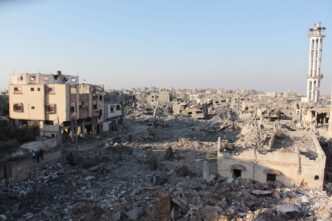


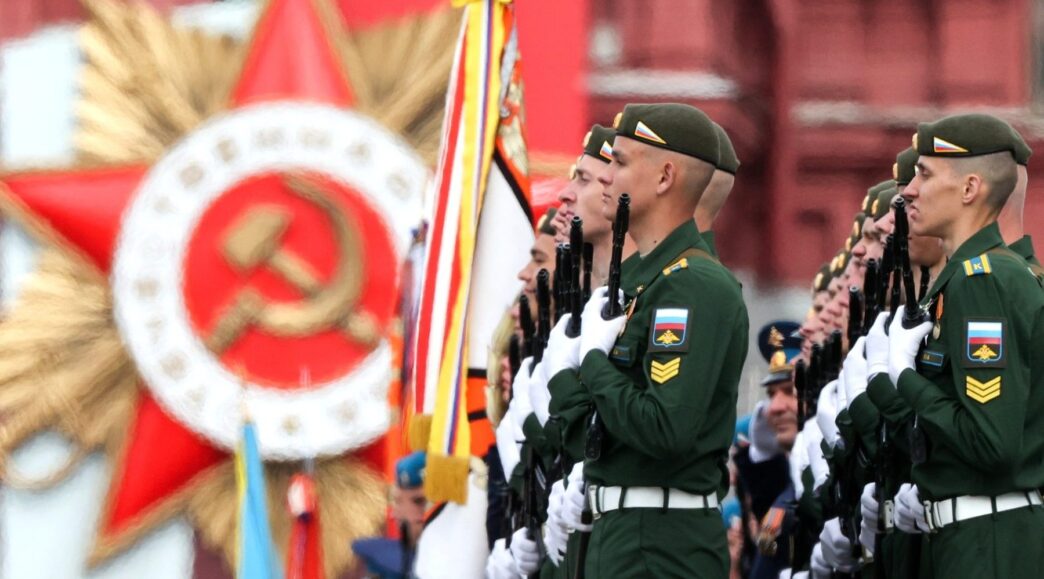
In 2014, after annexing Crimea and territories of the Luhansk and Donetsk provinces, Russia occupied 7% of Ukraine’s territory. In the spring of 2025, around 20% of Ukraine is occupied by Moscow’s troops. Among the provinces claimed by President Vladimir Putin (Luhansk, Donetsk, Kherson, and Zaporizhzhia), none are entirely under Russian control, more than three years after the start of the war. Furthermore, Ukrainian troops have been present in the Russian province of Kursk since the summer of 2024, and recently began occupying another, Belgorod.
There are numerous statements and working hypotheses regarding a US military withdrawal from Europe and a Russian-American „understanding” regarding the handover of Eastern Europe to the Kremlin. Amid an openness from the Donald Trump Administration for discussions and negotiations with President Vladimir Putin, with a view to achieving „peace,” fears have emerged that the US might cede its authority in Eastern Europe and cease substantial military support for Ukraine. This would involve the establishment of „spheres of influence” in Europe and a territorial expansion of Russia on the Black Sea coast, to include Odesa and the Danube Delta. That is, exactly at the border with Romania.
Russia wants to. But can it?
How could Russia control Eastern Europe?
The perception of most Eastern European inhabitants regarding their national security and relations with Russia is shaped by three major events of the last century: the secret additional protocol of the Ribbentrop-Molotov Pact in 1939, the October 9, 1944 agreement between Churchill and Stalin regarding the provisional division of spheres of influence in Europe, and the collapse of communist regimes, implicitly the withdrawal of Soviet troops, in the late 1980s and early 1990s.
All are related to Russian military aggression.
Some states, such as Poland, were abolished by Russia (or the USSR), in alliance with other powers, four times in 150 years. Others, such as Lithuania, Latvia, Estonia, and Finland, young independent republics in 1917-1918, were attacked by Stalin in 1939-1940 and annexed or kept under strict supervision of their internal policies, as was Finland after 1945. Romanian territories experienced no fewer than 12 Russian military interventions, starting in 1735. The last occupation, Soviet, lasted 14 years, from the summer of 1944 until 1958. Hungary, in 1956, and Czechoslovakia, in 1968, were invaded by the Red Army even though they were totalitarian communist regimes with no aspirations to break away from the Kremlin’s tutelage.
Then, in the 1990s-2000s, several „republics,” financed, supported, and recognized only by the Kremlin, appeared on the territories of the Republic of Moldova and Georgia. This historical memory cannot be erased in any of the Eastern European capitals. In the period between the two World Wars (1918-1939), the Eastern European states benefited from an insufficient period to consolidate their identities, institutions, and armies. Most of them had only just broken away from the dead empires at the end of World War I. Others, such as Romania, struggled with institutional weaknesses and threats to an unstable democracy. The internal policies of the Eastern European states were built on the idea of defense against external dangers, but in essence, they were reactions of fear, either towards Nazi Germany or towards the Soviet Union.
Anti-Semitic, nationalist, or outright racist ideologies were constructed and promoted in arguing for independence and statehood. Eastern European economies, although more attractive than the Soviet one, were far from being models of harmonious development; they were poorly modernized and lacked significant connections to world markets. Between the Eastern European states, after 1918, there were numerous rivalries, competitions for influence, and even military conflicts. 1
Regional policies were based on the prospect of war, either local or general, continental. A consensus among these insignificant states in the system of international relations was impossible to achieve, and Hitler’s Germany or Stalin’s Soviet Union fully benefited from these disagreements. Lacking effective strategic alliances and attractive institutional models, the Eastern European states collapsed into dictatorships or became annexes of Berlin or Moscow within two decades of World War I.
Lenin’s and Stalin’s Soviet Union, until the 1940s, fascinated a part of Eastern European societies through false ideological proposals spread through the press or by intellectual and political elites. The social equality promoted by the Kremlin, the strengthening of state authority, strong institutions, even if totalitarian, laws applied without exceptions, leaders who made quick decisions were models that captivated a part of Eastern European decision-makers, especially in the 1930s. The fascination with Nazism, communism, or fascism encompassed all these states, and all ended up losing either their statehood or their freedom.
Fear of the Kremlin was the basis of all internal and external policies of the Eastern European countries in 1939-1940.
Attacked by the Nazis and the Soviets, Poland surrendered in a few weeks of war in September 1939. Hitler and Stalin divided the country and signed a border treaty that officially formalized the disappearance of the Polish state.
Moscow occupied the Baltic states in a few hours in June 1940 before annexing them. In turn, Romania ceded Bessarabia, Northern Bukovina, and the Herța region following an ultimatum in June 1940, without even a minimal military resistance in the face of Stalin’s army. 3 The Soviet Union took advantage of the weakness of the political class and the institutional fear of communism.
When the „division” of Eastern Europe took place in 1944-1945, it was very easy for Moscow to obtain almost the entire region. Already in 1939-1940, in this half of the continent, either states no longer existed (Czechoslovakia, Poland, Yugoslavia, Lithuania, Latvia, Estonia), or they had become unpretentious satellites of Hitler (Romania, Hungary, Bulgaria). Most had experienced unprecedented destruction, such as Poland or Hungary; others no longer had national armies or governments and authorities within their borders; and some, as was the case with Lithuania, Latvia, and Estonia, simply became Soviet republics within the USSR.
Resistance to the Soviet occupation was neither lasting nor military in the longer term. And this was because the societies of Eastern Europe did not want a return to the era and regimes that existed between the two World Wars. These regimes from the period 1918-1939/40 became acceptable over time only in comparison with communist totalitarianism.
How could Russia still control Eastern Europe today?
Eastern Europe can no longer effectively enter a Russian sphere of influence for a simple reason: Russia can no longer do so, even if it wanted to.
For the vast majority of Eastern European inhabitants today, Russia no longer represents any kind of temptation or model of civilization. Membership in the European Union, with its freedoms of movement and work, as well as NATO’s security umbrella, have radically changed the options of the political classes and societies of these countries. They look more towards the West and especially towards America than towards the traumatic Russian past that recalls occupation, shortages, restrictions, and backwardness. The mirage of communism, of the egalitarian „new world,” has disappeared, with radical left-wing ideology becoming more of a relic than a parliamentary party. The isolated and sanctioned „Russian world,” without real opportunities for movement and free options, is not a model but merely a political slogan to combat the establishment, „the system,” as it is now called in Romania.
Younger Eastern European generations are more inclined towards an „understanding” of the Russian world and Moscow’s policies, in the absence of adequate education and the whitewashing of the communist regime by various institutions, including the Orthodox Church. Russian influence in the region manifests itself, as in 1918-1939, also through ideology, this time religiously conservative, with spectacular stagings of scenarios regarding the annulment of Orthodox identity, the elimination of the „traditional family,” or the removal from memory of the „peaceful times” displayed on social networks, which always correspond to the totalitarian period of the 1960s-1980s. A part of the more marginalized Eastern Europeans , including young people on the verge of their professional careers, accept the arguments offered by the Kremlin’s vectors of influence. Where solid education presents the memory of Russia in its entirety, as in Poland or the Baltic states, Moscow barely manages to make itself heard, let alone present. But there are also spaces such as Romania, Bulgaria, or Hungary where Russian stories have somewhat more success among young people, evidence of fragile educational institutions and the reduced efforts of the political class to sanction foreign propaganda and explicit invitations to celebrate totalitarianisms.
Russia can no longer defeat an entire region, as in 1944-1945, even if it benefits, almost everywhere in these states, from political parties, leaders, and intellectuals who support the Kremlin and its strategies. The political formations supported by Russia—directly or through intermediaries—cannot decide major changes in strategic orientation, and the Kremlin’s benevolent leaders, such as Hungarian Prime Minister Viktor Orban or Slovak Prime Minister Robert Fico, have remained at the stage of anti-European rhetoric and continuous harassment of policies. Neither the veteran Orban nor his ally Fico has proposed—nor would they succeed in—a withdrawal of their countries from the European Union or NATO to join Russia.
The economies of Eastern Europe are more dynamic and produce more wealth than that of Russia. For the first time in history, all former communist states that today belong to the European Union are financially better off than the inhabitants of Russia: Romania’s Gross Domestic Product per capita exceeded that of Russia in 2020 for the first time in history. For 2024, the estimates are even better, in the context where the Kremlin is spending enormously to maintain control over the occupied territories of Ukraine: $20,142 per capita for Romania and only $13,739 per capita for Russia.
The institutions of Eastern Europe are today much more efficient, more transparent, and more robust than ever before in the region’s history. Even if corruption exists, it is generally a phenomenon held under control by the justice system and politics, as opposed to the situation in Russia. Elections are free and transparent throughout the region (with exceptions such as Serbia), and there are no leaders permanently in power for decades, as is the case with Russian President Vladimir Putin or Belarusian President Alexander Lukashenko.
Even if Eastern Europeans express dissatisfaction with electoral offerings, the occasional slowness of judicial processes, or the central or local administration, all of this remains more comparable to Western systems than to the kleptocratic and authoritarian model in Russia.
Of course, Russia’s major project in the Black Sea and the neighboring region of Eastern Europe would be the recovery of Odesa, the Danube Delta, and influence in the Republic of Moldova, so that it could then become a decision-maker in Romania and Bulgaria.
How could Russia, even using armed force, still subdue societies with an anti-Russian memory and that have acquired a taste for Western liberal comfort? Three years after the start of the aggression against Ukraine, a country that until 2014 and 2022 was not as hostile to Moscow as those in Eastern Europe, the Kremlin has not achieved a major victory. Russia has neither occupied Kyiv nor changed the Ukrainian political regime, nor has it canceled European and NATO support for President Volodymyr Zelenskyy. How could this Russia change the will of a society like that of Poland or those of the Baltic states?
When Russia annexed Crimea in 2014, Poland had only the ninth-largest army in the NATO alliance. At the beginning of 2025, the authorities in Warsaw manage the third-largest army in the North Atlantic alliance, after those of the US and Turkey, totaling over 200,000 soldiers and officers. Poland’s defense budget has tripled in this decade of Russia’s war, spending over $35 billion. Only Western states such as Great Britain or France have spent more. Also recently, Poland requested the arming of its military with nuclear weapons to prevent Kremlin threats in the region.
Even if little and discreetly spoken about, the naval war in the Black Sea has been won, so far, by Ukraine. After losing the Sea of Azov coastline, Ukrainian troops liquidated the Russian occupation on Snake Island as early as 2022 and sank most of the flagship vessels of the Russian fleet in Crimea. Today, Russia no longer has many resources to overturn the reality on the Black Sea coast, lacking a strong fleet and increased capabilities. Reaching Odesa and the Danube Delta would therefore be a very big effort for the Kremlin.
How and why would any of the Eastern European states, defended by the policies of the European Union and the NATO alliance, give in to aggression? Why would the inhabitants of these countries renounce prosperity, free institutions, the state that has fared perhaps better than ever in the so complicated history of this region? How could Russia defeat and then control states such as Poland, the Czech Republic, Lithuania, or even Romania? Fear, the very thing that decided relations between Stalin and neighboring countries in the 1930s-1940s, is no longer a widespread feeling these days, even if there are social perceptions that might prove the contrary. Eastern Europe, after 1990, has become a political, military, and diplomatic consensus unprecedented in history. The strategic vectors of this eastern half of Europe are thoroughly anti-Russian and pro-Western. And a modification, even through military aggression provoked by a possible American withdrawal, is almost impossible. Russia would want to do it, but it is no longer able to.
Ne bucurăm că ne citești!
Dacă vrei să ne și susții: