

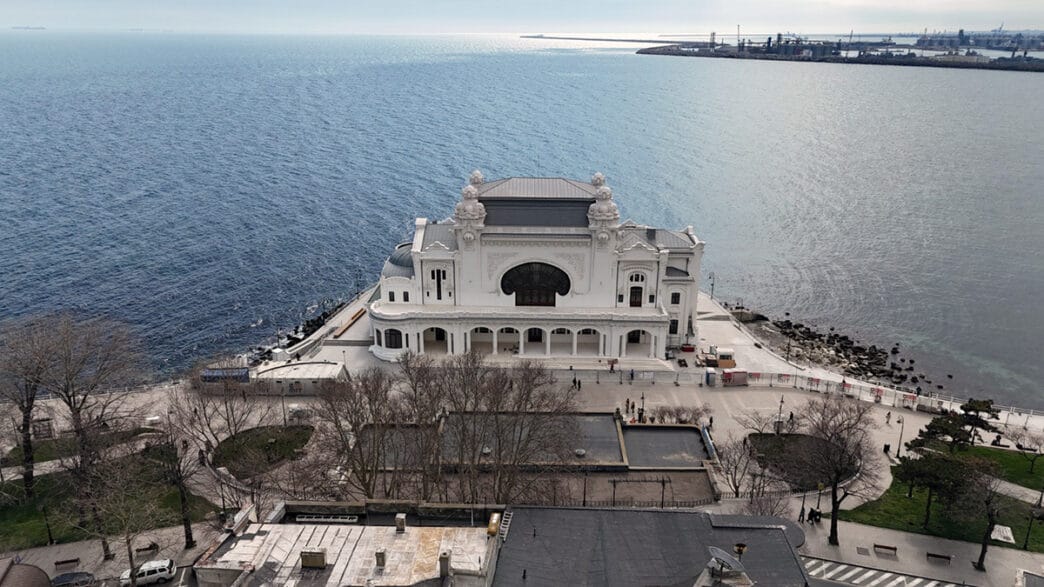
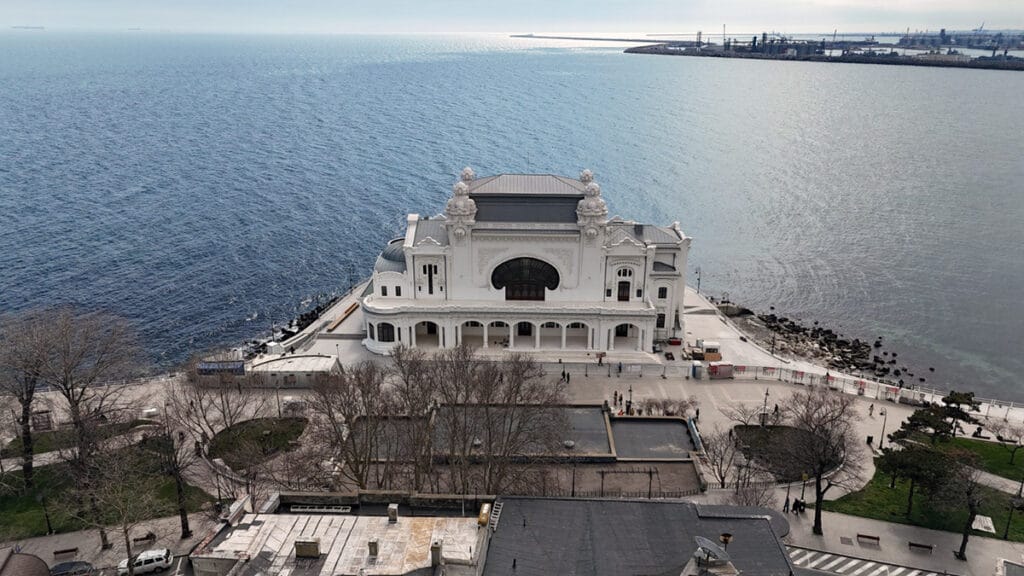
The Constanța Casino was rehabilitated and handed over to the city hall on Thursday, after more than 10 years of being left in ruin, completely non-functional and closed to the public.
The rehabilitation contract was signed in December 2019, under former mayor Decebal Făgădău (ex-PSD) and taken over on Wednesday by current mayor Vergil Chițac (PNL).
Former mayor Radu Mazăre wanted to sell the Casino to „rich Russians, Turks or Arabs”, but civil society intervened.
The historic monument, an Art Nouveau symbol and emblem of the city, was inaugurated in 1910, designed by French architect Daniel Renard.

The casino will host cultural events, exhibitions, shows and a café.
- Edited by Delia Dascălu
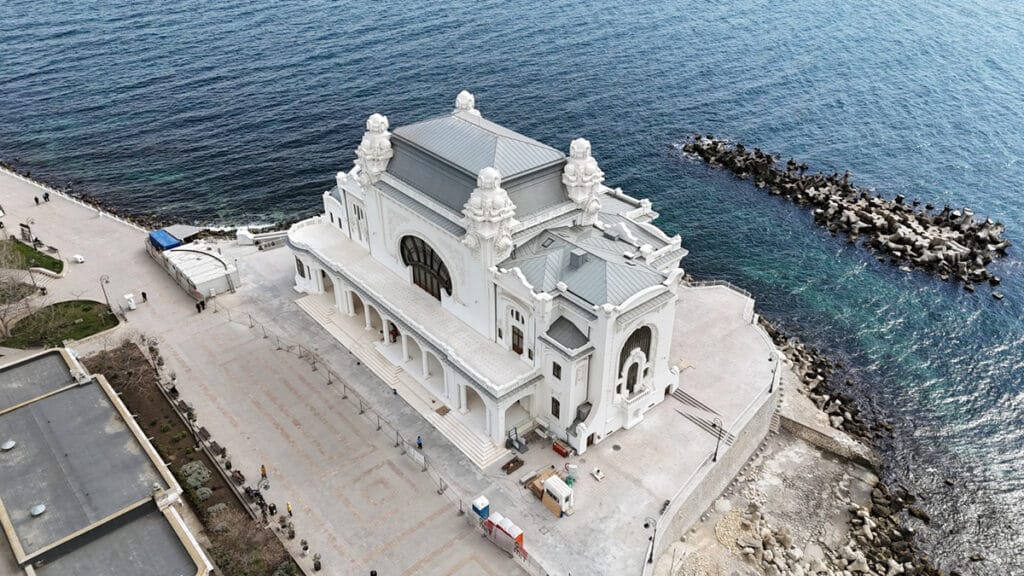
The Casino of Constanța was built according to the plans of the French architect Daniel Renard, being a representative symbol of the Art Nouveau architectural movement. The central part of the building features a façade terrace supported by a wide portico, which is dominated by a fan-shaped stained-glass window.

The upper part of the building stands out, decorated with architectural elements in the shape of ancient ships, ram’s heads and seaweed garlands. The building was inaugurated in the fall of 1910 and has long been a symbol of Constanța, according to Heritage Constanța.
The saga of the rehabilitation of the monument left in ruins after the Revolution, which was to go to „rich Russians, Turks or Arabs”
In 2000, the City Hall of Constanța took over the Casino from the state-owned company Litoral SA and tried to find solutions for the restoration of the historical monument which was already degraded, the last rehabilitation being realized in 1986. Several options were tried. The first was the 49-year concession, with the new owners obliged to invest in the rehabilitation of the historic monument.
An Israeli firm took the contract, but after three years, without making any investment, it was terminated. Then, the former mayor Radu Mazăre even tested in the public space the sale of the historical monument to „rich Russians, Turks or Arabs”. The community protested.
The Casino has, since 2011, entered a ping-pong game between the City Hall and the Ministry of Development. In 2015, money for the restoration of the monument – €8.5 million – was allocated for the first time, and the legal proceedings began. For three years, as many tenders were canceled, after several appeals by participating firms were accepted by the courts or the CNSC.
In 2018, after the third tender was canceled, a team of experts from Europa Nostra and the European Investment Bank Institute came to Constanța, after the Casino entered the list of the 7 Most Endangered sites in Europe (7 Most Endangered), on the nomination of the Arche Association. The program identifies valuable but vulnerable historic sites and contributes to the creation of strategies to save them.
After the visit in the summer of 2018, the experts compiled a technical report in which they pointed out the shortcomings of the restoration project, criticized the superficial agreement between the City Hall and CNI, but, perhaps more importantly, showed that the €8.5 million put up by CNI was far too low, as the restoration of the Casino would require at least €13 million. The publication of the report was the first moment when the annulment of previous tenders was seen in a positive light, as a restoration under those conditions would have been a fiasco.
After that, an effervescent period of public debate, meetings between authorities, experts and civil society began. The rehabilitation documentation was redrafted, the amount was adjusted and the CNI launched the fourth tender, which was won by a consortium led by Aedificia Carpați. The result was contested, but the application was rejected and the contractors started work.
How much did the restoration cost
The total value of the works has reached more than 236 million lei (including VAT) after the approval of the new technical-economic indicators, compared to the initial value of around 90 million lei, according to the CNI website.
Info Sud-Est wrote, in August 2023, that the company that won the tender discovered, during the uncovering, how the structure of the Casino was much more damaged than initially thought.
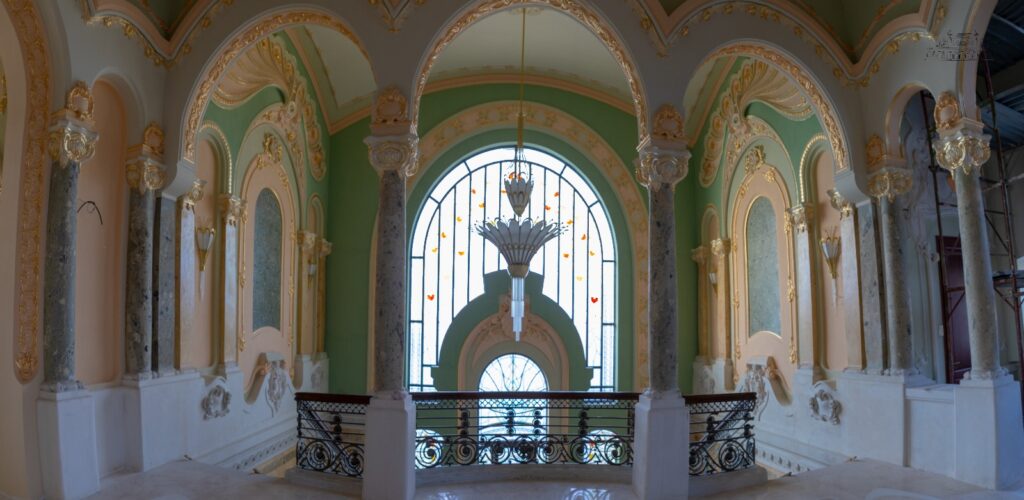
The designers could not predict the extent of the structure’s degradation because that would have meant stripping out large chunks of the monument before the actual work could begin.
The restoration of the Constanța Casino, an iconic building that has been abandoned for 30 years and has been completely non-functional for more than 10 years, was carried out by the Aedificia Carpați – Remon Proiect – Profesiona Construct Proiectare and Tehnoinstal consortium.
The tender was launched by the National Investment Company on the public procurement platform on May 23, 2019, and the actual works started on January 15, 2020.
Who restored the Casino
Aedificia Carpați, a company established in 1992 following the reorganization of the Carpați Trust. Aedificia Carpați, run by businessman Petre Badea, specializes in the rehabilitation and restoration of buildings that are historical monuments.
Before 1990, Trustul Carpați, the predecessor of Aedificia, restored the Cotroceni Palace, the Parliament Palace, the Palace Hall, the Foișor Palace and the Casino in Sinaia, the Olănești Palace, the Snagov Palace and others.
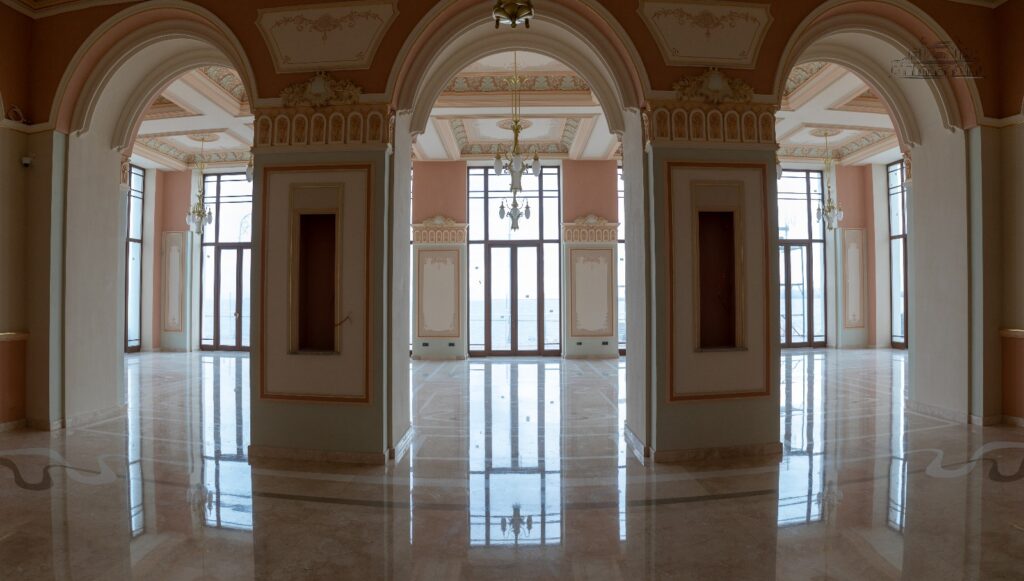
After privatization, the new Aedificia Carpați restored the Romanian Athenaeum, the National Bank of Romania, the National Theatre, the National Opera, the Romanian Peasant Museum, the Romanian Patriarchate building, the National University of Architecture and other important universities and institutions.
Among the civil and industrial buildings, Aedificia Carpați has restored the National Library, the Romanian Government, the National Operetta Theater, the Hilton Hotel Bucharest, the Romanian Football Federation Hotel and headquarters, the National Institute for Earth Physics, the Polytechnic University of Bucharest, the Tuborg Brewery etc.
Ne bucurăm că ne citești!
Dacă vrei să ne și susții: