

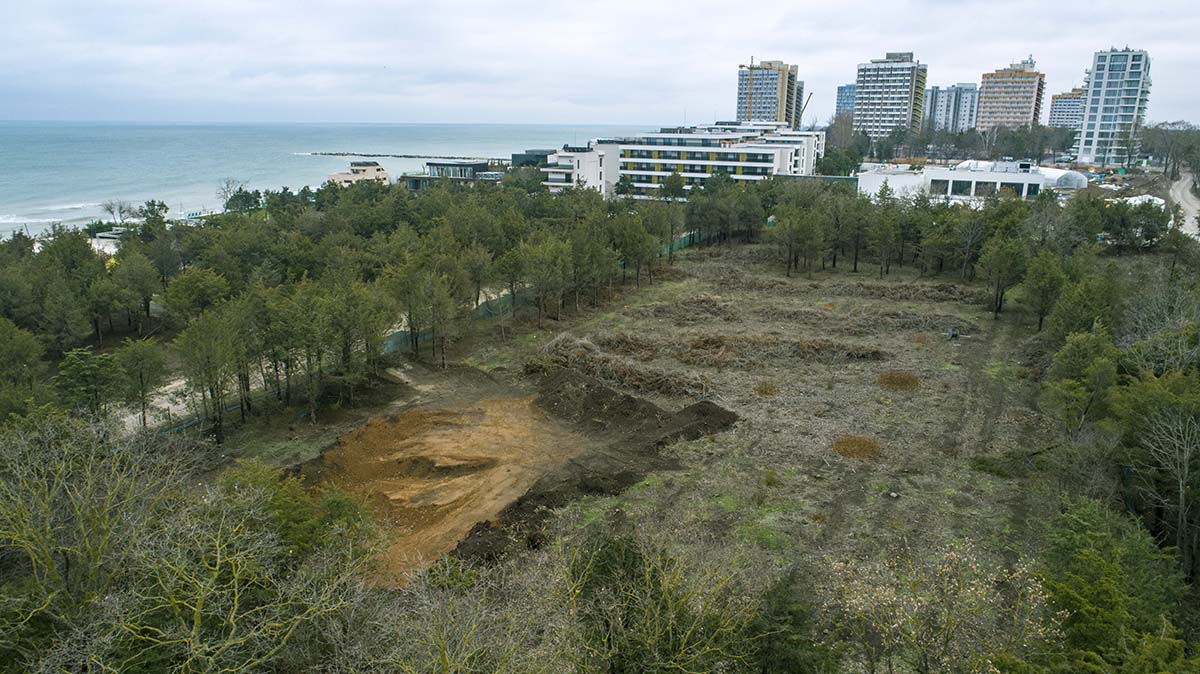
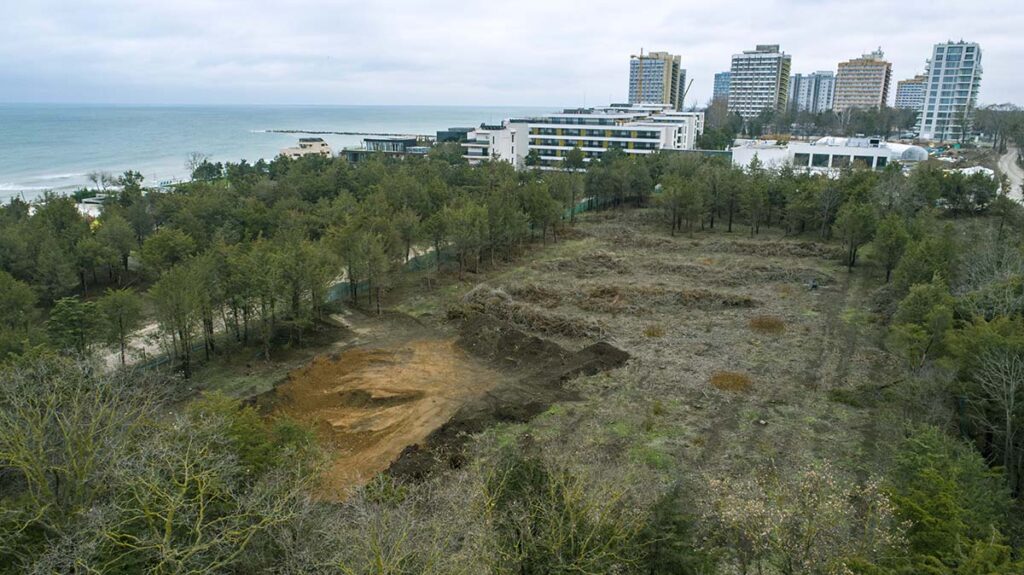
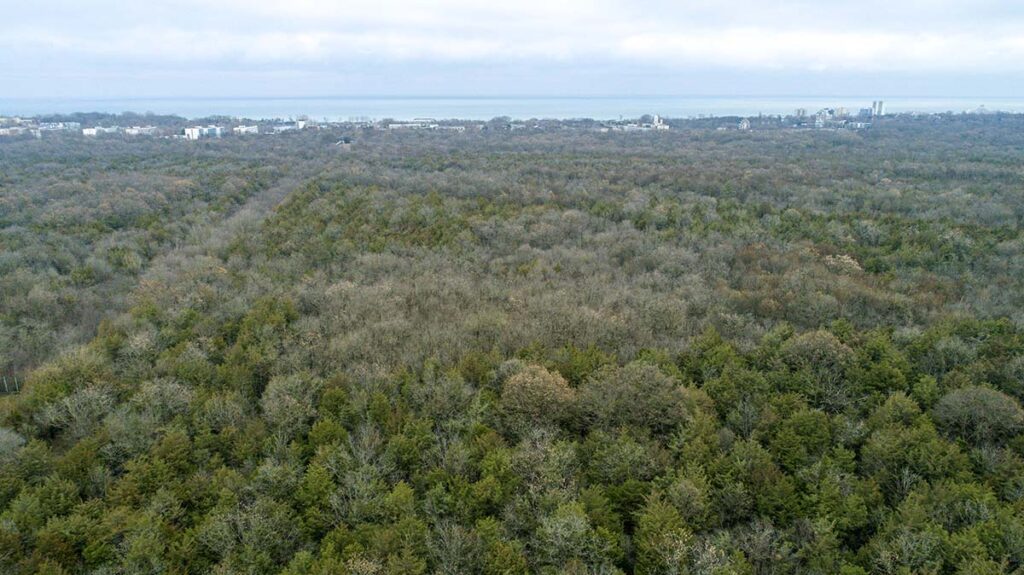
Dozens of investors in real estate, construction, HoReCa, gambling or energy have become owners in the only forest on the Romanian coastline. Unique in Romania, the Comorova Forest has been developed since 1890 to beautify and protect the beach and the surrounding area.
While the forest awaits the authorities’ approval for deforestation and builing of concrete mastodons, DNA opened a new case in August 2023 on the sale of the forest, after closing the first one due to the statute of limitations.
Info Sud-Est and Context.ro inventoried the forest’s registered area of almost 300 hectares. Who are today among Comorova’s most important owners and how was it possible to sell it off piece by piece while the Court of Auditors reported abuses by the authorities?
*This is the first article in a series of investigations that aims to track real estate development in the south coast, its environmental impact and the links between politicians, business, authorities and money.

Information in brief:
- Info Sud-Est and Context.ro X-rayed 280 hectares of Comorova, the only forest on the coast (in the Olimp-Jupiter area), passed into the private domain of Mangalia, then retroceded and sold off in the 2000s. Pieces of it ended up with the then mayor, his family and close associates, DNA prosecutors say;
- Subsequently, the land was sold to key people in the second echelon of the mayor’s office, other businessmen or the wife of the chief prosecutor of Dobrogea at the time;
- The transactions took place in the 2000s, but the effects are only being seen today. Massive deforestation and construction have begun, and the Mangalia City Hall offices are waiting for more requests for permits and documents announcing the great concreting of the forest: 10 and 11-story apartment blocks and hotels that would line the edge of the beach;
- This is possibly due to an „error” in the Cadastre system two decades ago, when dozens of hectares of forest were turned into „building yards” (i.e. land that allows building) or due to changes made on paper by the local administration;
- The Court of Auditors has repeatedly pointed out that the forest must urgently be returned to state ownership so that it is not „totally destroyed” and has stressed that, through the complicity of the institutions, Comorova has been „the victim of dishonest real estate deals”;
- The criminal file on the transfer of the forest from public to private domain, the retrocession and other transactions of the Mangalia City Hall 20 years ago has been closed by the prosecutors on statute of limitations. It took 5 years for prosecutors to start the prosecution;
- In at least one case identified during the documentation, the Environmental Protection Agency considered that its opinion was not required for the erection of a building of up to 10 storeys in the forest on the edge of the beach;
- According to Info Sud-Est, the Comorova Forest has once again come to the attention of the DNA, where the introduction of the forest (more than 500 hectares) into the urban area of Mangalia for the purpose of selling it is under investigation. The case was opened after the Court of Auditors referred the matter to the Court of Accounts on the 1st August 2023, after facts dating back to 2000.
From „forest” to „construction yards” and the first massive clearings. Who owns the forest today
Info Sud-Est and Context.ro X-rayed almost the entire registered area of the Comorova Forest, with a total of hundreds of transactions and land registers for the 280 hectares of land analysed.

Of this forest area, 24 hectares have been converted into „building yards” and another 12 hectares into arable land. This happened as a result of the cadastral surveyors’ measurements for the preparation of Mangalia’s zoning plans in 2003-2004, which led to „errors” in the computer system, according to press reports at the time, and other land was changed by the pen of city hall employees.
An analysis of the land registers shows that some of the largest or best-located plots belong to construction companies, gambling industry owners, HoReCa investors or real estate developers, among the most important in Constanța county.
Mangalia City Hall mentions on its official website the importance of the Comorova Forest and the oak trees protected by law and acknowledges that „in the midst of the lush vegetation, luxury villas have been built in recent years, surrounded by pine trees”.
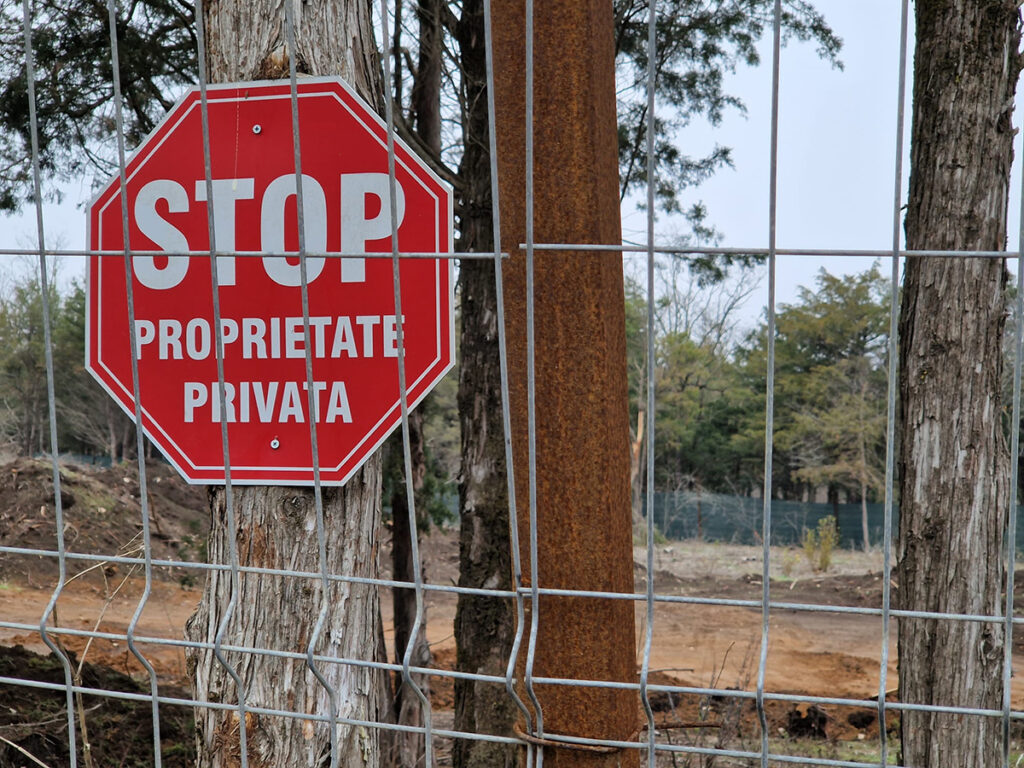
Nyota Olimp SRL has 1.2 hectares of „construction yards” in Comorova (i.e. you can build on the land). The company is owned by Iustin Fabian Roman (former PDL local councillor in the Constanța City Hall) and Buzoi millionaire Gheorghe Manole, who has a business in renewable energy and photovoltaics.
The land is on the edge of the beach and is forested, but on the 7th of December the Constanța Environmental Protection Agency decided that the real estate investment Nyota wants to make in Comorova (Olimp resort) „does not require an environmental assessment and will be subject to the adoption procedure without an environmental permit”.
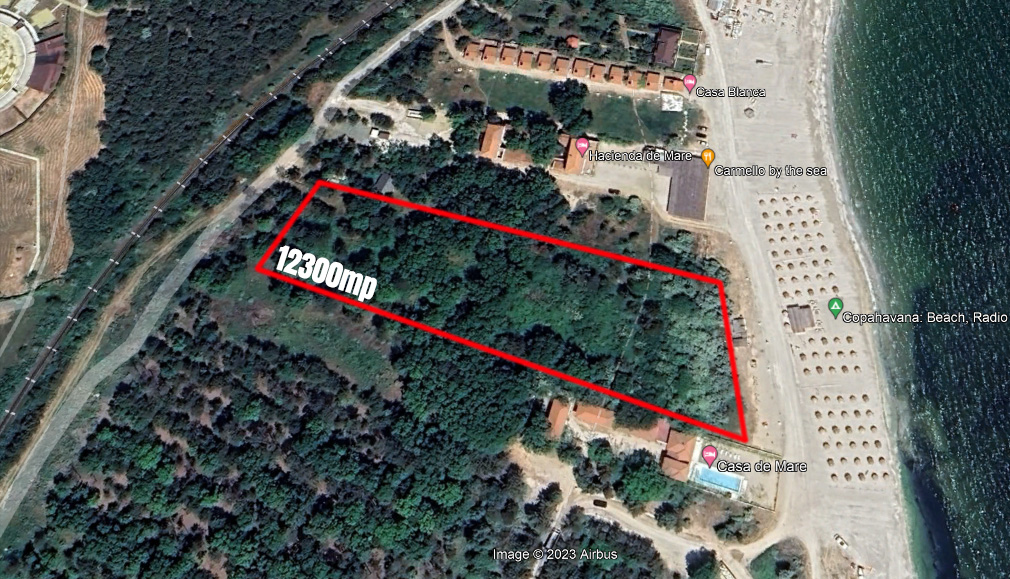
According to documents filed with the APM, the businessmen want to build a tourist complex including a hotel, a rehabilitation treatment center, a spa, shops and holiday apartments. The real estate project proposes a height regime of up to 10 floors, although currently the existing regime is G+2E (ground floor and two additional strories), according to information in the APM document.
A little further south, the Novum Group and the Fleancu family have applied for an urban planning certificate for new 10-story buildings, after inaugurating a luxury hotel in the Olimp resort in 2020, with a party attended by dozens of celebrities despite Romania being in the midst of the COVID-19 pandemic and restrictions.
Info Sud-Est showed in 2021 how 2.5 hectares would be cleared for the businessmen’s new real estate plans. The group told ISE at the time that their land is not forest, but is cadastrally classified as „construction yards”.
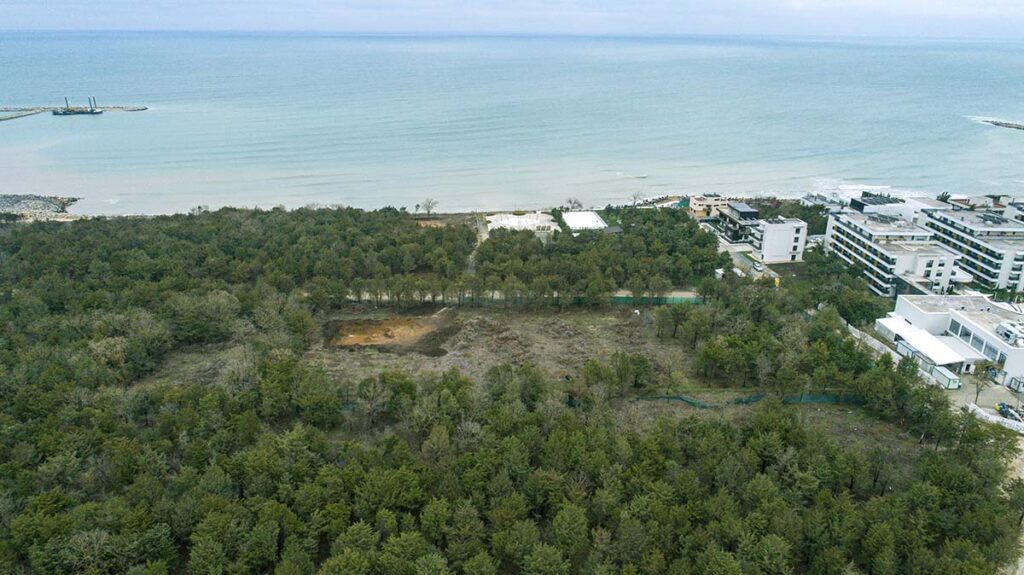
Romhouse Development SRL is listed with at least 3.9 hectares of forest in the documents consulted by ISE. The company is engaged in the rental of real estate, is majority owned by two Cypriot offshore companies (Aruana Enterprises Company Ltd. and Aurele Trading & Consulting Ltd.) and has another 0.24% shareholder, Greek national Athanasakos Efstratios Alexandros. Local publication Ordinea.ro revealed that Romhouse is headquartered in the house of a friend of former mayor Zanfir Iorguș, who proposed the forest’s retrocession.
Titan Sun Park has 8.5 hectares of „construction yards” in the forest on the edge of the sea (Olimp) and is the company owned by landowner Andrei Vasile Ceaușescu, who has built more than 1,000 apartments in Sectors 3 and 4 of the capital and is planning to build more than 500 houses in Balotești, Moara Vlăsiei and Mogoșoaia, according to Profit.ro. Titan Sun Park bought the land from Astra Investiții Imobiliare, and one of the transactions in the deal, worth €2.5 million, was made before notary public Ioana Băsescu.
In August 2021, Ceaușescu, through the company Tineretului Residence Park, was issued with an urban planning certificate (the stage before obtaining planning permission) for the construction of an 11-storey building. Subsequently, in September 2022, Mangalia City Hall approved the PUD documentation and the memorial for the construction of the building.
Manat Magnum SRL is owned by businessman Ilie Liviu Dumitrașcu, who together with Yvonne Manuela Dumitrașcu own several parcels of forest, all classified as „building yards” and with a total area of over half a hectare.
In November 2023, the Constanta-based publication dobrogealive.ro wrote that the Dobrogea-Litoral Water Basin Administration (ABADL) had filed a criminal complaint against the company for allegedly violating the conditions imposed by Apele Române and destroying the Black Sea coastal area. The investor allegedly illegally excavated hundreds of tons of earth to make a road to the sea for the clients of the tourist complex it owns in the town of 23 August.
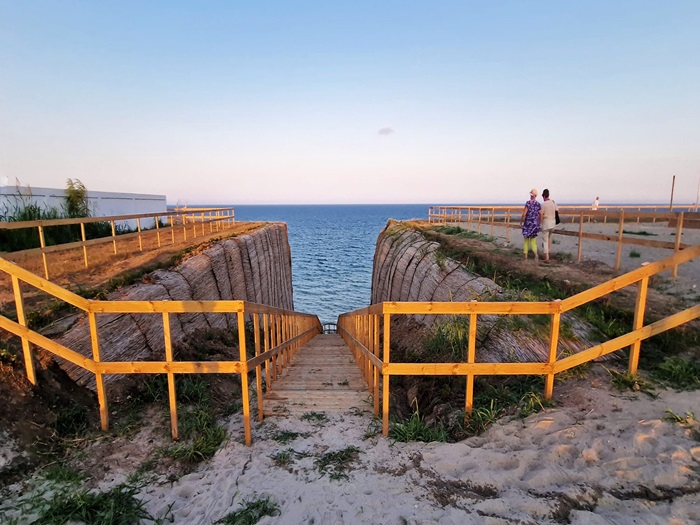
Tomis Garden Residence SRL and Tiger Investment SRL have about 4 hectares of forest. Half of the companies’ shares are owned by businessman Lucian Orban, known in Constanța for the construction of the Tomis Plus residential district, at the outskirts of the city towards Tulcea (Carrefour area). Orban has done or is doing business through 18 companies, mainly in real estate development. Tomis Garden Residence also has Daniel Zaif (49.95%) and Daniel Lascu (0.1%) as partners, and Tiger Investment has UAE national Al-Mahamid Khaled (25%) and Mohammad Waleed (25%), a Syrian national.
Prestige Projekt owns at least one hectare of the Comorova Forest. The company owned by a Turkish national, Kavus Ayhan, is in the business consulting business, and RISE Project wrote about the company being involved in the management of the business behind the Europe Eye private ophthalmology hospital. Opened in 2011 to great fanfare in the presence of Prime Minister Emil Boc, the hospital was closed three years later after one of the shareholders was arrested in Romania, RISE Project writes.

Mini Braseria Grand SRL operates in the hotel segment and is owned by Gheorghe Romeo Popescu. It owns about 0.8 hectares of forest in Comorova and also owns the Grand Hotel Complex in Eforie.
Representatives of the company told Info Sud-Est that when they bought the land (2016, according to the land register) on the urban planning certificate it said that they could build on 20% of the land area, level P+1, but two years later the same councillors and the same mayor (liberal Cristian Radu, editor’s note) told them that they could only build on alleys and parking lots:
- „Now I’m in court with the city hall. There I wanted to build tree houses for tourism and small huts so I wouldn’t have to cut down those super beautiful trees. I don’t know how much the investment will amount to, but more than €400,000,” said the company representatives.
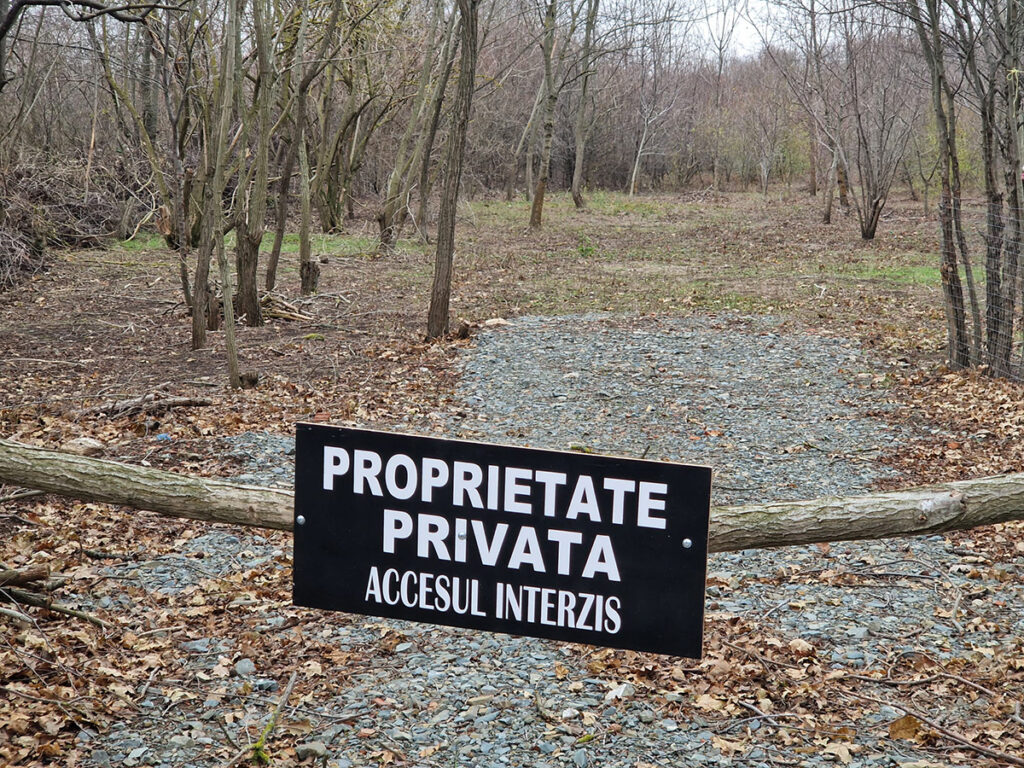
Another landowner who owns more than 2.5 hectares of arable land in the Comorova Forest is ACE Property Estate, owned by Alexandru Olea, Elvis Petcu and Constantin P. Vlase. Alexandru Olea is a partner in 10 companies and has businesses in several fields, including HoReCa, gambling and real estate. Elvis Petcu is a partner and administrator of the Meteor Hotel in Jupiter resort, and Constantin P. Vlase is or has been a partner (and in some cases administrator) in 8 firms in various fields, including real estate and freight forwarding.
Icon Arhitectura Concept and Classic International Development own 4.2 hectares of building yards where a complex they bought from the Bioterra University Foundation is located. Icon Arhitectura Concept is owned by the company Baraka One Properties, whose shareholders are Andreea and Iliuță Valentin Bratu, who are in the business of renting and subletting real estate, as well as in the beauty sector. Classic International Development is owned by Nicolae Alexandru Dragomir, who is involved in 12 other companies, with different activities ranging from retail trade to building installation works or construction of residential and non-residential buildings.
Other owners in Comorova are:
- the company G&G Invest, with 1.5 hectares of forest, owned by Vlad Gabriel Căciuloiu and Andrea Cristina Căciuloiu, son and widow of the former PNL Constanța (municipality) president, who died in a car accident in 2006;
- the Ateq Ind company, with 1.5 hectares of forest, owned by businessman George Eugen Bălan, active in HoReCa;
- Poseidon Residence and YBO Actual, with one hectare of forest each;
- Serenya del Mar and Execo Real Estate (5,000 square metres of building yards each), owned by businessman Bogdan Constantin Giambasu, co-founder of Ecoterm, and Violeta and Florin Voiculescu;
- the company Promyd Style owned by Carmen Luncan (2000 sqm of building yards);
dozens of other individuals to whom we will return.
*The economic agents did not submit a point of view to the ISE request, regarding the plans they have with the land they own in the Comorova Forest. We will publish them when we receive them.
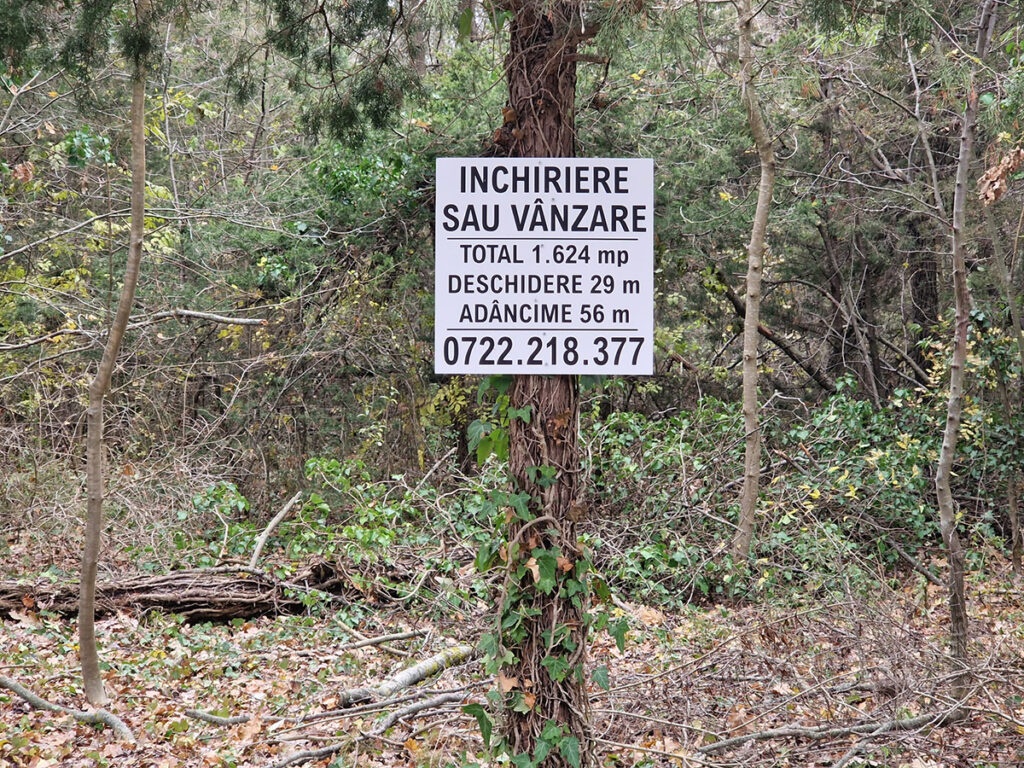
A forest the size of a prescription. A file buried by prosecutors
The start of deforestation in the Comorova Forest was reported in a 2005-2006 press campaign carried out with the environmental NGO Mare Nostrum.
According to Info Sud-Est, a criminal case was opened only three years later, at the beginning of the 2008 electoral year, following an ex officio referral from the Fraud Investigation Service of the Constanța County Police Inspectorate. Zanfir Iorguș, who had made the Comorova retrocession, lost the Mangalia mayoralty at the time but won a seat as a member of parliament.
For six years, from the beginning of 2008 to the end of 2013, the file on the mayor’s land deals and retrocedures was kept in the drawers of the Public Prosecutor’s Office of the Constanța Court, then of the Second Section of DNA Bucharest, without prosecution.
Subsequently, the file was transferred to DNA Constanța, where criminal prosecution began in July 2014, when the alleged facts were already time-barred, according to the case closure order consulted by Info Sud-Est. The case was closed in July 2016.
In the closure order, however, DNA Constanța prosecutors show how Comorova was taken out of the public domain and transferred to the private domain contrary to the law, because the forest was transferred from state property to that of the locality exclusively so that a park could be set up there. In other words, if there is no park, there can be nothing in Comorova, according to the law.
- „As stated above, the wooded area of 519 ha, unique at least in Romania, was passed by several acts of the Romanian Government and the Mangalia Local Council in the public domain of the territorial administrative unit exclusively for the purpose of establishing the Municipal Park of the municipality of Mangalia (…) the defendant did not have the right to change its destination,” the DNA order states.
But, prosecutors say, Mayor Iorguș asked the local council to change the forest from public to private under the pretext of guaranteeing bank loans with which the town hall would modernise the thermal power plants:
- „(…) Since this loan is to be granted by a commercial bank, it is necessary to guarantee it with real estate from the private property of the local council (…) I specify that this passage is necessary because only private property can be used as a guarantee for bank loans”, Iorguș motivated the change in the status of the forest, according to DNA.
Today there is neither the park nor the credit to modernize the plants. But, says the DNA investigation, the forest that the mayor was going to „pledge” to the bank was retroceded or alienated by other means, and pieces of it ended up with the mayor, his family and relatives, the wife of an influential prosecutor at the time, the then vice-mayor of Mangalia, local businessmen, city hall directors and councillors and so on.
- „This initiative of the defendant Iorguș Zanfir was the first step in the chain of illicit activities that was to follow, whose purpose was to damage the assets of the municipality of Mangalia and to obtain large areas of land in the Comorova Forest for himself and his close associates,” the document states.
One forest each
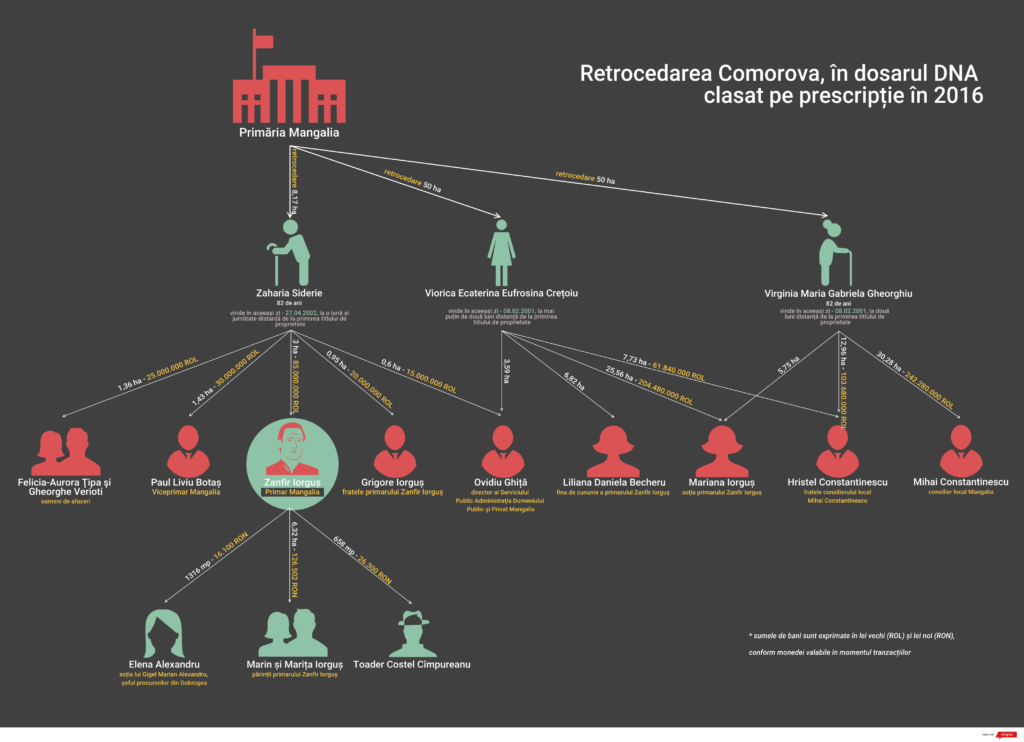
According to the information analysed by Info Sud-Est in the DNA order, it appears that out of the almost 300 hectares passed into private domain, about a year later, Iorguș proposed the retrocession of 108 hectares to three people, including two 82-year-olds.
- Note: Other hectares of forest have been alienated by the municipality through sale-purchase contracts, public auctions to set up „private clubs”, public auctions for sale, public auctions for foreclosure, exchange contracts or under Law 18/1991 on persons deported or displaced since 1944, according to prosecutors.
Two repossessions took place on 20 December 2000, to two women. A month and a half later, they both sold, on the same day, 90% and 97% respectively of the land they had acquired from the town hall run by Iorguș. The land went to:
- Mariana Iorguș, the wife of the mayor who proposed to retrocede the forest (25.56 hectares on one side and 5.75 hectares on the other);
- Liliana Daniela Becheru, goddaughter-in-law of the Iorguș couple (6.82 ha);
- Mihai Constantinescu, local councillor at the time (30.28 ha);
- Hristel Constantinescu, the councillor’s brother (12.96 ha);
- Ovidiu Ghiță, director of the Mangalia Public and Private Domain Administration Public Service (3.59 ha);
The third retrocession took place in March 2002. This time an 82 year old man who would die 8 months later. He also sold 90% of his acquired land, all on the same day, to:
- Mayor Zanfir Iorguș himself (3 hectares);
- Grigore Iorguș, the mayor’s brother (0.95 hectares);
- Paul Liviu Botaș, Mangalía’s deputy mayor at the time (1.43 hectares);
- Again Ovidiu Ghiță, director of the Mangalia Public and Private Domain Administration Public Service (0.6 hectares);
- Felicia Aurora Țipa and Gheorghe Verioti, businessmen (1.36 hectares).
DNA prosecutors also show how Mayor Iorguș subdivided his three hectares into 14 pieces and started selling, 6.32 hectares being bought by his parents, Marin and Marița Iorguș.
Another two plots were sold to Elena Alexandru, the wife of the chief prosecutor of Dobrogea at the time, Marian Gigel Alexandru.
Alexandru was one of those who headed the Constanța Court of Appeal Prosecutor’s Office in 2006, the year of the transactions, which is responsible for all the prosecutors in Constanța and Tulcea. His wife bought from the mayor two plots totalling 1316 square metres for 161. 00 lei. The transaction was made on the 13th April 2006, according to the DNA order.
Alexandru was removed from his position in March 2007, following a decision by the Superior Council of Magistrates, which found that the institution was poorly run, that there were a large number of cases that had returned to Alexandru’s subordinate prosecutors’ offices and that he had demonstrated significant managerial shortcomings, according to ziuaconstanta.ro.
Alexandru later returned to a management position in the same prosecutor’s office, as head of the prosecution section of the PCA, during the mandate of the general prosecutor Gigi Valentin Ștefan, who was also controversial because of his family’s real estate transactions.
Currently, former prosecutor Alexandru and former mayor Iorguș are colleagues and are involved in PSD politics.
Contacted by Info Sud-Est, former mayor Zanfir Iorguș admitted his friendship with former prosecutor Alexandru and the transactions made, but vehemently denies that his land is part of the forest:
- „I, my family and „close people” (as you call them) did not acquire any square meter of land in the Comorova Forest… the land you refer to does not belong to the Comorova Forest, it is agricultural land, it was vineyard and now it is alfalfa….or in other situations it is cultivated with vineyard or large crop,” Zanfir Iorguș told ISE.
Former prosecutor Marian Gigel Alexandru did not provide a point of view requested by ISE reporters before the publication of this story. We will publish it as soon as we receive it.
Court of Auditors on Comorova: „Institutional complicity”, „real estate deals „
DNA is not the only institution to have investigated, albeit belatedly, the situation at Comorova.
In its 2013 audit report on „The patrimonial situation of the forestry fund in Romania, 1990-2012”, the Court of Accounts speaks of the complicity of the institutions with „real estate interests in the area” and of the forest as „the victim of real estate deals through successive sales and resales of wooded land/lots between legal entities and individuals or between individuals, each seeking to make a profit from forest land transactions”.
The Court gives the example of a slice of forest sold by the municipality in 2003 for 1.8 million lei and a year and a half later resold for almost 17 times that price:
- „As an example, we present the case in which the Mangalia City Hall, on 8.02.2003 sold to a commercial company the area of 8.5 ha of forest for the sum of 1.8 million lei payable in 4 instalments. One year later, the commercial company resold the land to a private person for the sum of 2.2 million lei. The individual did not hesitate and 5 months later (re)sold the land to a real estate investment company for 29.8 million lei,” the Court of Auditors’ report says.
In the same report, the institution also demanded that what was left of Comorova be transferred from the property of Mangalia Local Council to Romsilva, in order to stop the „total destruction” of the only forest on the coast:
„(…) remaining in the private property of the Municipality of Mangalia and outside the forestry regime will inevitably lead to its total destruction (…) it is necessary to identify legal solutions and to carry out by the competent institutions the necessary steps to transfer the Comorova forest from the administration of the Local Council of Mangalia to the administration of RNP-Romsilva, respectively from local public property to state public property„, the Court’s report also states.
What is the Comorova Forest
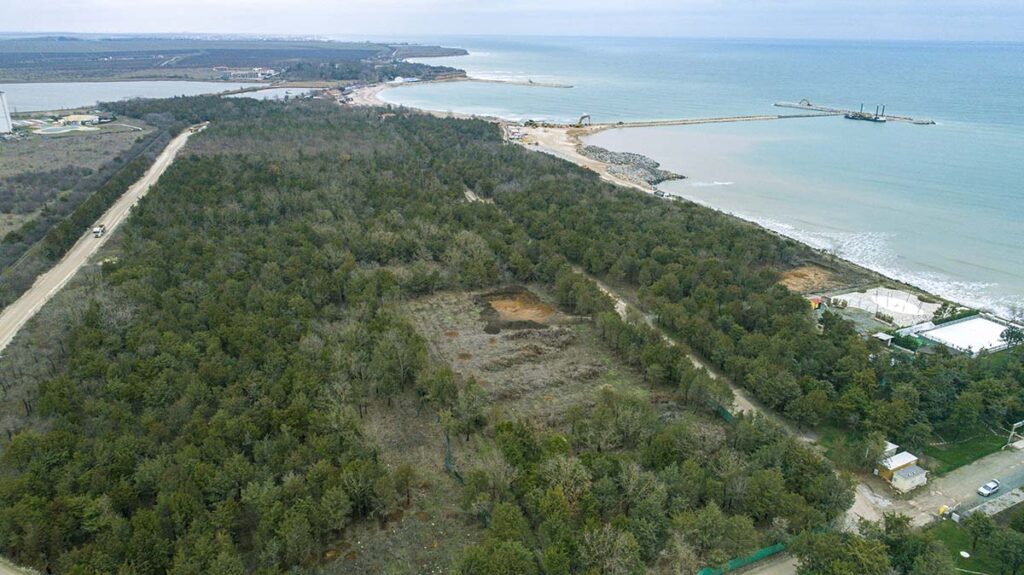
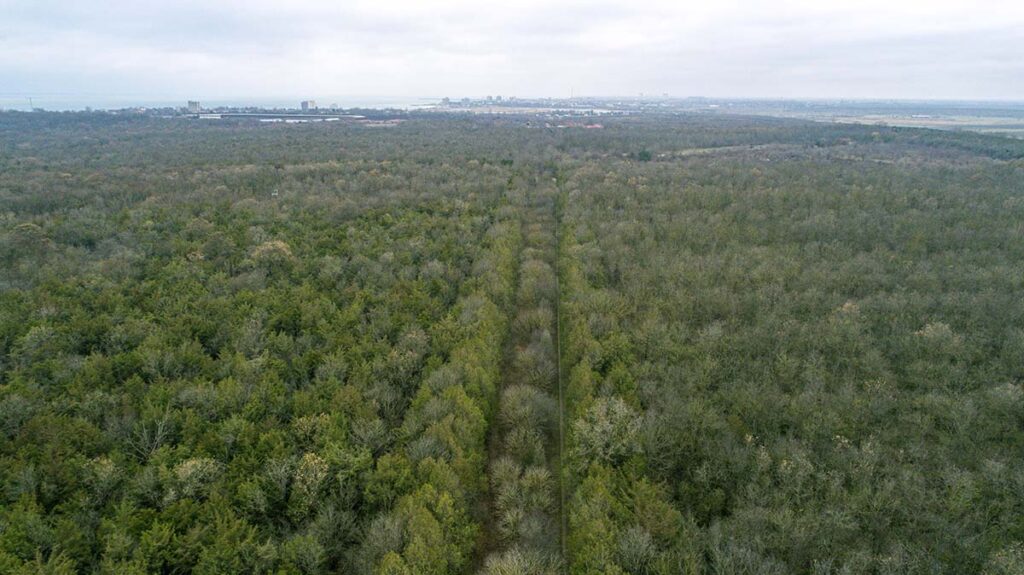
When you walk to Vama Veche in summer along National Road 39, you pass through a shady green tunnel about 2.5 kilometres long, where the dogore drops a few degrees. It’s the road that, together with the sea, lines the 519 hectares of the Comorova Forest, the only one on the Romanian coast.
With a maximum length of 5 km and a width of 2.5 km, Comorova originally had a much larger area, all planted by people, with money from the state, at the end of the 19th century.
855 hectares of trees and greenery have been planted since 1890, in a gamble by foresters with the sea and the capricious climate there. They won and turned the barren, drought-scorched, blizzard-whipped land into a forest cool in summer and protective in winter.
It lasted until 1967, when Ceaușescu took 259 hectares out of the forest to build the first three resorts named after planets, Olympus, Neptune and Jupiter. Further changes by the communist regime followed, at the end of which 519 hectares of forest remained.
Only one Peasant Party mayor „cut” out the forest as much as the communists did, during the 2000s.
Zanfir Iorguș, now a PSD councillor, after a stint in the PDL, removed almost 300 hectares of forest from the public domain when he was mayor and transferred them to the private domain of the municipality of Mangalia, which owns Comorova and a host of resorts named after planets, from Olympus to Saturn.
Simply put, any land that is taken out of the public domain of a municipality and passed into its private domain can always be disposed of (sold, retroceded, assigned, donated, etc.). This is what happened with the Comorova Forest.
*This is the first article in a series of investigations that aim to trace real estate development in the south coast, its impact on the environment and the links between politicians, business, authorities and money.
Ne bucurăm că ne citești!
Dacă vrei să ne și susții: