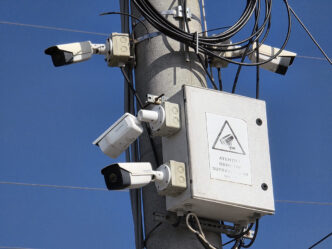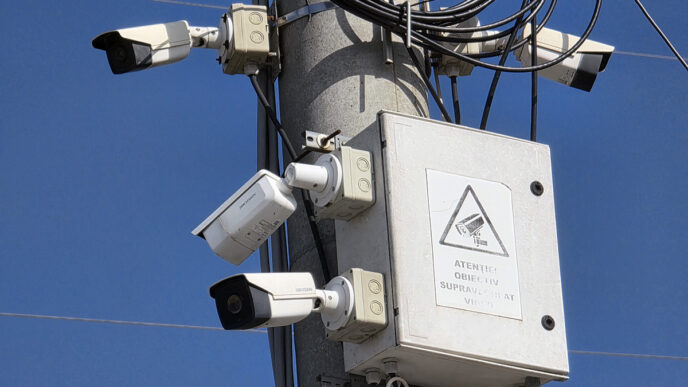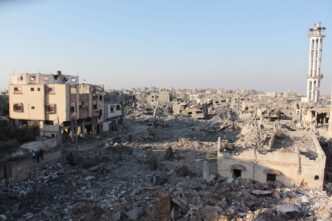




Thousands of video-surveillance devices imported from China have spread across Dobrogea, a region bordering Ukraine and forming part of NATO and the European Union’s external frontier.
The cameras were purchased with state budget money or EU funds, through Romania’s National Resilience and Recovery Program, from companies blacklisted by the United States, Canada, or the United Kingdom.
- Note: The National Resilience and Recovery Plan (NRRP) is Romania’s 28 billion euro strategy of reforms and investments to mitigate the economic and social impact of the COVID-19, financed entirely by the EU in the form of grants and advantageous loans.
In two of the three firms identified by Info Sud-Est, Dahua and Hikvision, the Chinese state is a shareholder. In the third, Milesight, it isn’t, but this company is also subject to the People’s Republic of China’s National Intelligence Law, adopted in 2017.
According to that law, “any organization or citizen shall support, assist, and cooperate with national intelligence work and keep secret the national intelligence work they are aware of.”

In other words, the Chinese state can obtain any information captured by the video-surveillance devices covering Dobrogea:
- Whether we’re talking about the road linking Constanța to Bulgaria and further to Istanbul, used for transporting military equipment;
- Whether we’re talking about the commune of Mihail Kogălniceanu, where the future so called “American town”, the potentially largest American airbase in Europe, is being built and where the 57th Air Base is located;
- Or whether we’re referring to the road crossing Tulcea county, along which aid for Ukraine or grain coming from the country invaded by Russia is being transported;
In fact, a joint note by Western intelligence services, including those of the U.S., the U.K., France, Germany, and the Baltic states, stated in May that 1,000 video cameras in Romania, near military facilities and railway level crossings, had been targeted by Russian spies. Romanian intelligence services did not take part in this investigation.

Meanwhile, Romania continued to import thousands of such cameras and to install them even in nearly abandoned villages. In total, almost 400 million euros were allocated by the Romanian state, through the NRRP alone, for “smart” local management systems.
The technical specifications documents drawn up by Dobrogea town halls were copy-pasted and stipulated, for example, road traffic that supposedly required flow optimization or traffic lights in villages where reporters counted two cars in three hours at midday on a workday.
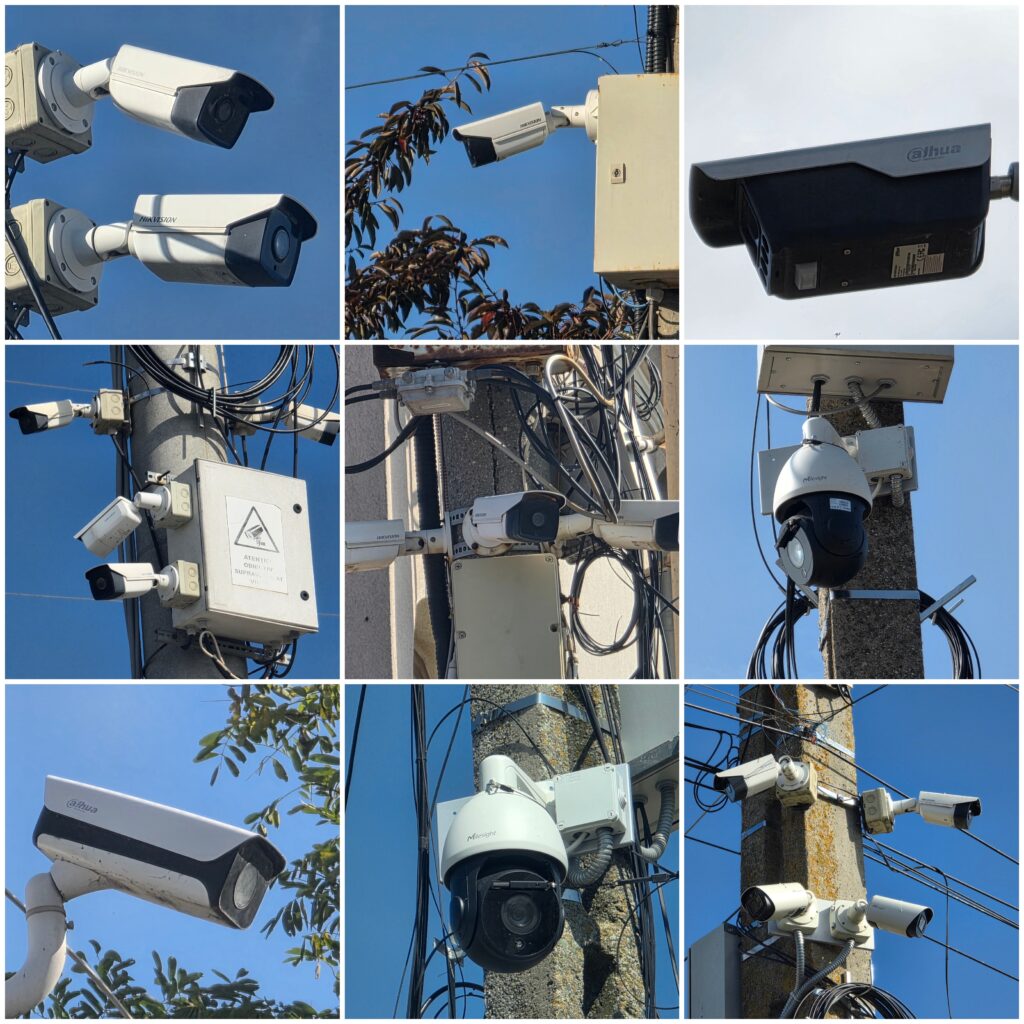
In most of the cases documented on the ground by ISE reporters, over several months, the video equipment is made by three Chinese companies: Milesight, Hikvision, and Dahua, the last two being at the center of several security scandals and ethical controversies, such as the illegal monitoring of Uyghurs, the Turkic population that the Chinese communist government is accused of trying to exterminate.
Bogdan Dragomir, representative of the company that installed the largest number of Chinese surveillance devices in Dobrogea using European funds, claims that the town halls are actually the ones asking for such cameras, cheap and in large quantities.
Dragomir acknowledges that the Romanian Intelligence Service (SRI) and the General Inspectorate of the Romanian Police (IGPR) recommend Axis (Swedish) or Bosch (German) cameras, but neither the applicants’ guide, produced by the Ministry of Development, the institution through which the European funds were disbursed, nor the specifications drawn up by town halls with the help of consulting firms, ban Chinese equipment: “So I sell what I’m asked to sell”.
- NRRP funds are being managed by the Ministry of Finances, but the way projects are handled on a practical level depends on specifications set up by ministries with the relevant responsibility. For IT and many other kinds of local infrastructure projects, that would be the Ministry of Development.
“As long as a system isn’t exposed to the internet and is accessible strictly via VPN, it doesn’t constitute a breach and there is never the possibility that a state actor like China could access those surveillance cameras,” says Dragomir, who adds that:
“Mayors want to have access through their phones, but we don’t give that to them,” the representative of the company that installed over two thousand such Chinese video devices in Dobrogea told us.
Representatives of the Ministry of Development had not provided a point of view by the time this article was published.
Chinese cameras banned by the U.S. and in the European Parliament
Info Sud-Est found in Dobrogea thousands of surveillance cameras produced by three Chinese companies: Hikvision, Dahua, and Milesight.
Hikvision has the cheapest products on the market, thanks to state subsidies from Beijing, which is a direct shareholder in the company.
International experts say the company’s video equipment is easy to hack and is at the center of controversies surrounding the monitoring of the Uyghurs, the Chinese Muslim community that Beijing’s regime is accused of seeking to eradicate.
For these reasons, the U.S. and other Western states have placed the company under sanctions.
In 2021, the European Parliament requested the removal of all Hikvision cameras from the institution’s buildings, due to the perceived risk that such equipment could support surveillance or espionage.
In Denmark, the intelligence agency (PET) recommended that the government stop the installation and use of Hikvision video systems on the grounds of cybersecurity vulnerabilities and the legal obligations that the Chinese government can impose on its companies.
The Chinese state is a shareholder in the case of Dahua as well, and like Hikvision, the company is banned by the U.S. and accused of the illegal monitoring of Uyghurs.
Milesight is not at the center of as many controversies, but it has acknowledged significant cybersecurity vulnerabilities in the past and is subject to the same Chinese law requiring the provision of information to the communist leadership in Beijing.
“They wouldn’t build us even a small bridge, the floods wash us out, but at least we’re being monitored.” Empty villages, packed with Chinese cameras
For several months we investigated the issue of video cameras in Dobrogea. We wanted to understand why they were a priority for mayors and how we’re affected by the fact that they are Chinese.
And, especially, why a commune with a few hundred inhabitants needs 120 video cameras, just like a commune with 15,000 inhabitants.
We went to the village of Altân Tepe in Tulcea county, 25 minutes by car from the Babadag live-fire training range. Altân Tepe used to host Dobrogea’s only copper mine. The village belongs to the commune of Stejaru and today has roughly 200 inhabitants.
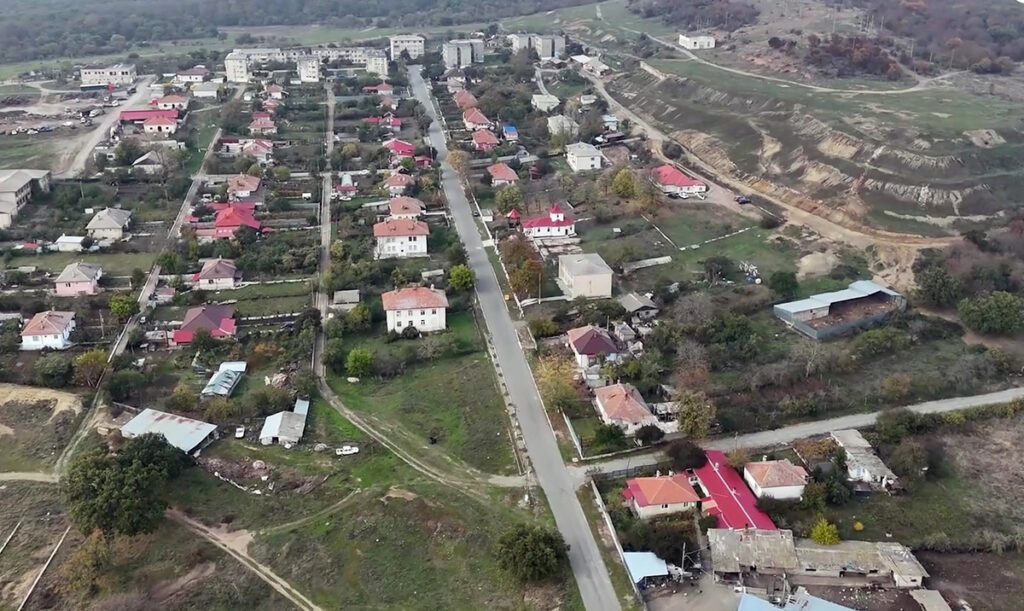
Over two hours, three cars passed along the village’s main street, during the day, midweek. In broad daylight, the village is practically deserted – not just of cars, but of people too.
Despite this, the Stejaru Town Hall bought 120 video cameras for its three villages: Altân Tepe (approx. 200 inhabitants), Vasile Alecsandri (approx. 400 inhabitants), and Stejaru (the remainder up to 1,200 inhabitants). The investment cost around 200,000 euros.

Eleven kilometers away, in Beidaud, another locality with roughly the same number of inhabitants, the town hall decided to install 151 surveillance cameras. All Hikvision.
The mayor claims the company that implemented the project decided which cameras to install in the locality.
“I’m not very good with electronics,” Mihai Culina told Info Sud-Est reporters.
Moreover, the company that installed the cameras in Beidaud, VHE Service SRL, is also the one that produced the technical project that formed the basis of the procurement, which VHE itself won.

It is not uncommon for consultancy companies to help public institutions draft technical documents for public tenders, but a company setting up the conditions for a bid in the form of writing the technical project and then winning the bid itself is a conflict of interest that Romanian legislation takes note of. In accordance with European directives, authorities are supposed to ensure fair competition, and excluding companies with such prior involvements in the project is an option.
Info Sud-Est has shown previously how, in spite of these legal provisions, actors found in such conflicts of interest managed to win numerous public tenders in Dobrogea, in a manner that was uncompetitive and lacked transparency. Details, here.
The mayor of Beidaud told us he would talk to the people who handle tenders at the town hall, “a young woman who’s just starting out”, and get back to us. He had not done so by the time the article was published.
Also, at the phone numbers associated with VHE Service, the people who answered hung up immediately after the ISE reporter introduced themselves.
Heading to Constanța
Another example is the locality of Dumbrăveni in Constanța county, where approximately 400 people still live, according to the latest census. The commune isolated commune on the border with Bulgaria has only one other village.
Locals say there are in fact no more than 200 people living in the commune year-round.
The town hall purchased another 120 video cameras, although it already had 18 functioning ones. Practically, in Dumbrăveni there is one camera for every 2–3 inhabitants.

The deputy mayor, Gabriel Hănțăscu, says he is the one who handles monitoring, in a control center with four TVs set up in his office.
Although the project required the town hall to hire a specialized, college educated person for the job, this was not possible, the deputy mayor says. “I turn on the monitors once a day to see if the cameras are working; there are plenty, you can’t cover them all.”
In Cerchezu, a locality with four villages but just over 1,000 people in total, there are just as many cameras, even though the locality is mostly dirt and gravel roads.
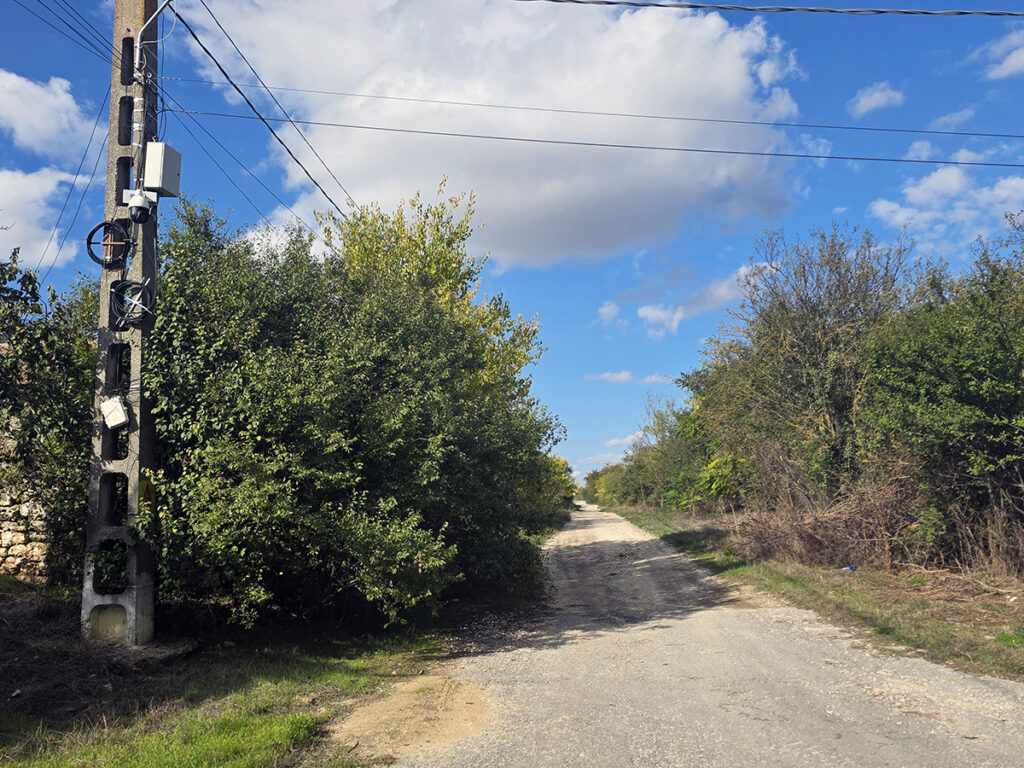
Residents complain that the commune’s infrastructure doesn’t protect them from floods, but “they’re well monitored” instead.
The mayor says that 120 surveillance cameras are still too few and estimates another 60 or so would have been needed to cover everything: “We solved a few issues with the trash; with cars bringing dogs over, not yet,” says the mayor.
- Note: Dog abandonment is a common issue in Romania, contributing to one of the largest stray dog populations in the EU – at least 500.000, by some estimates.
Here too there is no dedicated employee in charge of monitoring. “The lady from procurement” goes from time to time to check whether the surveillance equipment is working.
We asked her how it was that the technical specifications for purchasing surveillance cameras were almost identical to other documentation put out to tender by dozens of other town halls in Dobrogea, and why Chinese cameras were installed.
She says she worked with a consulting company that she found by asking around at other town halls.
Consultancy and the company that installed thousands of Chinese cameras: “SRI recommends Axis and Bosch, but mayors want these, we followed the budget”
Klad Consulting is the company that provided consultancy in Cerchezu, Dumbrăveni, and other communes in Dobrogea.
The company’s representative, which had a single employee in 2024, Daniela Hărlăuanu, says that town halls decided how many surveillance cameras had to be installed in the commune.
“Yes, the specifications look similar because if the object is the same, monitoring cameras, they can’t differ; they’re the same.”
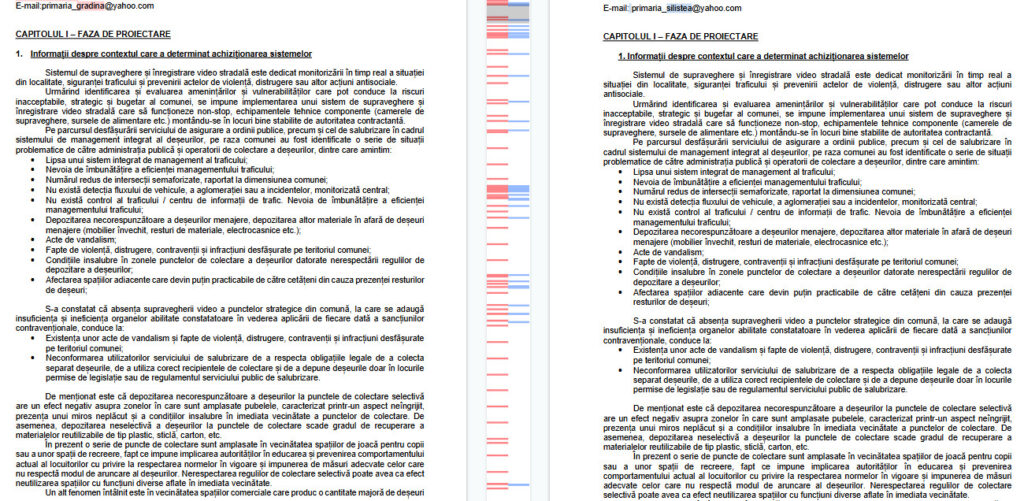
Hărlăuanu also says the documentation was prepared based on a guide from the National Agency for Public Procurement (ANAP).
Asked why the same number of surveillance cameras appears in a commune with 15,000 inhabitants and in one with 400, where the documentation was copy-pasted even in wording, with identical needs and specifications, the consultant said: “I can neither contradict you nor confirm you.”
Dab IT Outsourcing is a company that, between August 2023 and December 2024, won over 50 tenders, exclusively with European funds, worth approximately 8 million euros, all in digitization and mainly for street video-surveillance cameras or equipment purchases for town halls and schools.

In Dobrogea, the company won the majority of tenders where Klad Consulting provided the consultancy services. The two firms also crossed paths in Prahova, but their representatives say they have no connection.
“We’ve crossed paths many times. Of course we know them, because we found them wherever we bid, but we have nothing to do with them. It’s a coincidence that they produce some specifications we sometimes align with, but it’s not a rule,” says Bogdan Dragomir, security systems engineer and administrator of DAB IT Outsourcing, the firm that installed over two thousand Chinese Milesight cameras in Dobrogea.
“Because a consultant like that takes a set of specifications once and sells it to everyone,” Dragomir adds.
Regarding the installed Chinese cameras, the company representative says that this is what town halls ask for and that they have to keep within their provided budget:
“Town halls decide this, because they make their budgets based on Hikvision, Dahua, all those. Let’s be serious: we’d like to install Axis and Bosch, but there’s no way, because they don’t have the budgets for that. Town halls set the number of cameras, maybe they all talked to each other, and then we went and targeted that area,” Dragomir continues.
“But technically speaking, between Axis (a Swedish company) and Milesight (a Chinese company), there’s no difference from a technical standpoint; it’s about national security and context, I get that. From our point of view, as long as a system isn’t exposed to the internet and is accessible strictly via VPN, it doesn’t constitute a breach and there’s never the possibility that a state actor like China could access those surveillance cameras. Technically speaking, each camera passes certain tests for sale in Europe, certifying that these cameras can’t be accessed without you granting access. It’s about a cloud system. Any camera like this, say a TP-Link you put at home, goes through TP-Link’s cloud and automatically a Chinese guy can see what you’re doing, if he wants to,” Dragomir says.

There are, however, mayors, he says, who want the images on their phones: “And these Milesight cameras, in theory, like Hikvision and Dahua, can have that cloud function. But you enable that cloud function yourself if you want. We build closed-circuit systems. At town halls, even though mayors ask us, through Prahova, Dâmbovița, Buzău, they ask for access because they want to see it on their phone, we’ve never given it to them, because there are regulations we receive from SRI and IGPR that don’t allow it.”
“We were recently at a thing with SRI and, likewise, they recommend Axis or Bosch. In reality, each of these town halls works with some ‘guy’ on surveillance, from some small local firm, that guy will always propose to mayors what’s easy for him to deliver and install. So they automatically go for Hikvision and Dahua because these are accessible from most suppliers in Romania. Hikvision is the cheapest, indeed,” adds Dragomir, who believes that in this whole story, the Ministry of Development is to blame.
“The guilty party here is the Ministry of Development, in my opinion. Because they shouldn’t have allocated the same funds to all administrative units (UATs) in Romania. They should have allocated funds according to the number of inhabitants and the reality on the ground. When they drew money from the NRRP everywhere, they gave everyone the same. When everyone sat down politically at a table and said, <<done, you all get the same, regardless of whether you’re a commune with 10,000 inhabitants or one with 300>>, that’s completely wrong,” Dragomir says.
“We found ourselves having bid on what they asked for, and when we went on site, there were no poles where we could run fiber-optic cable. They made some plans, however they made them, they copy-pasted or asked a friend, a cousin who knows a bit, and they drew lines on Google Earth, in areas where there are no poles. It’s total chaos (…) I don’t really care; I sell you what you ask for. And if I don’t even have the chance to correct what you’re asking for, then that’s your business. The problem is that these surveillance systems end up not being used, that’s the big problem.”
“But it’s serious, because no rules were set,” concludes the administrator of the company that installed thousands of these Chinese cameras.
There are, however, town halls in Dobrogea that chose to install fewer video cameras—but imported from companies in Sweden or Germany.

Too few, though, and in localities where Chinese surveillance systems already existed and are still operational today
- Translation by Gabriel Mateescu
- This investigation was developed with the support of Journalismfund Europe.

Ne bucurăm că ne citești!
Dacă vrei să ne și susții: