


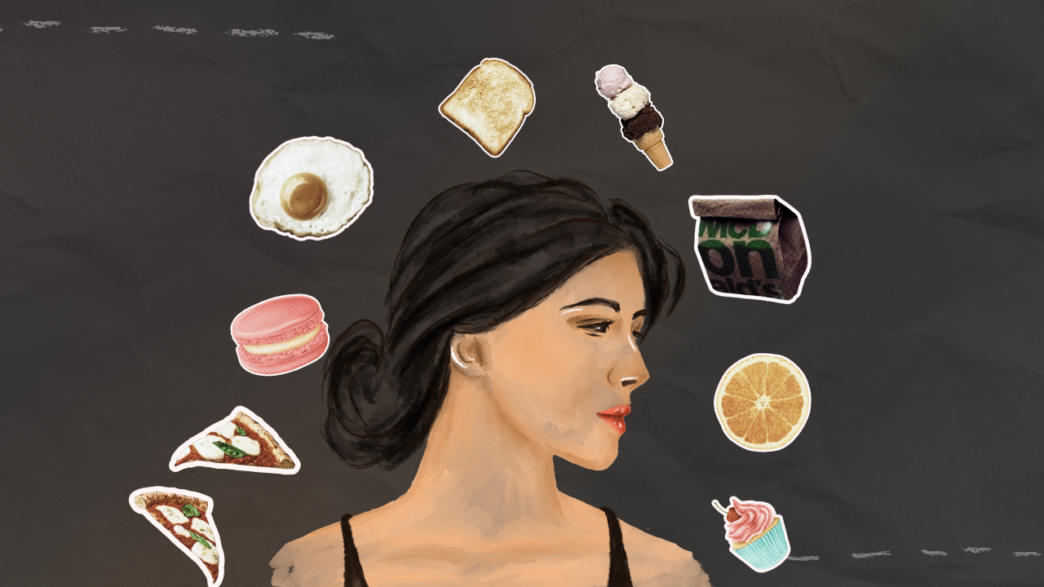
Some of the most frequently encountered eating disorders are the so called „binge-eating episodes”. They represent the situation when someone eats large or very large quantities of food without having control over what they are doing, according to Binge Eating Disorder UK. The website also specifies that this can happen to anyone, regardless of age and gender.
- Of note: Social media seems more open lately when it comes to eating disorders. Little by little, influencers are starting to no longer portray a ‘perfect’ life on social media and realize that they have a community that believes their content, so more and more content creators are deciding to use their platforms for an educational purpose, so that they make their followers feel safe.
The fifth edition of the Diagnostic and Statistical Manual of Mental Disorders (DSM-5) shows that binge eating disorder is the only eating disorder that does not present compensatory behaviors to ‘eliminate’ the food consumed, such as self-induced vomiting or excessive physical exercise.”
The European Parliament indicated in 2021 that women aged between 15 and 25 tend to be more often victims of eating disorders, and over 20 million young people in Europe have different variations of eating disorders.
It is no secret that the love triangle between women, social media, and food is often toxic, the reason being most often the unrealistic standards imposed by the most popular women on the internet.

As a woman, if you are a consumer of Instagram and TikTok, the chances of encountering an influencer who shows how they eat one meal a day and it is enough for them to feel full of energy all day are very high.
These ‘harmless vlogs’ can be damaging to the self-esteem of social media users, especially young women, and can be the main factor in eating disorders, such as binge-eating episodes, one of the eating disorders that is too little discussed on social media.
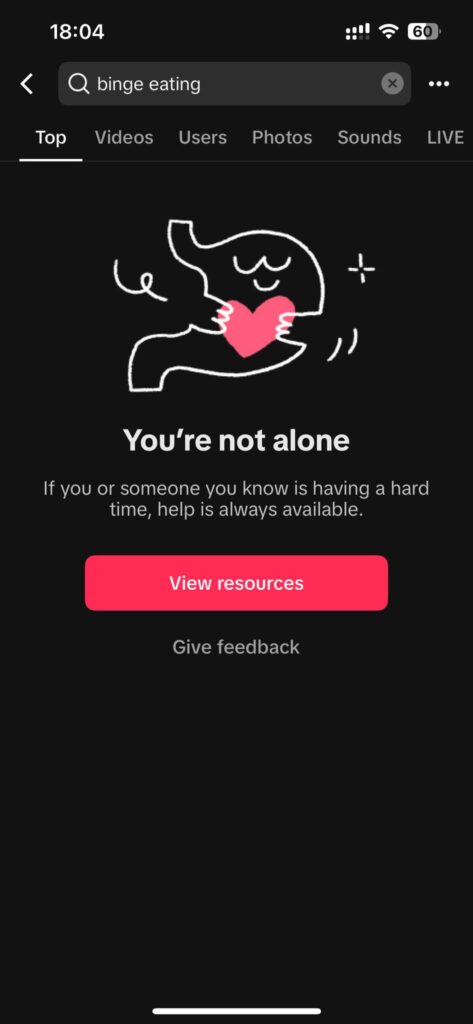
When you search for the words ‘binge-eating’ on TikTok, the platform will not offer you videos on this topic, but will offer you some educational websites on this subject and the following message:
- ‘You are not alone. If you or someone you know is going through a difficult time, help is always available.'”
In this context, the European Union has announced that it is investigating the ‘skinnytok’ trend on the Chinese platform, TikTok. ‘Skinnytok’ is a toxic phenomenon where extreme diets are promoted or starvation is encouraged to achieve the desired figure, such as that of supermodels. G4Media wrote about how this trend has accumulated millions of views and has gone viral globally, including in many European countries.
‘Young women are often faced with contradictory messages about who they should be and how they should look.’
Although eating disorders seem to be increasingly common among young people, they are too little discussed online, which leaves young people feeling ‘alone’ in their struggle with food.
We spoke with Mihaela Rus, president of the College of Psychologists in Romania, Constanța branch, to provide us with more details on how eating disorders manifest, especially binge-eating episodes, being an eating disorder that is not talked about enough on social media compared to its impact on young people, and about the reasons why women are more frequently victims of these eating disorders.
Mihaela Rus explained for ISE that binge-eating episodes are usually accompanied by a series of specific psycho-behavioral traits, of which at least three must be present for the diagnosis to be established: rapid consumption of food, eating until the appearance of an uncomfortable feeling of fullness, ingestion of food in the absence of physical hunger, eating in isolation due to the shame associated with eating behavior, and the appearance of subsequent negative emotions, such as disgust and guilt for having eaten.
- „Overall, compulsive eating behavior reflects a profound difficulty in emotional regulation and in managing the relationship with one’s own body and with food, representing a serious form of psychological suffering that requires a multidisciplinary therapeutic approach”.
Asked why women tend to be more often victims of eating disorders, such as binge-eating episodes, the psychologist argues that the higher frequency of eating disorders among women reflects a phenomenon related to how women live and experience the relationship with their own bodies, with their personal identity, and with the world around them.
She further adds that this predisposition should not be understood as an individual weakness, but rather as an expression of deep tensions, internalized throughout their personal and social development.
In the moments when self-image is formed and consolidated, young women are often faced with contradictory messages about who they should be and how they should look. In an attempt to adapt to these demands, many end up developing dysfunctional ways of relating to their own bodies and to food, which, over time, become ways of managing complex and difficult-to-express feelings. Thus, eating disorders do not appear in isolation, but as personal responses to life contexts full of pressures, insecurities, and expectations, says the president of the College of Psychologists in Constanța.
- „The increased vulnerability of women to eating disorders, especially binge-eating episodes, must be understood from an integrative perspective that takes into account the multiple socio-cultural, psychological, and biological influences that manifest during adolescence and young adulthood”.
„Psychotherapy remains one of the most effective forms of intervention”.
To combat eating disorders, such as binge-eating episodes, young people can learn to manage these difficulties by using scientifically validated tools and by building a framework of authentic and multidimensional support.
- „Firstly, psychotherapy remains one of the most effective forms of intervention. Cognitive-behavioral therapy (CBT) in particular has proven effective in restructuring dysfunctional thoughts related to body image and eating, in emotional regulation, and in preventing relapses. Other useful forms of therapy include dialectical behavior therapy and compassion-focused therapy, especially when the disorder is associated with shame, anxiety, or trauma”, says Mihaela Rus.
A second important tool is social support, which can be mobilized through family, friends, support groups, or online communities moderated by specialists. Young people need to know that isolation fuels compulsive behaviors and that, on the contrary, connecting with people who understand their difficulties can significantly contribute to the healing process.
In addition to the support offered by loved ones, psycho-nutritional education plays an equally important role. Understanding how the body works, the relationship between emotions and food, as well as recognizing the signs of eating disorders can contribute to prevention and early intervention. The psychologist also emphasizes that promoting a healthy relationship with food, which does not involve rigid restrictions or guilt, is crucial for recovery.
In the case of young women, Mihaela Rus highlights that self-compassion and body acceptance are not signs of weakness, but rather resources of resilience when it comes to their relationship with food.
- „Constant comparison with unrealistic ideals promoted online or in popular culture can intensify compulsive behaviors; therefore, cultivating a realistic and gentle perspective on oneself is essential”.
The president of the College of Psychologists in Constanța emphasizes that eating disorders, which include anorexia nervosa, bulimia nervosa, and binge eating disorder, have a multifactorial etiology and involve a complex interaction between biological, psychological, and socio-cultural factors:
1. „Socio-cultural factors: One of the most powerful triggers for eating disorders is the social pressure related to beauty standards. Mass media, social networks, and the fashion industry often promote unrealistic body ideals, especially for women, which leads to body dissatisfaction, low self-esteem, and the tendency to resort to restrictive diets or extreme compensatory behaviors;
2. Psychological factors: Eating disorders are often correlated with psychological traits such as perfectionism, the need for control, anxiety, depression, childhood trauma, or experiences of abuse. Food often becomes an emotional regulation mechanism, offering either a temporary sense of control or a way to calm down in the face of stress;
3. Biological and genetic factors: Studies show that there is a significant genetic component in the development of these disorders. Neurochemical imbalances, especially in serotonin and dopamine levels, can influence eating behaviors and impulsivity. Also, hereditary predispositions can be activated by environmental factors and specific stressors;
4, Environmental and relational factors: Stressful life events – such as parental divorce, bullying, academic pressure, or sudden changes in lifestyle – can trigger eating disorders, especially in adolescence. Conflicting or hyper-controlling family relationships can also contribute to the onset of symptoms”, the psychologist explained for ISE.
How social media affects young people’s relationship with food
Mihaela Rus believes that social media platforms create a space where body image is constantly exposed to the gaze of others, and validation through the number of likes, comments, and followers becomes an indicator of people’s personal worth. Excessive use of these platforms is often associated with a significant increase in dissatisfaction with one’s own body, especially when users are repeatedly exposed to edited images that reflect unattainable standards.
- „The social pressure related to conforming to a certain type of figure or ‘healthy’ lifestyle also contributes to the internalization of rigid body ideals. This is not limited to models of feminine beauty but extends to the entire lifestyle promoted as ‘correct’ – from diet to physical exercise and personal success. In this context, eating is no longer a natural act but becomes a source of anxiety and a tool for social validation”.
The psychologist further adds that while social media offers access to information and support communities, it can also encourage unhealthy behaviors by promoting ‘miracle diets,’ extreme workouts, or toxic messages about ‘motivation’ and willpower.
Ne bucurăm că ne citești!
Dacă vrei să ne și susții: