

Reporters from Info Sud-Est and G4Media posed as students and spoke to people behind several websites that sell undergraduate papers for between 1,200 and 1,600 lei each. All the websites we contacted claim to provide „cover services” for bachelor, master and doctoral papers. In reality, they take orders for the whole paper. The Education Act prohibits this practice and provides for fines ranging from 5,000 lei for buyers to several hundred thousand lei for sellers.
For three weeks we corresponded, by e-mail and telephone, with a woman and a man who took our orders, negotiated a smaller number of pages and an emergency fee to get the papers faster, and in the end we sent the papers back to the „specialists” because they abounded in grammatical and editorial errors and, most importantly, contained serious errors of information.
As a result of the journalistic endeavour, we contacted authorities and institutions to point out the phenomenon and to understand if and how this form of imposture at the lowest university level could be stopped.
Note: The documentation of this story was prompted by an email received from a person claiming to be the father of a student who became chronically depressed, with suicide attempts, after such a degree paper was rejected and he was expelled. The student had bought the paper from one of the websites listed below by G4Media.ro and it was deemed by professors to be poorly written and documented and plagiarised. Scoala9 also published a piece on Friday with information about the firms behind the affair, which can be read here.

The information in brief
- Romanian police are investigating after G4Media and Info Sud-Est reported that they had negotiated with several websites to sell and buy licensed works for between 1200 and 1600 lei;
- ANCOM, the authority that can close down websites in Romania, told G4Media and ISE that it has not so far closed down such websites because such action can only be taken after a contravention has been found and enforced by representatives of the Ministry of Interior;
- G4Media and ISE reporters negotiated incognito with several sites selling theses in Romania and „bought” theses in Law and Medicine to understand how the system works and what the student-seller interaction looks like. Listen to the audio and read the correspondence in the article.
- Samples of the papers the reporters received are full of grammatical and typing errors and contain serious misinformation, and the paper is written in special fonts so that plagiarism cannot be detected when students check it on search engines;
- Behind the websites operate companies with profits of hundreds of thousands of lei a year, with one or two employees, whose business is ‘editing’, ‘consultancy’ or ‘advertising’. Three of the companies identified by G4Media and ISE have their headquarters in a house in Sector 1 of the capital.
- Romania’s education law punishes sellers of theses with fines starting at 100,000 lei and buyers with fines starting at 5,000 lei;
- University representatives explained why the phenomenon of selling and buying licences needs to be completely eliminated.
Beginner’s luck. We got a Black Friday discount for a bachelor’s thesis
The process began on the 29th of November, when we sent emails to all the addresses and completed forms on seven websites specialising in undergraduate work.
We received almost identical responses, with the same guidance, wording and conditions, then we replied further. In parallel, the information obtained in the documentation indicated that we should continue correspondence with three of them.
In short, the procedure works as follows:
- Students send an email to the addresses or forms on the website, or call directly (but will not be answered immediately), requesting an undergraduate paper with title X (or asking for a random paper to be distributed/edited);
- Generally, students then receive an email with information about how things will go and the price to be paid;
- But if students ask for more information, are more insistent or have questions, as was the case with the reporters, the people behind the websites agree to talk on the phone;
- Conditions, price, number of pages, delivery time, etc. are negotiated if necessary (no advance payment is required for the work, but there is a rush fee, for example);
- Students receive a free preview of the paper, a „plagiarism report” confirming that the paper is genuine, plus the first page, table of contents, bibliography and introduction, along with the bank account and company name behind the websites;
- If there are no complaints about how the first pages look, any mistakes, if the information is deemed correct by the student, the money is transferred and the full paper is received;
- In the case of reporters, there have been not one but two license revisions due to mistakes and errors in information, but also because we wanted to see how far our approach could go and get as much as we could from the back of „specialist” sites.
- We chose to be medical and law students, and in the endeavour we were helped in our specialist knowledge by a resident doctor and a lawyer.
We proposed two themes to them:
- „Upper GI bleeding. Contemporary methods of diagnosis and treatment”;
- ” Non-denunciation. Particularities of the crime of omission”.
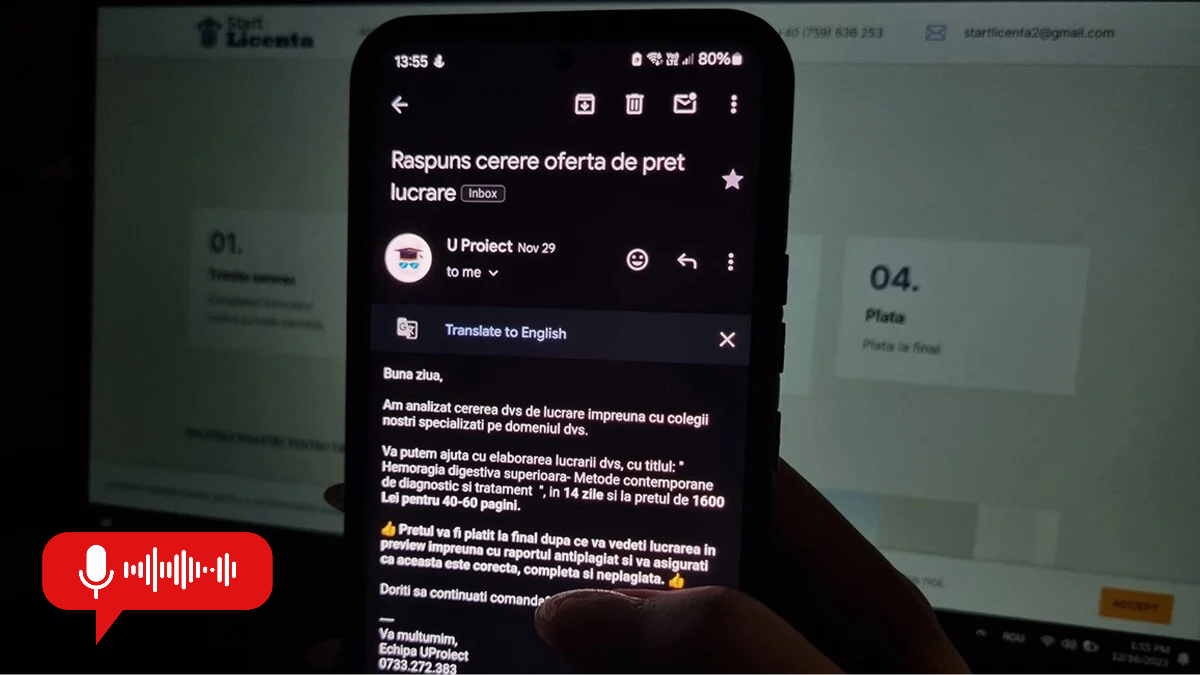
The answers of the websites were almost identical, with the same address, time conditions, drafting, price and number of pages: 14 days, 1,600 lei, between 40 and 60 pages, payment is made at the end, after we see the preview and the anti-plagiarism report.
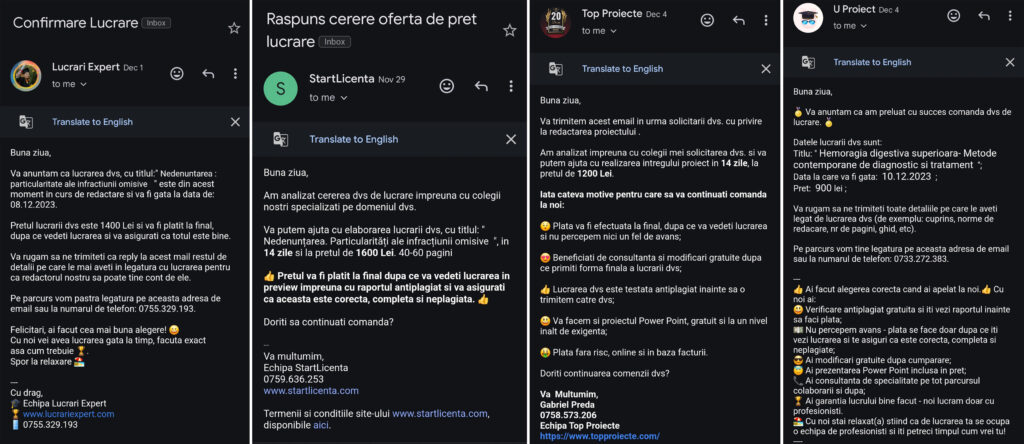
We asked to receive the works or at least a chapter of them sooner and we got this in exchange for an emergency fee of 200 lei. The fee was offset, however, by the „bonus” we got on the original license price, which was reduced from 1,600 to 1,400 lei on Black Friday because we had placed the order in the last days of November.
After the initial emails, we tried talking to the people behind the sites on the phone. This is what an initial discussion looks like, the example below being with Expert Works (initial discussions go the same way in all cases consulted):
After we received the paper (in the case of the law paper, from Start Licence) we consulted a lawyer who pointed out that the one and a half page introduction contains only generalities and excerpts from the Penal Code or other scholarly works and which are not properly cited, but which are also not seen in the „anti-plagiarism report” the student receives. What’s the catch?
When the student checks the Google entry they receive, they can’t „see” that they are randomly copied and pasted from the internet, because special characters are used in the wording of the paper, precisely so that they can’t be found on Google.
But plagiarism cannot be hidden from the software used by universities, so students end up in front of their teachers convinced that they are holding a genuine paper.
In the case of the Medicine paper, the resident with whom we consulted pointed out, in addition to poor writing, serious errors of specialist knowledge:
„First of all, they are clots, not chiages, and foods are substances that the body takes in from the environment, they must be referring to nutrients perhaps, not food. Melena occurs when there is at least 50 ml in the upper digestive tract, it does not occur when there is blood in the intestine. The intestine is one thing, the digestive tract is something else (…) The small intestine starts after the angle of Treitz, i.e. after the duodenojejunal ligament. Which means that if there is melena, bleeding occurs above this ligament,” was one of the resident’s explanations
„I don’t know what you’re talking about, I just work the call center”
We told the site reps that their work was poorly done and the teachers wouldn’t accept it. We were accepted on the spot for the „revision request”, but were told to correct the errors ourselves and email them what needed to be changed in the paper. The licence entries contained mistakes even after the first revision, so we were registered with a second revision request. And after that the papers still contained mistakes, mostly in the typesetting.
We then called them and asked what guarantees we had that in return for the money we would get a correct paper in full since after two revision requests not even the introduction was properly drafted. They told us that we would get revisions until we were satisfied.
After this experiment, we called them as reporters to ask them why they encourage academic imposture and if they know that what they are doing is against the law.
- „I’m not in a position to answer such questions. Forward by email and you’ll get from colleagues there the answer as clearly as possible. You forward the email and it will be redirected to the legal side and you will get the answer from there,” was the response of a woman from Start Bachelor.
- „I don’t understand what you are referring to. I don’t know what you are talking about, I don’t know how to answer that. I am only on the call centre side”, was the response of a man from Expert Works.
- No one from UProiect responded to requests from G4Media.ro and Info Sud-Est for a point of view.
When you’re in doubt about whether to pay for your law school paper, with how poor the introduction is.
Full correspondence in the video below:
When you’re a med student and you’ve got a thesis sample worthy of being thrown away:
„They treated my child worse than a dog.”
G4Media.ro’s original source claims that his son fell into chronic depression, with several suicide attempts, after being threatened and blackmailed by the people he had been in contact with to write his paper, and eventually expelled because of his poor and plagiarized license.
„My child used the services of these so-called specialists, I know that what he did was not moral either, but he was threatened, blackmailed, they treated him like a dog; because of their work he was expelled, followed by a depression that has already become chronic and several suicide attempts (…)”.
Other students have been in the same situation, as shown by several sites where users leave negative comments about those they turn to for writing their undergraduate papers. Some examples:
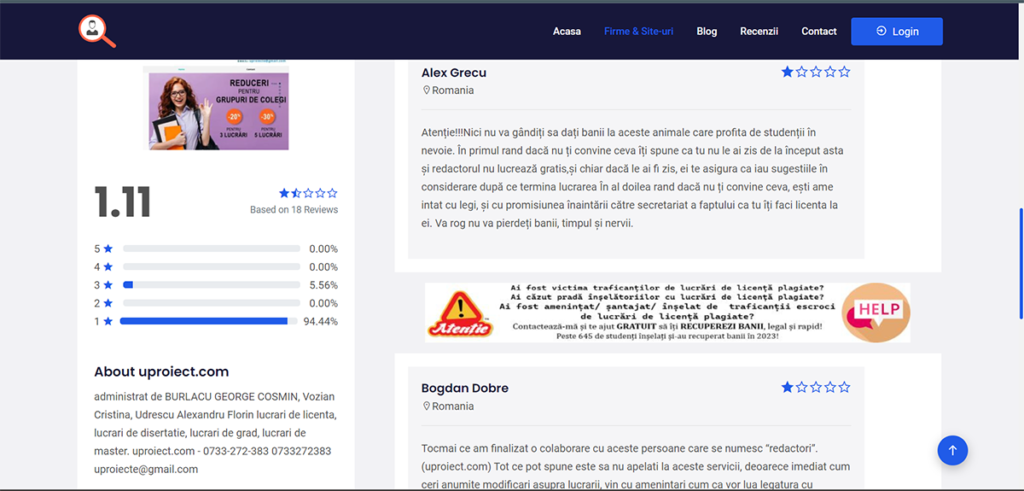
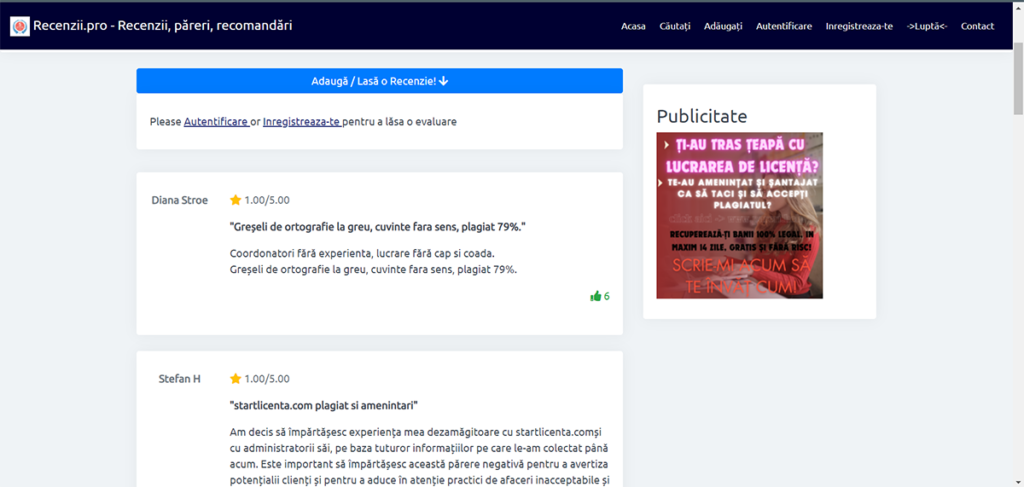
In response to the complaints, websites named after the pages selling the papers have also appeared, denouncing the poor quality of the papers, which are full of elementary errors in writing and serious errors of basic knowledge in the fields in which they are documented.
The „specialists” network
Once the licenses had been entered, previewed and the „anti-plagiarism report” completed, we received the bank account and the name of the company to which we were to transfer the money: Premium Project Content SRL, whose business is „other publishing activities”.
The company is wholly owned by Cristina Contor, originally from the Republic of Moldova, residing in Sector 2 and who is the sole partner and administrator in two other companies, Nova Content Project and Ent Content Consulting.
Nova Content was founded in 2022 and has a turnover of almost 300,000 lei and a profit of 200,000 lei. Ent Content Consulting is founded on November 3, 2023 and is engaged in publishing books and magazines.
The parent company, Premium Project Content, is opened on the 26th of November 2021 and has a turnover of almost 700,000 lei in 2023 (with an increase of 4242% in 2022) and a profit of almost 300,000 lei (an increase of 1865% in 2022), according to the portal termene.ro.
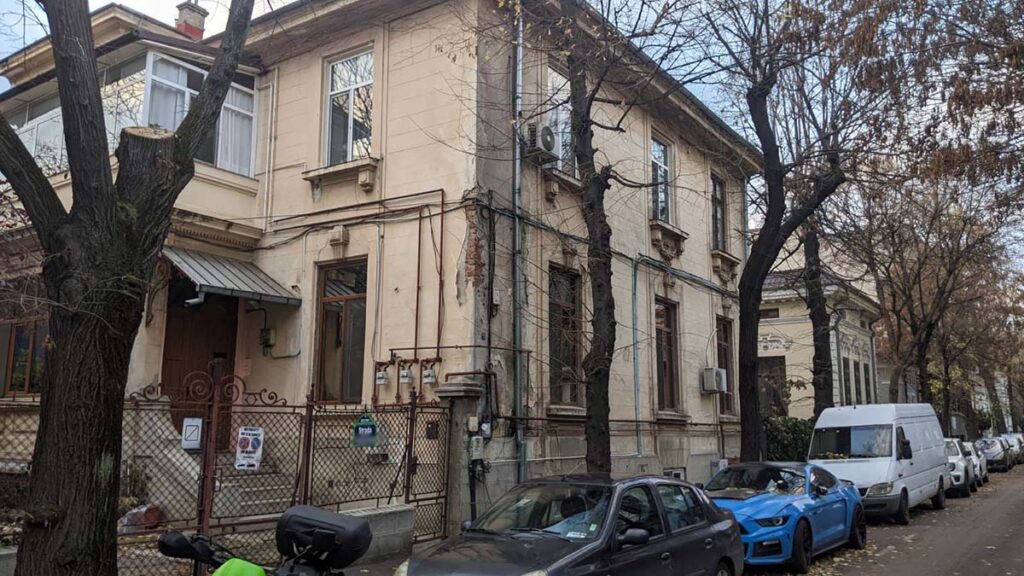
All three companies are headquartered in a house in the centre of Bucharest, in Sector 1. We were unable to contact the companies on any of the phone numbers available on termene.ro.
Prior to publication, we have brought our approach to the attention of the Ministry of Internal Affairs and the National Authority for Administration and Regulation in Communications (ANCOM), in order to understand if and how the phenomenon of buying and selling licenses in the online space can be stopped and what the risks are for those who sell and those who buy.
ANCOM is the authority that can, among other things, shut down websites in Romania. Sites such as those that sell licensing work can be shut down, but the institution has not done so so far because:
- „(…) this action can be considered only to the extent that it is previously established, by the competent bodies, that the materials referred to are subject to the contravention provided for in Article 259 para. (3) of Law no. 199/2023 on higher education, for which ANCOM is not competent (…)”, the institution sent.
ANCOM talks about the draft law approving GEO 72/2023 for the amendment of certain regulatory acts in the field of education and says that it will be able to intervene at the request of the Ministry of the Interior, which in turn will act on „a reasoned request from the higher education institution”:
(…) According to the draft, the detection of contraventions and the application of fines will be made by police officers or agents of the Ministry of Internal Affairs (MAI), at the motivated request of the higher education institution. The investigating officers of the MAI may also order the additional sanction of immediate interruption of the transmission of the content of the offence on an electronic communications network. The MAI’s request to ANCOM will be made only if the offender does not implement the additional sanction ordered by the report issued by the investigating officers, in which case ANCOM will issue a decision to this effect”, ANCOM representatives have sent to G4Media and Info Sud-Est. Read ANCOM’s full response here.
In other words, the first to intervene in this situation are the police, who are under the Ministry of Interior Affairs (MAI).
Georgian Drăgan, director of the cabinet of the Romanian police chief, told G4Media and Info Sud-Est that an investigation was launched following the situation reported by reporters:
„The Romanian Police and the Ministry of Internal Affairs are collaborating with the Ministry of Education and ANCOM to find the best solutions to prevent such situations and of course to take legal measures accordingly. The sites you submitted have already been given to colleagues in the Romanian Police for verification. When these checks are completed, measures will be taken accordingly.”
According to the Higher Education Act of 2023, selling and buying licenses (dissertations, doctorates or any other similar projects) is prohibited, is considered a misdemeanour and is punishable by fines of 100,000 to 200,000 if you sell licenses and 300,000 to 600,000 lei if you had a site closed for this reason and reopened it. Buyers are also fined between 5,000 and 50,000 lei.
In all cases, the fines are given by police officers or agents of the Ministry of the Interior, who have powers in this area, the law adds.
Can a teacher tell that the work does not belong to the student in front of him?
We wanted to understand how the phenomenon is viewed within a university, how they try to detect plagiarism or academic fraud, and especially whether professors can tell that a paper is plagiarised or not written by the student taking the graduation exam, beyond the software they have at their disposal.
Ovidius University of Constanța (UOC) says, for example, that a student’s degree is run through the anti-plagiarism system no more than twice before the paper is examined. If it does not pass the system after the two reviews, then it is automatically rejected and cannot be entered in the final exam for the session in which it was scheduled. See the university’s full explanation here.
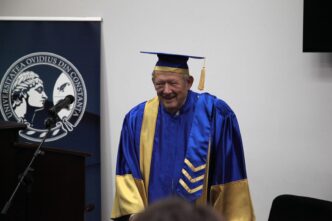
Emanuel Plopeanu is a professor of history and dean of the UOC’s Faculty of History and Political Science and says the university’s anti-plagiarism system is the sole authority that can decide whether a paper is plagiarised or not.
He calls the trade in theses an „academic crime” because it contributes to maintaining the phenomenon of plagiarism, which would otherwise be reduced:
„The academic can identify, through a careful analysis of the content, the lack of originality of the text and, more seriously, the resemblance to scientific texts and the taking without citation. The academic community must show zero tolerance for such practices. And buying or copying a previous text is an academic crime. Selling and buying undergraduate/dissertation work contributes to maintaining plagiarism, which would otherwise be significantly reduced. We believe that it is necessary to limit, to the point of extinction, starting with the publicity that is given to this phenomenon, which should come under the law, as a criminal activity.”
Ne bucurăm că ne citești!
Dacă vrei să ne și susții: