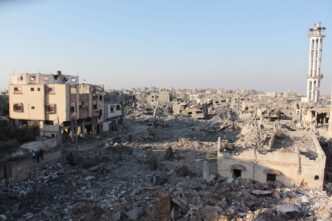


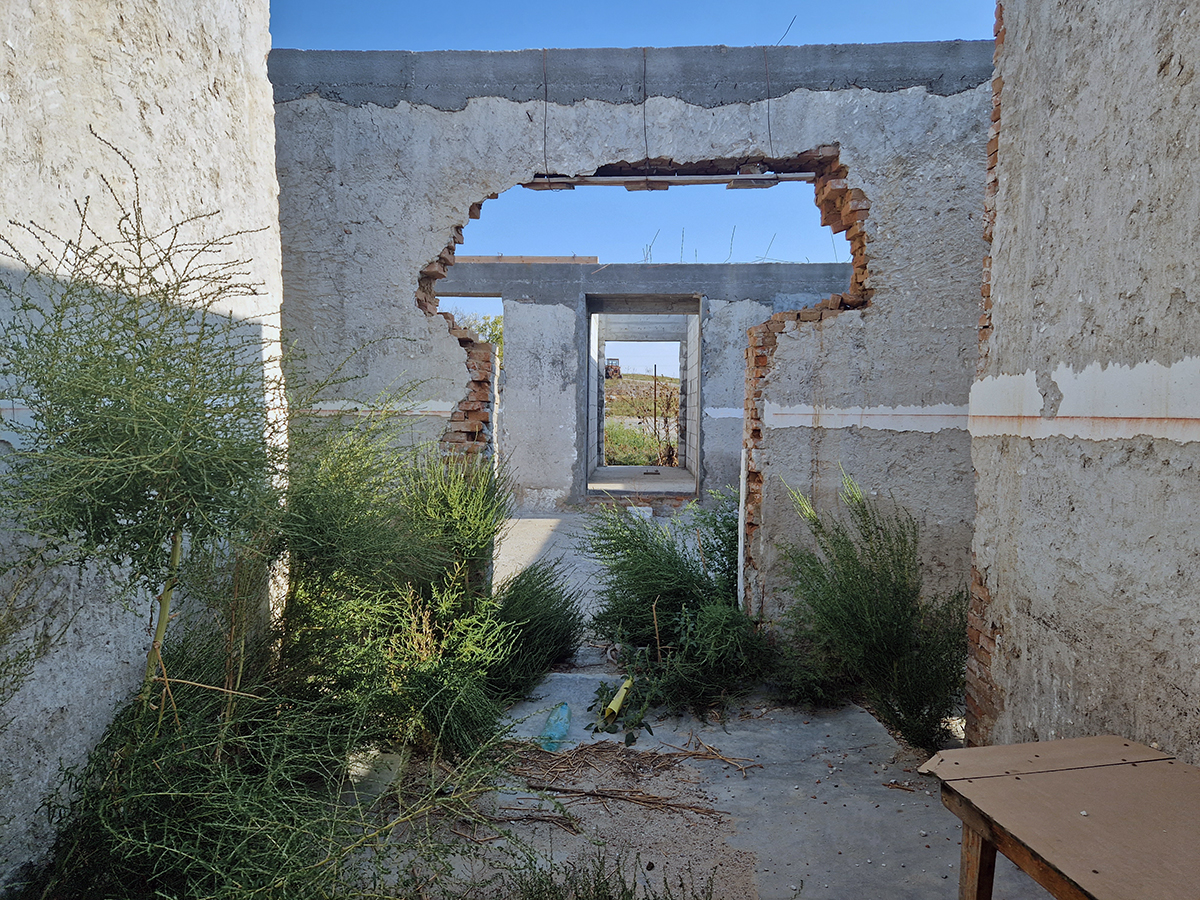
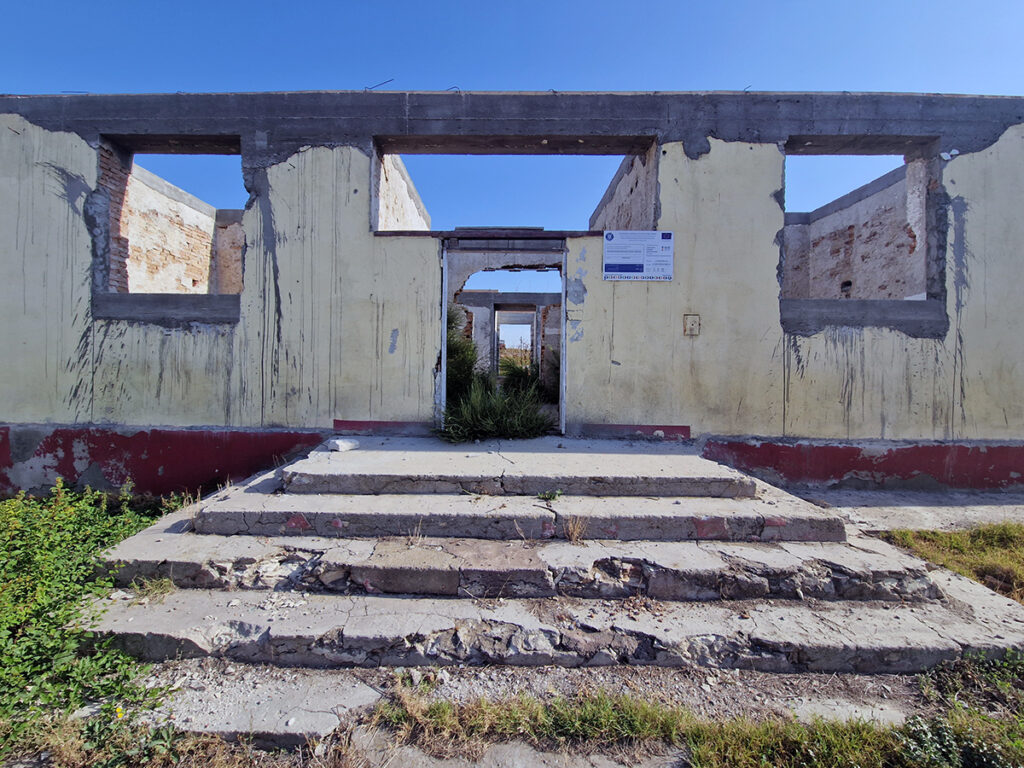
A third of the schools, kindergartens and cultural centers that should have been renovated, equipped or built from scratch with European money from the Danube Delta ITI are in ruins, unfinished, not built at all or not put to use because they do not yet have the necessary facilities. In all cases the deadlines agreed upon in the EU contracts have been exceeded.
In many cases it takes more than 5 years to renovate a public building of between 200 and 500 sqm (school, kindergarten, center). In other cases, over 7 years. We even found a case where a municipality built a school from scratch faster than renovating a cultural center.
Long tender deadlines, a lack of workers and vocational schools, high construction prices, the rule of the lowest tender price, few employees in key institutions and late payments from the Romanian state are blocking construction sites in rural areas, according to the mayors.
However, they have some leverage to avoid long waiting times, but they don’t use it, according to public procurement experts, who admit that the lack of employees working on European projects in key institutions makes the implementation process more difficult.

In early October, Info Sud-Est reporters went into the field to check more than 90% of schools, kindergartens and cultural centers in the Tulcea county that received European money from the National Rural Development Programme (PNDR), through the Agency for Rural Investment Financing (AFIR), as part of the ITI Danube Delta pilot project. All of them should have been completed. Instead, municipalities have asked for extensions of up to 2 years, for which they pay penalties.
The Baia Case: A company with millions in debt, commercial risk and only one employee in 2022

The municipality of Baia has four other villages in addition to its town of residence: Panduru, Camena, Ceamurlia de Sus and Caugagia.
In all of them there are cultural homes that should have been renovated, modernised or equipped with European money, with sums between 170,000 and 270,000 euros each.
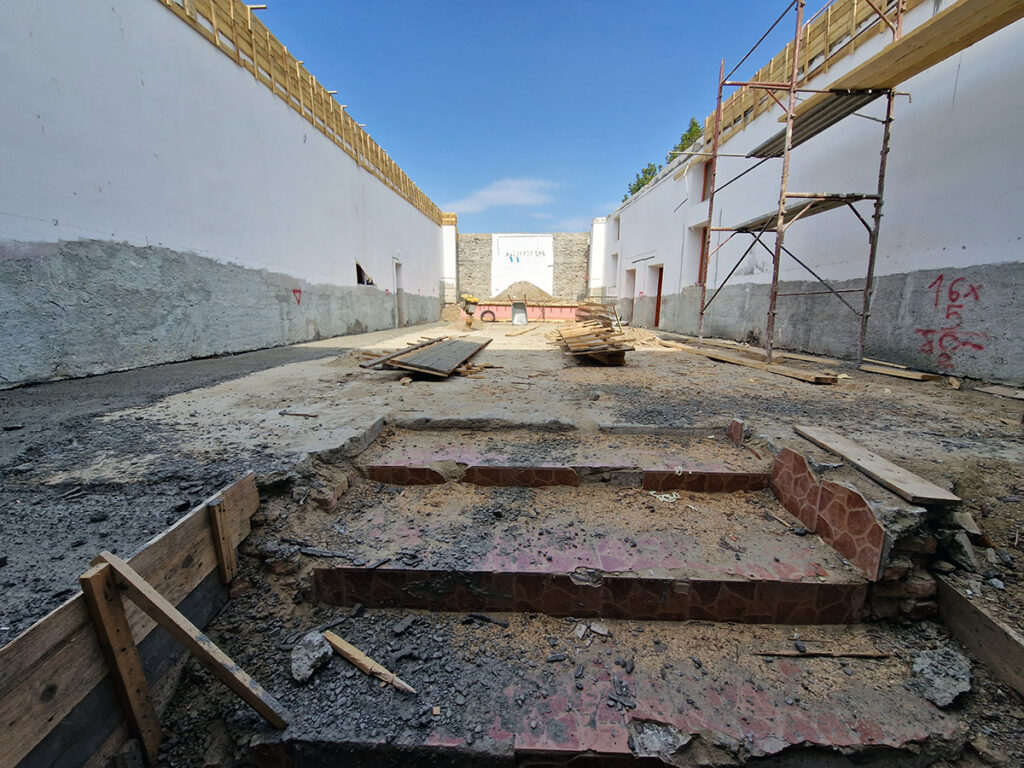
Two of them need further renovation, the one in Ceamurlia de Sus is far from being finished and the one in Caugagia is a ruin, although it should have been ready last year.
The company that won the tenders for the unfinished dormitories was supposed to renovate
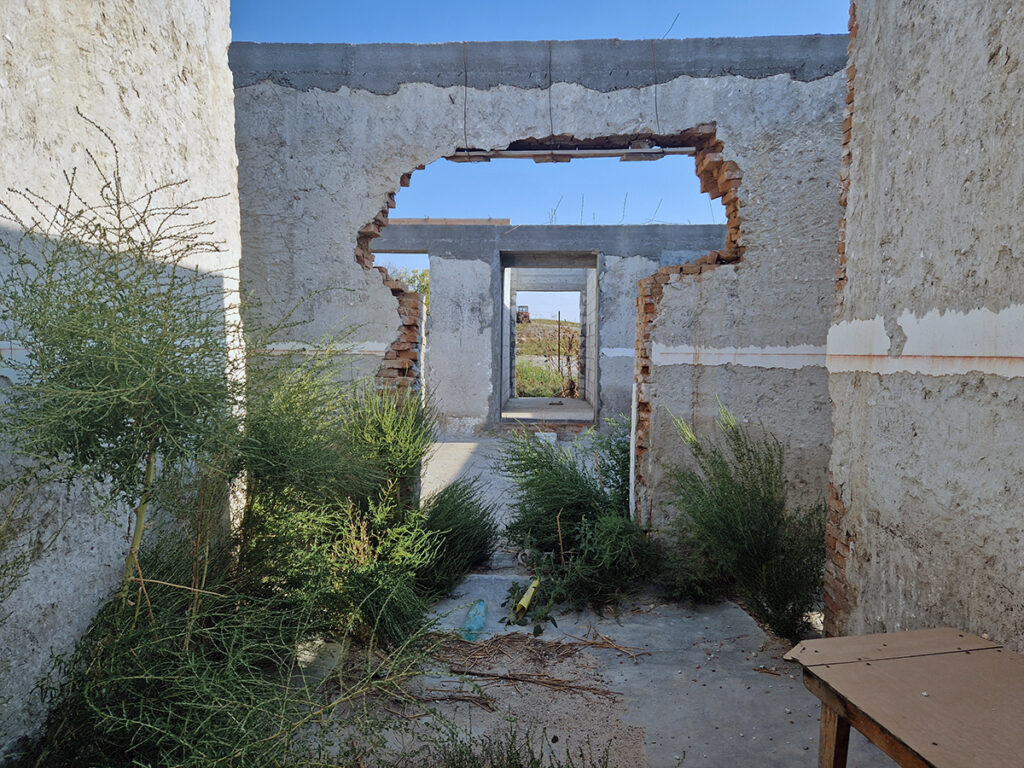
The company that won the tenders for the unfinished dormitories was supposed to renovate two buildings of 220 sq m and 550 sq m respectively in three years.
The workers we find on the roof of the Ceamurlia de Sus hostel tell us they’ve only been working for 2-3 weeks:
- „We don’t know when it will be done. It’s not up to us. We are just workers, how would we know this information? The roof should be finished by the beginning of the year. Nothing is done inside. We’ve been working here for two weeks, we don’t even know who took on the project. We don’t know and we don’t care which company it is. We’re a separate company. The man who took the project hired another contractor. I don’t think they have anything to do with the company we work for. It’s from a neighbouring municipality.” (The workers refuse to say what company they work for, editor’s note).
The company that won the tenders, Alexe`s Construct Armat, had 3 employees, losses of hundreds of thousands of lei in the previous year and debts to third parties of 4 million lei, according to the Ministry of Finance.
It managed, however, to win both contracts on European funds, one for 250,000 euros, the other for 373,000 euros, because the law allows it.
In the meantime, Alexe’s Construct Armat was left with only one employee, accumulated debts of over 7 million lei and financial losses of 864,000 lei in 2022.
The company is considered high commercial risk, according to termene.ro, has a payment capacity of 6,900 lei and is owned by two associates, Maria Alexe and Alexe Alexe, who have 7 other companies, either struck off, without activity or with losses of hundreds of thousands of lei and with only one employee each.
The houses waiting to be renovated don’t stand a chance in the next few years, admits Mayor Mugurel Marșavela (PSD), who says he hasn’t given up on the builder because he would have had to start the procedure from scratch and would have lost the European funds for both projects. This way, he may only lose one.
He complains that the law obliges him to choose firms according to the „lowest price” criterion. Otherwise, says the mayor, he would have chosen another company, which has worked in his village before and built a multi-purpose centre from scratch in just one year:
- „It should have been ready a year and a bit ago, and he still led us on, saying that he was doing it, that he was fixing it. In Constanța (in the county, editor’s note), he has another project, and it’s also abandoned (…) If this tendering system with SICAP (the public procurement platform, editor’s note)… I understand the need for transparency, but it sometimes puts you in some situations, sometimes you get one of them, you don’t even know who he is, what he’s like… He makes a low bid, abandons the work and so on (…) At Caugagia he didn’t submit any documents to me, he didn’t… I communicated extremely badly with him (with the builder n.ed.). It was already very late for me to give up the work, they didn’t know about the extension at the time, we’ll try to do a new procedure because it’s not like I’m gonna pay myself. But the procedure for resuming the works will take another year and a bit”, explained the mayor of Baia about the situation of the centers.
The mayor also blames the bureaucracy in Romanian institutions and the sudden increase in construction prices:
- „About the verification of projects, there was another trick to it. Do you know how it goes? If they find any problem, they don’t solve it on the spot, you get pushed back in line and you have to wait again (…). An obstacle was also the price spike, they doubled and many builders gave up. They said they’d rather lose the billion put up as a guarantee than lose 5 billion at the end of construction.”
A former employee of the company in charge of renovating the cultural centers told us, anonymously, that Alexe’s Construct Armat representatives hoped to receive the money from the EU first, through the municipalities, and only then to start the work. In the absence of funding, the construction sites have stalled.
The law requires companies that win tenders to carry out the work with their own money, then settle with the municipalities, which in turn get the project money from the EU, via the managing institutions.
Stelian Alexe, one of the partners in the „Alexe” chain of companies (ranging from restaurants to construction), which is controversial in the local media in Constanta, presented himself to ISE reporters as a representative of Alexe’s Construct Armat, the company that is supposed to renovate the centers in Baia.
Aggressive in his dialogue with reporters, Stelian Alexe says that the buildings are not yet renovated because of the accelerated rise in construction prices:
- „There’s no problem, work is being done on Ceamurlia, at Caugagia it is getting started. Work is being done at Caugagia (he gets very nervous, editor’s note). What am I gonna do, tell you on the phone why, how and what kind? Are you testing me on why the construction work is the way it is? The deadline has been extended, it’s 2025, and let me tell you why it’s being postponed. Because these works were budgeted with 2020 prices, yes, 2019-2020, for all materials, when the prices were 2 lei, and now they are 8 lei, right? That’s why we’ve had problems with the speed of completing these works. That’s why you can’t sleep at night because I didn’t complete the job at Ceamurlia? Go to Ceamurlia and see that I have 20 people working there (in the field, at the beginning of October, 3 people were working on the roof, editor’s note). Is this a subject of international, world-wide interest now, why I didn’t finish the cultural home in Caugagia (…). What does the work there look like? You’re annoying too, you’re recording me and that’s how we end up arguing”, was the reply of the builder Stelian Alexe.

The Jijila, Somova and Frecăței cases: When companies don’t show up to several consecutive tenders
In Somova and Frecăței, work on the construction of kindergartens has been postponed and in Jijila the renovation of the cultural center has been extended beyond the deadline, in all three cases because of consecutive cancellations of tenders.
In Jijila, it was because no firm had bid twice consecutively. It was only the third time that the municipality managed to award the work to a company.

In Frecăței the tenders were held but contested each time, so that the local administration failed to get the building up and running on time.
Marian Naiman, the mayor of Frecăței (PSD), explains that it is not the tender challenges that are the biggest problem in the implementation procedure, but the long deadlines granted by the management institutions for obtaining the approvals, documents and for approving the changes in the projects.
He says that municipalities should not receive penalties when they delay the implementation of a project if this is due to the managing institutions:
- „It should be a level playing field. If we get penalties for being late because of us, then we should not get penalties if we are late because of their delays, from the institutions,” Marian Naiman told Info Sud-Est.
The mayor of Jijila, Costică Deacu (PNL), says that only during the third tender two companies came up that were interested in renovating the center. He built a school from scratch faster than renovating a cultural center because the first job was more attractive to more financially able investors:
- „For a year we worked hard to get approvals. The work started this year and it’s being done (this year the work should already have been completed, editor’s note),” explains the mayor about the delays in renovating the dormitory.
The mayor says that financially sound firms find more convenient contracts elsewhere and renovating a cultural center is no longer attractive. Then, the mayor says, businesses sometimes run out of money during the implementation of projects because municipalities are late with payments because they too are slow in receiving money from the EU via the managing institutions:
- „If I delay payment on a job for 5 to 7 months, because they are in the circuit of a proceeding, the firms are decapitalised, they run out of money. And last year very few firms took any work because they saw the price spike (…). The company makes a request for payment, to settle on the money with us, we make a request to the ministry, the ministry gives us the money from the state budget and then they make a request to the EU to give them the money. That’s a lot of work, a lot of paperwork”.
The mayor also talks about the lack of AFIR employees in the South-East region, as all changes, however small, go through this institution:
- „In 2018-2019-2020 they didn’t have enough people in Constanta and they sent the files to Pitesti, Satu-Mare, where there wasn’t such a big load. Everything is endorsed by AFIR, everything, every move, design, structure, everything, everything requires their endorsement. I make a documentation, I send it to AFIR, which is very busy and it takes time to look and to endorse. It can take 15 days or a month (and three to five months, according to other mayors, ed note.), they may even ask for further clarifications”, explained Costică Deacu, the mayor of Jijila.
The Niculițel case: When firms subcontract. Where are the foremen, the painters, or workers of any type?
The cultural center in Niculițel was supposed to be renovated and modernised by this summer, but the work is far from being completed:
- „It’ll be ready next year,” says foreman Costel Corciovei, a representative of the subcontractor and the man coordinating the team working on site.

He says that in some cases the contracts are taken on by larger firms who then subcontract them:
- „It was taken by another company, it’s a big job (the modernisation of the dormitory, editor’s note), they didn’t manage to finish it. It will probably be finished next year. There are staffing problems, like everywhere else. You can’t find staff. We are a different company, we came as subcontractors.”
In his view, the biggest problem facing construction companies and the main reason for delays is the lack of manpower, from skilled to unskilled workers:
- „There is a problem in Romania, construction companies have no more foremen, no more engineers, no more schools for foremen. The Romanian education system has not produced any more master schools since the revolution. I wouldn’t like to say how I find my workforce. You have to advertise on Facebook to get a guy out of bed if you can.”
He says that people in the villages, the day labourers of yesteryear, are no longer encouraged to work on construction sites because the work is hard and rigorous:
- „There’s money to be made, but the problem also lies with the Romanian state. Too much welfare. There are a lot of physically fit people who don’t want to work. The help is there, they still go to work as diggers, they still go to the harvest, but they don’t stay on schedule. We’ve ended up bowing down to workers in order not to lose them. If I have a worker who is not good, who does not perform well, I sometimes have to close my eyes to avoid losing that worker. For the finishing touches, we have thought about whether to take on a foreign workforce or not. We’re also thinking about that solution.”
„It’s good that we can pay penalties and not give the money back” – president of the Tulcea County Sustainable Development Association, set up to attract EU money
Ion Eugen is the mayor of Jurilovca commune (PSD), president of the Tulcea branch of the Association of Communes and president of the Tulcea County Sustainable Development Association, a structure that comprises 34 territorial-administrative units and was set up to attract EU funds for the rural environment more efficiently.

The mayor explained to Info Sud-Est that Order No 15 of 2021 has improved the conditions under which commune town halls in particular can access European funds, in that they are no longer obliged to return the money or bear the expense from their own budget after the completion deadline stipulated in the contract has passed. Now, explains the mayor, mayors are obliged „only to pay penalties”, which are not much compared to what the loss of funding would mean:
- „It is now stipulated in the AFIR funding mechanism that if the deadlines set out in the project are exceeded the municipalities must pay penalties, but they are not large, they are somewhere around 1% of the value of the work remaining unexecuted at the time of the deadline in the project. They are not large compared to what it would mean to give the money back or bear the rest of the costs.”
Ion Eugen explained to Info Sud-Est how, in concrete terms, it takes 5, 6 or 7 years to renovate a building in a rural area and what are the main problems causing such long delays:
- „Regardless of whether it is European or national funds, the first problem of rural town halls is the lack of specialists because, as in all professional sectors, there are no specialists in town halls anymore. Some have retired, others have gone to the cities or abroad, and there are few or none left in rural areas.”
- „As mayors, we need to put more emphasis on improving the performance of the people in town halls. The expenditure you make on sending people to training courses is nothing when you talk about the budgetary impact and the benefits it can bring you afterwards. So if you have people, but they are not trained on procurement, you do nothing.”
- „At the same time, another problem is the imbalance of employees in public institutions: there are counties or regions that have submitted more projects, but the apparatus (AFIR, Environment Agency, other institutions that give approvals n.ed.), as it is designed in Bucharest, does not cope, because a region may have 5000 projects and another 3000, and you have employees according to the number of inhabitants and not projects”;
- „Another problem is when we find that the budget we made years ago no longer corresponds to reality, mainly because prices are rising so much. And this is precisely because of the delays caused by the above reasons. And then your work is no longer interesting for any builder and you repeat the tenders.”
- „And then eventually a firm comes to the tender, wins, but it’s usually a small firm, maybe they don’t have the capacity or they’re short of people or they can’t cope with other work they have. And so you end up with years of delays. But in the market you don’t even have enough firms for all the projects, especially as European funding starts at the same time.”
Contacted by Info Sud-Est, representatives of the Rural Investment Financing Agency (AFIR), part of the Ministry of Development, did not give a comment by the time this article was published.
Public procurement experts: „Mayors don’t monitor the investment, they wait for it to reach the deadline”/ „How relevant is an investment if you finish it after 6 years?”
Procurement expert Valeria Tudora, who has been a consultant for many years on projects run through AFIR, explained to Info Sud-Est why the agency’s deadlines are so long and how many specialists are working on projects with EU funds:
- „A group of two experts takes on a funding request and checks it and monitors it until the contract is signed, and another group of two experts takes over a signed contract, monitors it and does all the necessary procedures until the last payment request is signed. This means that two AFIR experts must have both technical and financial procurement knowledge, which is almost impossible for two people to cover such a wide range of issues. In previous years, the procedures were different, there were people specialized in procurement, financal, the technical side, etc.”
Valeria Tudora also points out that one of the big problems of investments with EU money are technical projects that are either incompletely designed and drafted, incorrectly done or both:
- „Contracting authorities tend to gloss over problems, not solve them, which leads to horrendous delays, additional costs and bottlenecks. Any contracting authority has the desire to sign as quickly as possible because at least on AFIR the funds are small, the interest is high, the submission sessions last very little, on the order of days or hours, in the case of agricultural roads it lasted 6 minutes, and then the mayors, they want to submit as soon as possible, to be on the list of submitted projects on the principle that „we’ll see how we solve it afterwards”. And the problems start to appear, on the technical side, because underestimation because the feasibility studies are done long before, etc. There are hardly any projects without problems on the technical documentation. I’ve seen projects that were missing entire parts of the necessary work.”
Valeria Tudora also gave the example of a project session in which two possible investments were submitted for financing, but it took 8 months from the moment the documentation was submitted until it was approved.
On the other hand, the procurement specialist explains why companies with only one employee or newly established can participate in tenders with European funds:
- „The law allows the registration of small companies because it starts from an absolutely healthy idea, to allow access to public procurement to newly established companies. If you set criteria for the selection of only bidders with similarly high experience then, practically, a newly established company would never again be able to enter the public procurement market. Entry is however conditioned by the law, it must be guaranteed by someone. A firm with two employees can participate in public procurement, but must prove that it has a third party supporter or an experienced operator participating as an associate. Theoretically, the entry of a new company should not be a problem. Practically, the third party does not intervene, because it only gave a paper stating it’s support, the associate is only an associate on paper, and the fault of the contracting authorities is that they do not monitor the project, but let them reach the deadline. They must be permanently monitored, and in the situation where the economic operator has not fulfilled the contract, we must see those negative certificates and clean up the SEAP, which is now mandatory”, said Valeria Tudora for Info Sud-Est.
On the other hand, Septimius Pârvu, an expert in good governance and electoral processes within the Expert Forum, which analyzes, among other things. political clientelism, told Info Sud-Est that one of the major problems in the implementation of projects with money from the state budget or from the EU is the large number of companies that have political connections. These, says Pârvu, receive contracts not for their ability to implement them, but because of the factor of support from the political sphere.
Septimius Pârvu also shows that during his documentation he found examples of purchases made 2-3 years after the signing of the contract:
- „Do you wonder how relevant that investment is after 6 years? For example, a building deteriorates if you leave it without a roof for so long, a road as well. An explanation would be that the purchases take a long time, for example I found purchases that were 2-3 years after the signing of the contract. Purchases take a long time, due to appeals or because there are no bidders. In some cases it may be the lack of capacity of the town hall, for example I found a commune with 10 projects to implement but very few people, how do you manage all that?”.
Septimius Pârvu also explained that it is more difficult for a city hall to terminate a contract than to conclude it, and that in many cases political support is also involved so that a company does not lose funding:
- „It is very difficult to terminate a contract, it is not as easy as it seems. It is much more difficult than ending it and then, often, if there is still political support, you have to finish it, because you receive instructions from the party leader (…) For the simplified procedures, the category most public procurements fall into, the terms are not so long (…) but you can have problems that no one comes to your procedures or that you receive dumping prices. We had found in our analyzes companies that give very bad prices and then ask for additional money. Of course, it’s hard to work with such companies (…) Sometimes the lack of competition (of companies, ed. n.) can be a problem. Some companies don’t want to participate anymore because of the settlements, because it happens very late”.
Another issue raised by Septimius Pârvu is the usefulness of projects after they are completed, but also the prioritization of investments. Last but not least, the projects financed from the state budget money should be complementary and not overlap with the projects budgeted by the EU, says Pârvu.
Instead of conclusions. The pattern of powerlessness
The pattern identified by ISE following discussions with mayors, builders, public procurement experts and following the study of projects that were subsequently documented in the field shows the following:
- The projects were submitted for financing, at AFIR, in the 2018-2019 period
- It took, on average, between 1 year and 1 and a half years from the time of submission of projects to the signing of contracts with the firms that won the tenders (contracts were signed in 2019-2020 or, in some cases, 2021);
- The municipalities have made a commitment to the EU (through AFIR) to finish the projects within 3 years from the moment of obtaining the funding (beginning of 2023 at the latest). The same three-year term was granted by the town halls to the builders. It is a mistake, claim the parties consulted by ISE, because by granting the same deadline for the completion of the works, the periods of appeals to tenders or the checks that the EU makes on the project are not taken into account, so it is one of the reasons why the town halls reach request project extensions and pay penalties;
- Any modification to the initial project, any change that occurs during the implementation of the investment, any deviation from the first commitment, even if it occurs for reasons that do not depend on the builder or the municipality, is reported to AFIR. That is precisely why a poorly done technical project means delays from the start;
- It takes from 5 days, in the most fortunate cases, to 5 months for AFIR to operate the changes, explain the mayors who see the bureaucracy and the long response times from the institutions as the main problem of the cumbersome implementation of investments with European money;
- It takes about three months to obtain approval for the feasibility study and another three months for approval of the technical design, the main pillars of starting any infrastructure investment. High caseload of files per employee in management institutions is the explanation. In some cases it takes between 5-8 months to obtain the approvals;
- When the investment implementation deadline expires (in the current case, 2023), town halls start asking for extensions, for which they pay penalties. It is much better than losing the funding, say the mayors in unison;
- Due to the long period of time from the moment of submitting the projects for financing to the actual start of the construction site, the probability of sudden changes in the social or economic context or the occurrence of unforeseen events or situations (eg: pandemic, war, economic crisis, rising prices etc ) also increases. The town halls have to take money from the local budgets in order to bear with the price differences between the amount initially provided in the budget and the new reality on the market, there are situations in which the town halls take out loans, wait for government aid or stagnate the started projects and other situations in which the builders „freeze” the construction sites due to lack liquidity, predictability or both;
- The lack of workers and foremen on construction sites and small firms without financial strength or efficient management, but which win the tenders because they put forward the lowest bids, are other explanations why, when we draw the line, we see that for the simple renovation of a 200 sq m building, in rural Romania, it takes at least 5 years. And it can easily reach even 7 years.
Ne bucurăm că ne citești!
Dacă vrei să ne și susții: