


A „prison” in Chilia has swallowed up almost 600,000 euros, 85% of which came from Norwegian funds and 15% from the Romanian state budget, and after the investment period it was abandoned, say locals and a former prison guard.
It is an experiment for more effective integration of prisoners, called by the authorities the „Delta Project”, which involved the construction of four houses made of reeds and mud on the island of Ostrovu Tataru, a village left without inhabitants, which belongs to the locality of Chilia Veche.
The Tulcea penitentiary says the Romanian state has not invested any more money after the Norwegian grant ended, but is contradicted by the Prison Administration and the Justice Ministry, which said „enough money” has been allocated and the project is still running.
In fact, the project’s website is no longer working either, and the information retained by the wayback machine shows that the page has not been accessible since September 2022. The Ivan Patzaichin Association, a partner in the project, has reported that the project has only been running during the period of the Norwegian grant, but the buildings „are being maintained”.

Reporters from Info Sud-Est and G4Media went to look for the „prison” on the island of Tulcea and found the houses deserted, with open doors, without guards or any tracks of inmantes. We returned to the site two months later and the situation was the same, as the locals and the guard told us, and different from how the authorities describe it in their official responses.
More than half a million euros for four mud and reed houses
We arrived in Chilia Veche around noon, after a 70-kilometre drive of almost 3 hours, an experiment in utopian patience that we wrote about here, in a heat like only the puddle knows.

Perhaps because of this, or perhaps because the drone fragments hadn’t yet fallen, people weren’t so talkative back then, not used to the press in the small, almost deserted town, not used to YouTube footage, so not used to cameras of any kind.
I was looking for them to tell me about the „prison without bars” or „place where inmates are almost free” on Tătaru Island, as the press called the Delta project in 2016 when the houses were completed.
A few more seasoned villagers knew about the project and told us it „stopped working a long time ago” and „closed down a few years ago.” They haven’t seen the inmates „tractor the ferry across” in years. And they sent us to a former guard of theirs.
In addition to the „prisoners’ ferry”, people today arrive on the island of Ostrovu Tătaru, which has been without inhabitants for over 10 years, with a platform pulled by hand by a man, an improvisation that can only be explained by the laws of physics themselves.
That’s how we got there, which is the only way if you don’t have a boat to take from Tulcea or another place along the Tataru river arm.
After arriving on the island we drove for about 20 minutes on a broken, agricultural road, swallowed up by weeds, then lined with wheat and sunflowers. It’s the main road into Ostrovu Tătaru, where no one lives anymore, but it has some of the most fertile land in the area. As far as the eye can see, the island is cultivated.
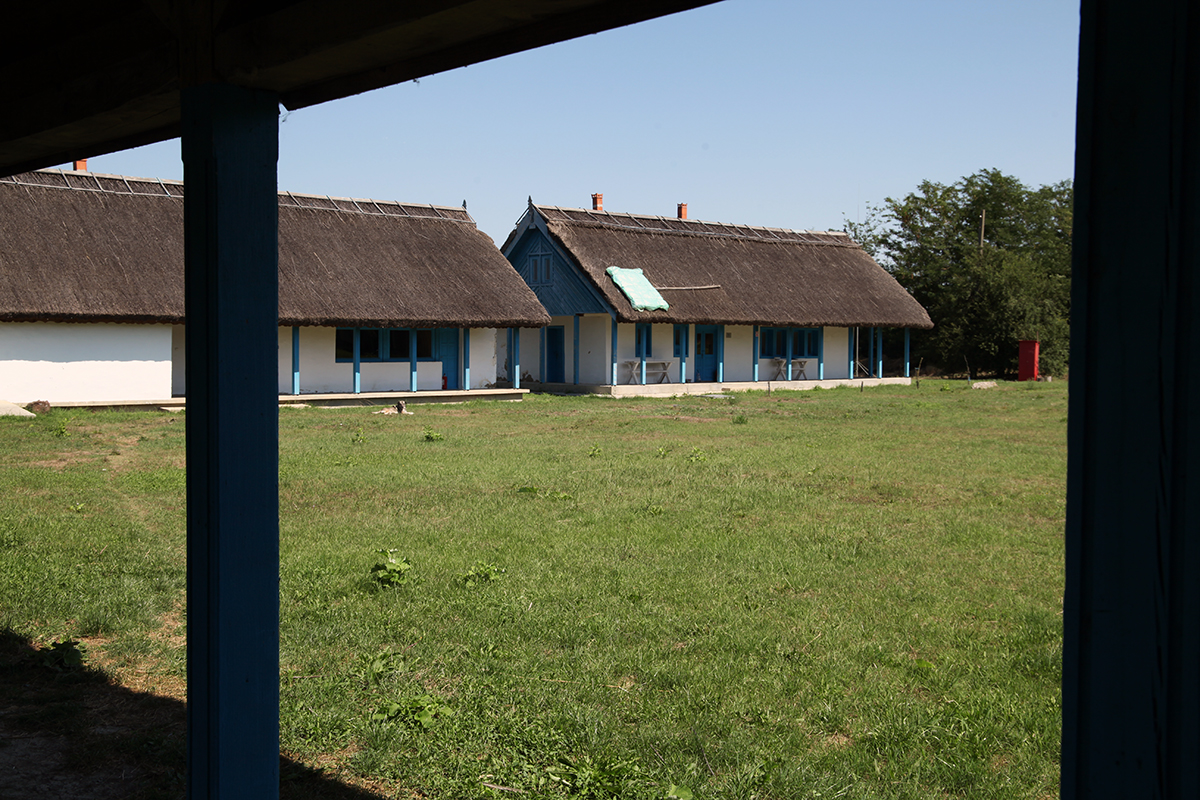
At the end of the road, towards the Tătaru arm, we came across four mud-brick houses built in the Lipovician style, in blue-white and cooled by the clay of the walls and thick, beaten reed roofs. Five dogs and a cat waited for us, torpid in the sun, in a wide courtyard and a silence that rang in your ears.
Authorities say the project is still running, but by the end of July the houses looked deserted. With open doors, no guard and no sign of an inmate, they kept things exactly as they were last time, we don’t know when: puppies made of what looks like plaster, sachets hanging from the ceiling and some animal shapes made of wood. The workbench was framed by thousands of cuts. Colourful paper garlands hung from the ceiling, and dust all around was a sign that no one had worked there for some time. Two months later, at the end of September, the situation was the same.
Tulcea Penitentiary: „The State has not invested after the Norwegian grant was completed”/ ANP and the Ministry of Justice intervened to „complete” the response
The houses have been built by the inmates starting in 2014. According to the project („Establishment of an ecological mechanism for social reintegration of prisoners”) inmates were not housed here, but came only during the day for work and post detention integration activities.
„During the implementation period of the project, on the Tătaru Grind, 115 inmates were qualified in areas such as construction, carpentry, eco-agriculture. During the period of sustainability and so far, in addition to the workshops and courses mentioned in point 3, activities for the development of skills for independent living and work-related activities have been carried out, in which 75 detainees have been included,” the National Administration of Penitentiaries sent to Info Sud-Est and G4Media.
Prisoners convicted of murder, rape, aggravated robbery, aggravated theft, drug trafficking, unlawful deprivation of liberty, outrage, cheating, pimping, driving without a license, driving a vehicle under the influence of alcohol have passed through Tătaru, according to Tulcea Penitentiary and ANP. They also say there are no recidivists among the inmates who were part of the Norwegian project.
But the Tulcea prison claims that the Romanian state has stopped investing in the Tătaru project after the implementation period ended:
„The state did not invest in the Tătaru Project (DELTA) after the Norwegian grant was completed,” reads a response to Info Sud-Est and G4Media. See the full response from Tulcea Penitentiary here.
The ANP has intervened following the response received from Tulcea Penitentiary to „complete the information from colleagues in Tulcea”. In its response, the ANP insists that the project continued after the Norwegian grant ended and gave examples of two other grants obtained from the Norwegian state for the reintegration of prisoners, subsequent to the Tătaru – Delta Project.See here the full PNA response.
In turn, the Ministry of Justice intervened with additional clarifications to the PNA’s response, stressing that the sustainability obligations of the project have been met for a minimum of 5 years after the grant was completed (i.e. 2017-2022).
„In accordance with the provisions of the grant contract, the PNA has undertaken to ensure the sustainability of the project by continuing to use it in accordance with the project objective indicated above, and by providing the necessary funds for its maintenance/upkeep for a period of at least 5 years after the end of the project. Following the monitoring process of the PNA’s fulfilment of the sustainability obligations, the Ministry of Justice concluded that they have been respected, continuing to carry out activities as a whole at the Tătaru Grind, with the aim of facilitating the social reintegration of detainees, while ensuring the necessary funds for its maintenance”, the Ministry of Justice informed Info Sud-Est and G4Media. See here the full response of the Ministry of Justice.
It should be noted that the project’s website will no longer be operational as of September 2022, when the minimum sustainability period set out in the Norwegian grant expires.
Representatives of the Ivan Patzaichin Association said that the project has been close to their hearts, but they do not know why it is still not working today:
„All we know is that the place is maintained, it is in the administration of the prison. The activities continued as long as they had the funds from outside (Norwegian, editor’s note), during which time they brought in trainers. I don’t know why they didn’t continue, but as far as I know, with the project some small changes in the regulations were necessary (…)”, Doru Frolu, vice-president of the Ivan Patzaichin Association, told Info Sud-Est.
The locals and the guard, a former employee of the Chilia section of the Tulcea Penitentiary, with whom we spoke, told us that the „prison” has not been working „for years”.
The guard remembers how the prisoners were put on a tractor and moved by ferry on the Tătaru arm: „They were free, yes, and at night we used to bring them back to Chilia (Tulcea penitentiary section, ed.)”.
The man told us that the prisoners were happy because they were free: „I used to go fishing with them, here, on the canal. And in the evening there was always a guard at Tătaru”.
About the Tataru – Delta Project
According to the authorities, the Tătaru-Delta project was intended to follow the Norwegian model of the Bastoy prison on the island of the same name, which has a lower recidivism rate and low maintenance costs, where inmates are released.
The project cost 580,320 euros, of which 85% was Norwegian state funding. The investment was carried out during 2014-2017 on the land on the Tătaru hill which belongs to the Chilia Veche outer section of the Tulcea Penitentiary.
It was implemented by the PNA, as lead beneficiary of the project, in partnership with the Norwegian Correctional Services in the Southern Region, Tulcea Penitentiary and the Association formed by the Ivan Patzaichin Association – Mile 23, as consortium leader, and its partner the Romano ButiQ Association. The project was funded through the Norwegian Financial Mechanism 2009-2014 („RO 23 – Correctional services, including non-custodial sanctions”).
Ne bucurăm că ne citești!
Dacă vrei să ne și susții: