

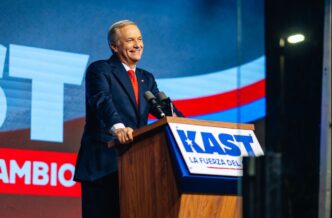

Chile’s presidential elections were won in mid-December by a candidate described by the international press as “ultra-conservative,” a term that doesn’t even half describe José Antonio Kast – a far-right politician who praises dictator Augusto Pinochet Ugarte and whose father, according to documents examined by journalists and confirmations obtained from German archives, was allegedly a member of the Nazi Party during the Second World War.
As absurd as this situation may seem, the truth is that Chile’s newly elected president is almost at home in today’s political landscape in Latin America, a continent where deep disappointment and an almost total lack of trust in traditional political structures, steadily rising crime, and the increasingly aggressive involvement of the United States under Donald Trump have created the perfect storm for the emergence of “tough guys” and the far-right politics that define them.
“Learn history”
In Chilean politics in recent years, it’s hard to find a president whose career hasn’t been marked by significant controversies. For instance, Sebastián Piñera, who served as president in 2010-2014 and 2018-2022. escaped, only posthumously, an investigation opened by authorities into suspicious dealings by his family, which were brought to public attention in the Pandora Papers scandal.
Likewise, in 2024, the administration of former president Gabriel Boric was shaken by two high-profile sexual-assault accusations: one against the president himself, the other against Interior Minister Manuel Monsalve, who was arrested last year for rape. Both accusations were immense blows to Boric, a left-wing president who had built his political identity, among other things, on support for the feminist movement and other social issues facing the country.
In any case, José Antonio Kast’s presidency is already beginning with a “scandal” that has smoldered for decades, but was brought to public attention relatively recently by a document more than 70 years old: a Nazi Party membership card bearing the name Michael Kast, the president-elect’s father—whom Chilean society had long suspected of having been part of Adolf Hitler’s party.
These suspicions surfaced from the very first moments when Kast began asserting himself on the national political stage as one of the most serious presidential contenders, and they led to a series of viral moments. The best-known was a tense exchange in 2018 on the Chilean TVN program Llegó tu hora, between José Antonio Kast and journalist Ignacio Franzani.
The discussion did not start with Nazism, however, but with the political movement Kast launched in 2016, Acción Republicana (Republican Action), and its extremist image. Franzani brought up a Kast supporter who appeared at one of the movement’s meetings wearing a shirt reading “Pinochet Helicopter Tours” – an obvious reference to Chilean dictator Augusto Pinochet Ugarte, infamous for murdering political dissidents in so-called “death flights,” which ended with victims being thrown from helicopters.
Franzani challenged Kast to “take responsibility for what your discourse generates,” then moved to Kast’s family history and asked him directly: “Who was Michael Kast?” More precisely, what is the story of the Nazi officer who came to Chile?
Kast dismissed from the outset the idea that his father had been a Nazi and insisted that, yes, he fought in the Second World War, but not all Germans who fought in that conflict were Nazis. He ended the exchange with a line that became famous in Chilean public life in the years that followed: “Learn history.”
In practice, Kast’s defense has since been based on the idea that his father, Michael Kast (1924–2014), was simply another young man involuntarily conscripted into the German army, whose life was overtaken by a military conflict in which he had, in fact, no choice.
That narrative was tested in 2021 during the presidential campaign in which Kast emerged as one of Gabriel Boric’s main rivals. At the time, the American news agency The Associated Press published an investigation that many observers believe destroyed any chance Kast had of becoming president that year. AP journalists obtained from German authorities confirmation of the authenticity of an ID card from the country’s Federal Archive that had initially leaked into the Chilean press and which shows that an 18-year-old named Michael Kast enrolled in the National Socialist German Workers’ Party (NSDAP) on September 1, 1942, during Hitler’s war against the Soviet Union.
Representatives of Germany’s Federal Archive could not directly confirm that the young Michael Kast in the document and the father of Chile’s current president-elect are one and the same, but they noted that the date and place of birth match exactly.
AP’s investigation quickly circulated through the international press because it directly contradicted Kast’s claims in recent years. As several historians consulted by AP explained, although the German army during the Second World War was primarily made up of conscripted soldiers, membership in the Nazi Party was never imposed on German soldiers, not even in the darkest days of the war. All in all, an 18-year-old newly enlisted in 1942 almost certainly could have joined the party only of his own initiative.
Faced with these accusations, Kast did not deny the authenticity of the document or the information published by AP, but continued to claim that his family “detests” Nazis.
- “Regardless of what a 50-year-old document says, my father, I, and our entire family detest Nazis,” was Kast’s first response to the press after AP’s investigation, The Irish Times notes.
The Kast family – the flight from Germany and collaboration with Pinochet’s regime
What is important to remember is that Franzani’s question did not come out of nowhere. AP’s 2021 investigation was not the first journalistic effort to address the Kast family’s links to the German Nazi Party. In 2014, Chilean journalist Javier Rebolledo published the volume A la sombra de los cuervos. Los cómplices civiles de la dictadura (In the Shadow of the Crows: The Civilian Accomplices of the Dictatorship), in which he wrote in detail about the story of the Kast family’s arrival in Chile in the early 1950s – based mainly on a memoir by Michael’s wife, Olga Rist, attributed to the author María Angélica Arteaga Lyon, titled Olga Rist: Misión de Amor.
In the biographical volume cited by Rebolledo, Kast’s wife recounts how he was persuaded to join the Nazi Party by a sergeant in the German army, how he fought on the Eastern Front, then in Italy near the end of the war, and how he managed to return to Bavaria—his native region—where he lived for a few more years after the war ended. Finally, Rebolledo writes, Kast left the country in 1950, as many other former Nazi Party members did in the years after the war.
- Note: After the Second World War, thousands of Nazi Party members fled Germany to evade criminal responsibility, and Latin America was one of their main destinations. Although some high-ranking Nazis were over the years captured by Israeli services or other groups dedicated to tracking Nazi fugitives after the war, many others remained until the end of their lives in the countries they reached—often without even needing to hide their identity, writes The Wiener Holocaust Library.
The “hidden history” of the Kast family thus became an infamous topic in Chile, but until 2021 there were no official documents that could confirm Michael Kast’s connection to the Nazi Party: the information published by Rebolledo in 2014 was based mainly on Olga’s testimony. She married Michael Kast in 1945, only after the war ended, and claimed her husband destroyed all documents linking him to the Nazi Party before leaving Germany—with the help of a judge who sympathized with him.
What is certain about Michael Kast is that, once in Chile, he managed to build a successful family business. According to the Chilean newspaper Interferencia, he began in agriculture, but by the late 1950s entered the meat industry: at first he produced only Bavarian-style sausages in Paine, a town south of the capital Santiago where he initially settled, but the Kast family’s products proved particularly popular on the local market. In the following decade they expanded the business and opened butcher shops in several cities across the country.
When Augusto Pinochet seized power in a coup on September 11, 1973, the Kast family was already well known and fairly influential south of Santiago, especially in Paine, a town that became the site of some of the regime’s most brutal actions, particularly in the turbulent period after the coup. According to locals’ testimonies and later press investigations, people in Paine suffered an extraordinarily high number of murders, executions, and disappearances during the dictatorship relative to the town’s population size, writes SWI Swissinfo.
In total, a 2017 study shows, around 70 residents of Paine lost their lives because of Pinochet’s regime: executed, killed in episodes of street violence incited by regime supporters, among whom were many members of the Kast family, or disappeared.
- Note: During the 17 years of Pinochet’s dictatorship, thousands of Chileans were kidnapped, tortured, and in many cases executed without trial or without families being informed of their fate. According to NPR, in 2023 the fate of more than a thousand people who disappeared between 1973 and 1990 was still unknown.
The Chilean media generally portrays all members of the family as “collaborators” of Pinochet’s regime, but the most notable is Miguel Kast Rist, Michael’s first son and José Antonio Kast’s older brother, a technocrat who came to hold several important leadership posts during the dictatorship. He was one of the architects of Pinochet’s economic project, the planning apparatus known as ODEPLAN (Oficina de Planificación Nacional).
In this regard, a 1975 ODEPLAN publication, Mapa de la Extrema Pobreza, mentions Miguel Kast as coordinator of certain state social programs, mainly intended to measure and find solutions for the country’s poorest populations.
From 1975 onward, Miguel continued to rise through the regime’s hierarchy as part of the “Chicago Boys,” a group of free-market economists who occupied many of the key posts in Pinochet’s government. Miguel himself served as Minister of Labor under Pinochet and then, during the economic crisis of the early 1980s, as president of the country’s Central Bank, The Wall Street Journal recalls.
José Antonio Kast: praise for dictatorship and far-right policies
Although Kast still publicly rejects any association with Nazi ideology, he has made no effort to distance himself from Pinochet’s legacy. In fact, his entire political career is defined by the praise and apologia he has offered for the dictator whose regime left behind tens of thousands of victims, people killed on Pinochet’s orders, still missing today, or tortured, writes the Center for Justice and Accountability.
In 1988, Kast—22 years old at the time—appeared in a campaign video that went viral again in Chile in 2018, in which he delivered messages supporting Pinochet’s regime in the context of that year’s national referendum to determine whether Pinochet would remain in power for another eight years. More than 55% of the country voted against the dictator, Encyclopedia Britannica recalls.
After Pinochet was removed from power, Kast spent the following decades first in local politics and then in parliament, as a member of Unión Demócrata Independiente (UDI), one of Chile’s largest right-wing parties.
His public turn toward the far right, and the moment he began attracting the attention of voters nationwide, came in 2016, when he left the UDI and launched his first campaign for the presidency, but he won just under 8% of the vote in the 2017 elections.
This was the moment when Kast began adopting the typical far-right discourse: from virulent opposition to abortion, same-sex marriage, and “gender ideology,” to calls for a “new right” to replace today’s political currents, which are in free fall, writes the Spanish newspaper El País.
During the campaign, Kast made no effort to hide his sympathy for Pinochet. On the contrary, he argued the dictator led the country better than many democratically elected leaders in recent decades, declared that he is the candidate with “the fewest hang-ups” about Pinochet, and that he “recognizes part of the work” done during the military dictatorship, writes the Chilean newspaper Emol.
In the years that followed, his pro-Pinochet rhetoric became increasingly aggressive: in 2018, for example, Kast said that in 1973 Chile “chose freedom” and that the people had risen up against a “Marxist revolution,” writes CNN Chile.
Eventually, Kast came to openly float the idea of pardoning some of the country’s biggest convicted criminals for crimes committed during the dictatorship, according to El País, and from 2021 began campaigning to dismantle Chile’s National Institute for Human Rights and to withdraw the country from the UN Human Rights Council.
Both proposals were included in his electoral program published for the 2021 campaign, alongside promises to fight “gender ideology,” promote traditional family values, and treat illegal immigration as a national-security issue, among many others.
Against the backdrop of this discourse, the Republican Party founded by Kast in 2020 became within just a few years one of Chile’s main political forces, and the 2021 revelations about his father’s origins proved only a temporary obstacle: Kast won over 58% of the vote in 2025, after a campaign in which opinion polls consistently placed him about 10 percentage points ahead of his main opponent, Jeannette Jara, who served as Labor Minister during Gabriel Boric’s term, DW notes.
The far right in Latin America
This victory may seem surprising less than five years after Kast lost to a left-wing candidate, but the reality is that Chile has simply joined a growing number of Latin American states that have swung sharply to the right in recent years, amid dissatisfaction with left-wing governments that in general have disappointed voters’ expectations and failed to manage some of the most important problems facing the continent.
As a Politico analysis shows, this wave of disappointment has brought major victories to authoritarian leaders and other right-wing and far-right politicians across the continent over the past year: Javier Milei in Argentina, Daniel Noboa in Ecuador, Rodrigo Paz in Bolivia are just a few examples.
In this context, it is no surprise that U.S. President Donald Trump praised Kast, calling him a “very good person,” and that U.S. Secretary Marco Rubio said talks had already begun about “expanding economic relations and stopping illegal migration,” or that American flags and “Make Chile Great Again” signs began appearing on the streets of Santiago shortly after Kast’s victory was announced.
In the first year of Donald Trump’s term, the White House has shown a particular affinity for “tough” leaders whose rhetoric resembles that of the American president. In recent months, for example, the U.S. sent Argentina tens of billions of dollars, but Donald Trump made clear in October that he would continue this economic aid only as long as Javier Milei remains president—and that month’s electoral victory by the right-wing leader is attributed largely to the support he enjoys from the White House, Encyclopedia Britannica writes.
In a similar case, the American president has become the most important ally of Nayib Bukele, El Salvador’s president known for the brutal campaign he has waged against organized crime in his country and the leading supporter in South America of Trump’s plan to deport undocumented immigrants from the U.S. to third countries without regard for their country of origin.
Meanwhile, the conflict between Trump and Venezuelan strongman Nicolás Maduro, one of the few remaining representatives of the “pink tide” of left-wing politics that until recently dominated Latin America, has led to an unprecedented increase in U.S. military presence in the Caribbean Sea, and the American president has already said he is “considering” even direct military action against Venezuela.
The fact that a politician long associated with downplaying Pinochet’s dictatorship has managed to win the presidency in Chile may seem unthinkable, and less than a decade ago it truly was, but the world has changed considerably in an extremely short time. It remains to be seen what the long-term effects of this shift will look like in a country where thousands of families still do not know what became of their fathers, grandfathers, and brothers in the prisons of the last “tough right-wing leader” who took power.
Ne bucurăm că ne citești!
Dacă vrei să ne și susții: