


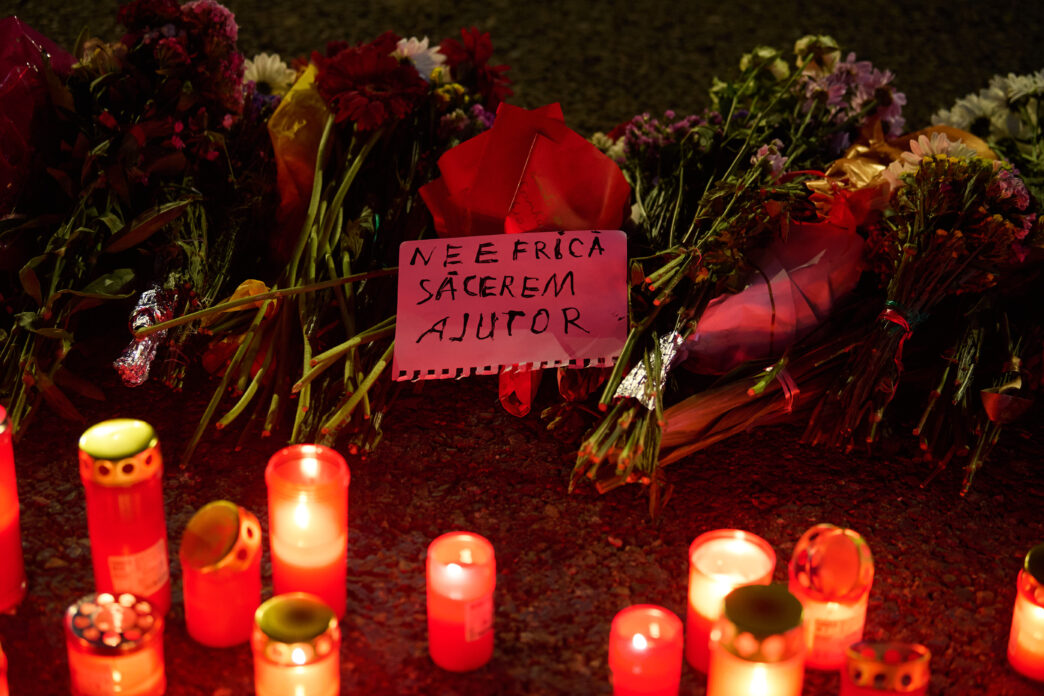
When you think of the most famous crimes in Romania, the cases of Elodia, Caracal, or, most recently, that of Teodora Marcu, most likely come to mind. The most well-known crimes in Romania have had women as victims. Why?
Why do we kill women?
These three crimes are just the most known examples where the safety of women is ignored by authorities.
I spoke with a renowned criminal profiler, with over 20 years of experience in homicides, who has investigated a wide range of femicides, but who chose to remain anonymous.

So, why do we kill women? What are the reasons why women are killed more often than men? And what is the pattern that most aggressors follow when committing femicide?
The criminal profiler says there is a branch of psychology, called victimology, which criminals follow when choosing their victims, who are most often women.

He explains that women are, unfortunately, more at risk of being victims, especially women who work at night, either at gas stations or shops, or who are alone on the street.
Another category of exposed victims are, according to the source, women who are subjected to physical and psychological violence in the family or in relationships.
The specialist also maintains that no woman is killed „by mistake,” as some aggressors declare. The cited source states that all criminals are aware of the moment they kill women.
He mentioned a femicide case that remained etched in his mind, that of a serial killer taxi driver from Bucharest, who killed several women in the 1990s, put them in suitcases, and threw them into Lacul Morii.
Zafer Sadîc, a criminal prosecutor and spokesperson for the Prosecutor’s Office attached to the Constanța Tribunal, also spoke for Info Sud-Est.
The prosecutor explains that women are killed more often with the same explanation as the previous specialist: women are among the most vulnerable categories of victims of violent crimes.
- „As a rule, the life partner is the most accessible for killers, due to proximity and the advantage of knowing the victim well. We can externalize our frustrations towards those closest to us, and this also happens due to convenience. Aggressors attack the victim they know best and believe that killing the woman next to them does not require much effort. Exacerbated jealousy was one of the common motives for killers of partners or former partners in my work as a criminal prosecutor,” the specialist declared.
Zafer Sadîc states that you cannot kill someone by mistake, especially if they are close to you. When the level of anger, usually generated by a strong emotion or a despicable feeling, such as jealousy or revenge for lost love, is too intense, then the partner loses control and acts uninhibitedly.
He also maintains that there are always signs of such a potential lethal manifestation before a murder, but some women have no choice, due to precarious material conditions and dependence on their partner. In some cases, many abuse victims end up suffering from Stockholm Syndrome, a psychological condition where the victim develops emotional attachment to the aggressor:
„Some women are too optimistic and hope until it’s too late, because hope dies last,” says the criminal prosecutor.
As for the most horrific femicide case the specialist encountered during his career, he recalls an extremely jealous husband who, without a valid reason, installed hidden microphones in the marital bedroom.
He was a truck driver, and once, when on the phone his wife seemed to behave unusually, he drove non-stop from Germany to Murfatlar, a locality in Constanța, where he hid under the bed in the bedroom, armed with a knife, and waited all night to surprise his partner cheating on him, but without results.
A few months after this episode, due to pathological jealousy, during a simple argument, when she refused to let her partner check her phone, the man killed her with over 40 knife blows, breaking the blades of three knives in the victim’s body.
How Romania „Defends” Women
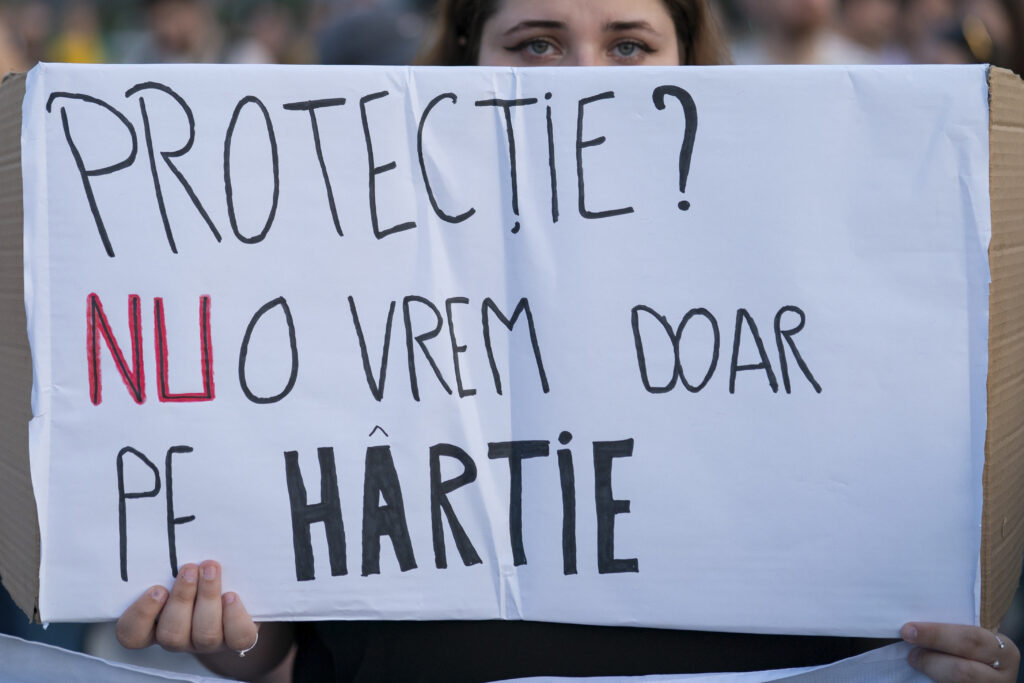
Over time, the Romanian state has tried to apply several initiatives that could have saved women who are victims of physical or psychological abuse in Romania. A well-known example would be electronic bracelets, intended to help authorities protect victims who have filed a protection order, by monitoring aggressors. This initiative, which could have saved women’s lives, did not survive long itself.
According to an article written by Scena9, in 2023, only 5% of protection orders were monitored through these bracelets, in the counties where this service was available.
The then Minister of Family, Gabriela Firea, declared in 2023 that 426 women had been killed in the last 8 years by partners or family members. Since the beginning of the year, 25 femicide cases (the deliberate and systematic killing of women, just because they are women) have been registered, as declared by former Minister of Justice, Alina Gorghiu, on Antena 3 CNN.
In 2024, authorities registered around 60,000 cases of domestic violence, 35% more than in 2019. And these are just the cases of abuse where the victim gathers the courage to ask for help. In the worst case, the woman ends up being killed.
Now let’s talk about some of the most famous crimes in Romania. In three of the bloodiest and most well-known cases of the last quarter-century in Romania, the victims were women, and before being killed, they were subjected to unimaginable abuse, according to authorities’ reports. These cases highlighted how violence against women can be practiced without fear due to shortcomings in the protection system and a lack of involvement from the authorities, as well as ineffective prevention and intervention.
The Elodia Case
Elodia Ghinescu was the wife of policeman Cristian Cioacă, from Pitești. In September 2007, Cristian Cioacă announced her disappearance, and two weeks later, investigators found blood-stained clothing items that allegedly belonged to her in a ravine in Râșnov, as explained by Digi24. Approximately a month later, investigators found Cioacă’s police uniform, along with other objects belonging to him and Elodia in another ravine in Râșnov, but Cioacă was left free because there was no body and not enough evidence for him to be detained, authorities claimed at the time.
In January 2008, Cristian Cioacă was arrested for allegedly accessing Elodia’s email address without authorization, but he was released after a few days. Although there were blood-stained clothes as evidence, it was not enough for authorities to detain Cioacă. The case stalled for 5 years, which attracted public attention during that period, and this further viralized the case at the time. Due to the years in which Elodia’s body was not found, hundreds of jokes circulated online on this topic.
Cristian Cioacă was arrested in 2012, after investigators searched, again, this time with specialized equipment, the house where the two lived, at which point they found blood traces on the wall and floor. Cioacă was sentenced to 8 years in prison and is the first case in post-December Romania where a person is convicted of murder even though the body was not found.
The authorities’ conclusions were that Elodia’s husband, Cristian Cioacă, killed her after a conflict between the two, at the end of the summer of 2007, and then he hid her body. The Elodia case remains to this day the most famous case of murder and domestic violence in Romania after 1990 and was investigated by prosecutor Marius Iacob.
The Caracal Crime Case
The Caracal case is one of the most tragic and defectively managed crime cases in Romania. In 2019, in Caracal, two teenagers, 15-year-old Alexandra Măceșanu and 18-year-old Luiza Melencu, were killed after being raped.
The perpetrator of the two murders is Gheorghe Dincă, who was sentenced to 30 years in prison and is currently incarcerated.
From the information gathered with the help of witnesses, surveillance cameras, and Dincă’s statements:
Luiza Melencu had hitchhiked to Caracal in April 2019, according to her family, but she never returned home. A few hours later, the family reported her disappearance to the police, and according to ProTv, the police allegedly dismissed the situation, explaining to Luiza’s grandfather that „the girl probably ran away from home with her boyfriend.”
While the authorities were searching for Luiza, the girl’s grandfather received a call in which a man informed him that the girl no longer wished to return home, being in Switzerland.
DIICOT Craiova declared that this case had indications of victim recruitment through kidnapping/coercion for sexual exploitation and ordered the initiation of criminal proceedings regarding the crime of human trafficking, but without results.
Alexandra Măceșanu was hitchhiking in front of her house in the summer of 2019 to prepare for high school, Europa Liberă reports. She was picked up by Gheorghe Dincă, and subsequently kidnapped, sequestered, beaten, raped, and then killed by him.
While Alexandra was still alive, she called 112 three times, explaining that she was being held captive and had been raped, detailing her location and what she saw outside the window. However, the police did not enter Gheorghe Dincă’s yard when they managed to locate the call; instead, they waited for the search warrant to be approved for the three possible locations, which happened the next day, when it was too late for Alexandra. She was already dead.
According to the chronology made by ProTV, the 112 dispatch tried to contact Alexandra 9 times after her calls, but there was no answer. The police searched Gheorghe Dincă’s house the next day, when their search warrant was approved, but found no evidence.
Alexandra’s parents allegedly received a phone call on the night of the crime from someone posing as the girl’s boyfriend, who stated that Luiza „is fine” and that they would be leaving for Belgium together.
The police searched Gheorghe Dincă’s home again, where they found ash, human remains, as well as clothes and jewelry. The killer claims the ash was from a fire he started to repel mosquitoes in the yard. Gheorghe Dincă is detained, and he admits to the acts committed against Luiza Melencu and Alexandra Măceșanu, for which he received 30 years in prison for qualified murder and human trafficking. Shortly after, it was discovered that an accomplice was also present, who received 12 years of detention for rape, according to Digi24.
The Teodora Marcu Case
Teodora Marcu is the 25th femicide case registered in 2025 and the case that drew attention to the safety of women in Romania due to the violent circumstances in which it occurred.
The 23-year-old woman, six months pregnant and with a three-year-old child in her arms, was walking on the streets of the Cosmopolis residential complex in Ilfov (Ștefăneștii de Jos), when she was killed. Ironically, the Cosmopolis neighborhood, where the young woman lived, was famous precisely for its strict security measures, which had made it attractive to many public figures.
Teodora was walking with her three-year-old child and other friends on the streets of the residential neighborhood, in broad daylight, when she was shot four times by Robert Lupu, the 49-year-old man who had been harassing and stalking Teodora since she was 14. The man shot her twice in the chest, then shot her in the stomach, from top to bottom, to ensure the child also died.
In 2021, Teodora Marcu, along with her husband, filed a complaint against Robert Lupu for harassment and threats, but the aggressor escaped prosecution. According to G4Media, the young woman applied for a protection order in 2021 against the aggressor in Bacău, and then moved to Bucharest.
Robert Lupu often posted passages from his diary on Facebook, where he frequently wrote disturbing messages about murder and violence, addressed to women. On the day of the crime, he posted a photo of himself with the caption „It’s just a matter of time.” The killer committed suicide shortly after killing Teodora Marcu, also in the Cosmopolis neighborhood.
This tragedy drew attention to the abuses women are subjected to and how authorities tend, for the most part, to minimize the gravity of the situation or discredit victims, leaving women who pluck up the courage to report the danger they are in to fend for themselves.
The incompetence, lack of interest, or misogyny of the authorities and an almost completely ineffective legislation regarding the prevention of gender violence discourage victims from coming forward with their experiences, and in the worst case, they end up being killed. Others, due to terror and pressure or the depression they fall into, commit suicide.
Following this crime, civil society mobilized online, and together with NGOs advocating for women’s safety, organized several protests in various cities in Romania, demanding the enforcement of laws and the protection of women. Over three thousand people were present at the demonstration organized by the Filia Center in Victory Square in the capital.
The safety of Romanian women in several words
PressOne reported exclusively last spring that every week, a woman is killed in Romania. The newsroom did not easily obtain this data because, to make this statement possible, they had to use statistical data on violence against women and gender-based violence obtained from the Ministry of Justice, the General Inspectorate of Romanian Police, and all county police inspectorates.
However, the county police inspectorates initially did not communicate data on violence against women and gender-based violence, which violated one of the provisions of the Istanbul Convention. 33 non-governmental organizations sent an open letter to the Minister of Interior in March 2024, complaining about the lack of communication of data on violence against women and gender-based violence.
The Istanbul Convention, formally „The Council of Europe Convention on preventing and combating violence against women and domestic violence,” is an international treaty adopted by the Council of Europe (CoE) in Istanbul, on May 11, 2011, as stated on the CoE website.
The Convention aims to protect women from all forms of violence, punish aggressors, and protect victims. This regulation represents the first international legal instrument that establishes binding standards for preventing and combating these forms of violence against women.
Romania signed the Convention in 2014 and ratified it in 2016, which brought the obligation to put its provisions into practice. However, Romania is still not keeping pace with other countries under the wing of this Convention, as reported by PressOne. According to the cited source, Romania still lacks a functional strategy, which highlights the lack of collaboration between institutions and clear working methodologies that can help prevent and combat domestic violence.
Ne bucurăm că ne citești!
Dacă vrei să ne și susții: