

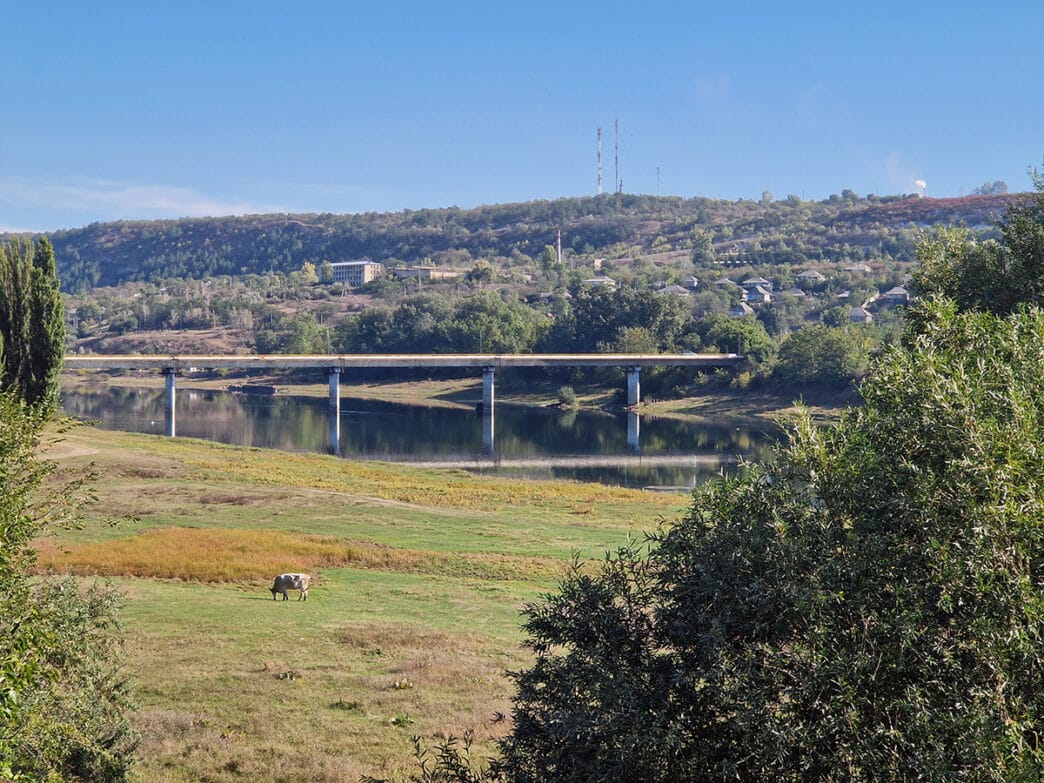
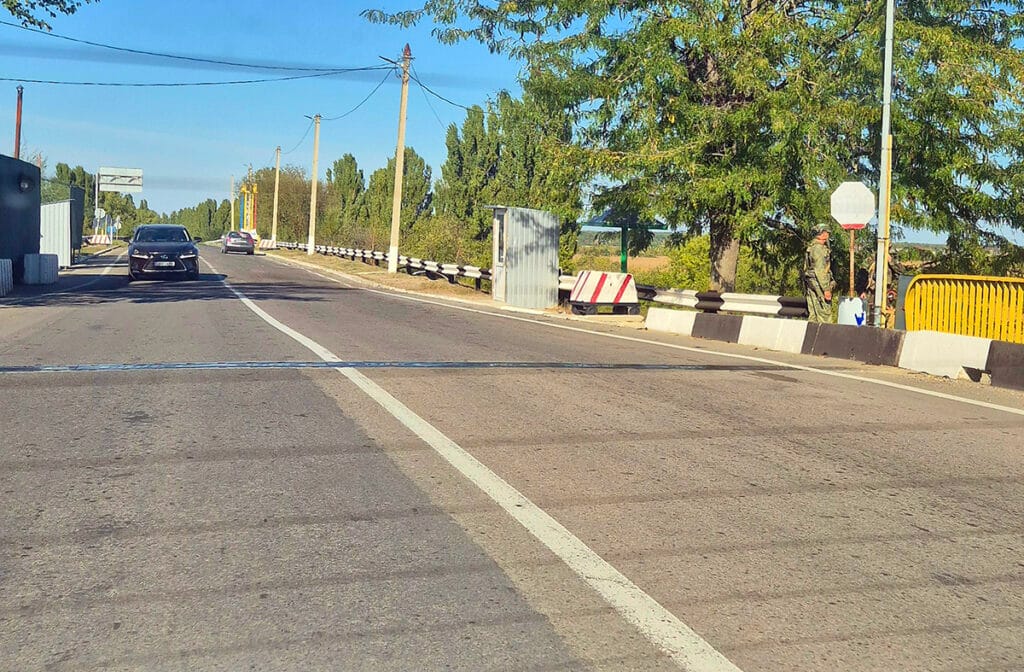
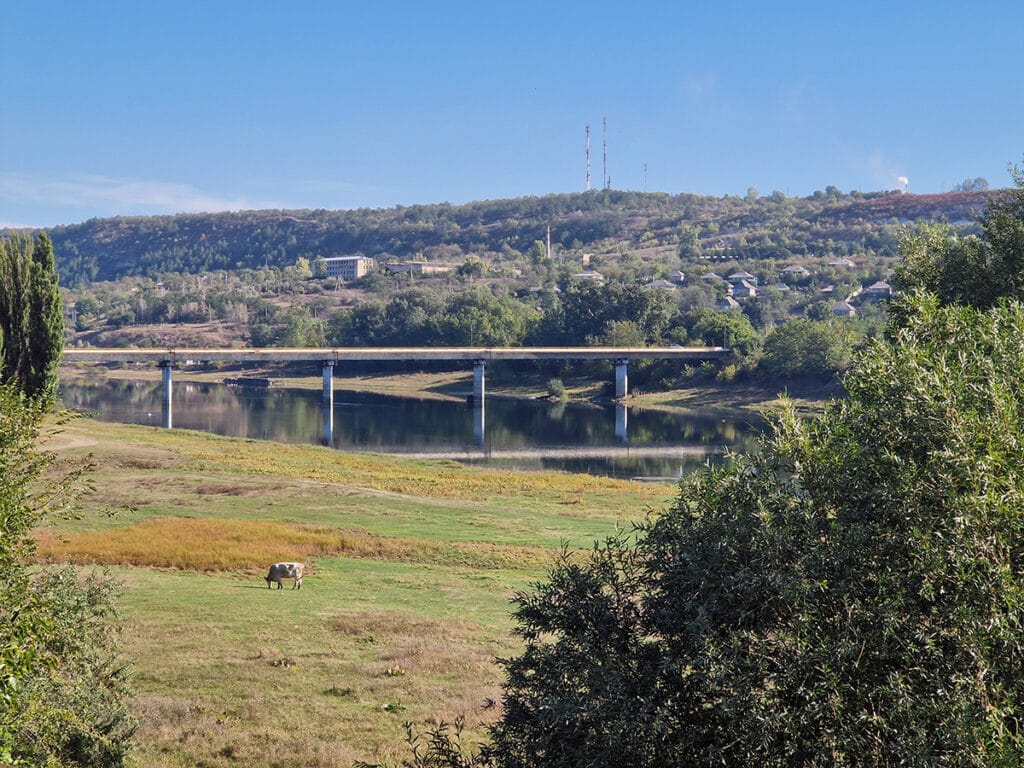
I crossed the Dniester sometime after lunch, through a “trilateral” checkpoint – meaning it wasn’t only guarded by Russian and Moldovan troops, but also by Transnistrian ones.
From the clamor rattling the small, old Ford we had been driving for hours from the north, through the villages along the border with Transnistria, silence suddenly fell inside the car.
All the “peacekeepers” were waiting for us on the bridge, bulked up in bulletproof vests and helmets twice the size of their heads, rifles slung from chest to feet, and tanks flying the Russian flag. No one spoke again until we met the first locals.
The fate and the “bends” of the Dniester
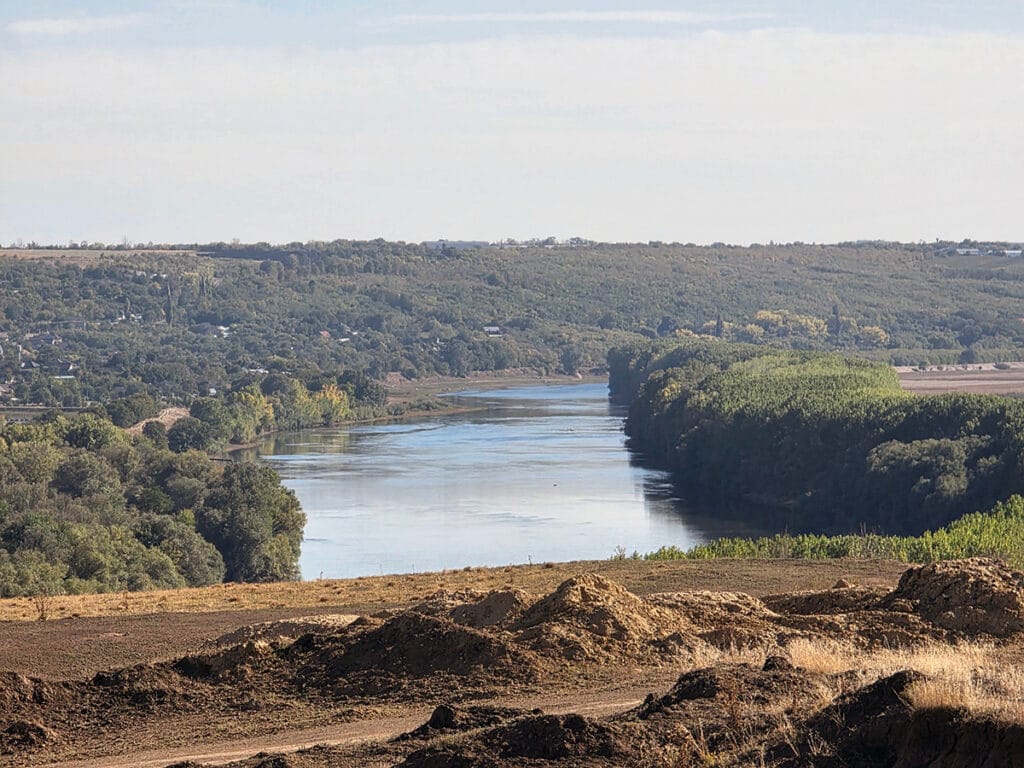
I had entered a “bend” inhabited by Moldovans, a bend the Dniester carved at a moment of rebellion, when it turned right instead of flowing straight ahead. In this bend shaped by fate, despite forced Russification, Moldovans have continued to be an overwhelming majority.

That is why, after the fall of the USSR and the proclamation of the Republic of Moldova’s independence, the communist leaders Boris Yeltsin and Mircea Snegur decided to establish a so-called security zone — a kind of shield between Transnistrians and Moldovans who were slaughtering each other along the Dniester.
This is how the Russian “peacekeepers,” the Unified Control Commission (UCC), the Military Peacekeeping Format (MPF), and other satellite terms that speak of peace around the conflict in the region appeared.
In reality, beyond the security zone established in 1992, there have continued to exist several “problem villages” where tensions pulse without interruption. Or, as a local would say, here the neighbors quarrel and it’s not pretty.
The tension doesn’t disappear in these communities because, although territorially they are on the left bank of the Dniester — that is, in Transnistria — the villages here are controlled by the government in Chișinău and administratively belong to the Republic of Moldova.
But what is Transnistria, and how did it come about?
Russian blackmail and the sheriff’s loan
Transnistria was carved onto the map by the Soviets as a form of blackmail against Romania, after Bessarabia – which had belonged to the Russian Empire starting in 1812 – was integrated into Romania’s borders in 1918.
Stalin established the Moldavian Autonomous Soviet Socialist Republic — what we now call Transnistria – on October 12, 1924, and since then the Kremlin has used the strip between Moldova and Ukraine as a tool of blackmail against Chișinău, Kyiv, the EU, and NATO.
In 2022, there were 1,600 Russian troops illegally stationed in Transnistria, guarding the huge stockpiles of weapons and ammunition left from the Soviet era. The pro-Russian enclave also has its own army, made up of about 5,000 soldiers, police officers, and secret service agents.
Transnistria cannot be economically independent; it depends entirely on external financial aid. This became clearest during the gas crisis of January 2025, when the region was left without heating after Russia cut off supplies in the midst of a conflict with Chișinău.
At that time, the international media spoke of the risk of a “humanitarian catastrophe,” and a Deutsche Welle Moldova analysis predicted in August the “collapse of Transnistria,” against the backdrop of a massive decline – more than tenfold – in the region’s exports to Russia.
No later than last year, the separatist leader in Tiraspol, Vadim Krasnoselsky, threatened a “world war” if the Republic of Moldova tried to reintegrate Transnistria.
A world war sparked by a separatist leader whose capital, Tiraspol, was saved in critical moments of 2025 with money from the oligarch Victor Gușan, who effectively controls the entire strip through the Sheriff commercial chain and who provided the authorities with a “charitable aid” pack of $1.8 million.
That came after the same sheriff had proposed in 2016 an interest-free loan of $26 million to pay the debts that Tiraspol’s authorities owed to Transnistrian public employees.
But you cannot truly understand how complicated the situation is there until you travel along the border yourself and try to remain in Moldova without accidentally crossing into Russian territory.
Along the border, on the Moldovan bank
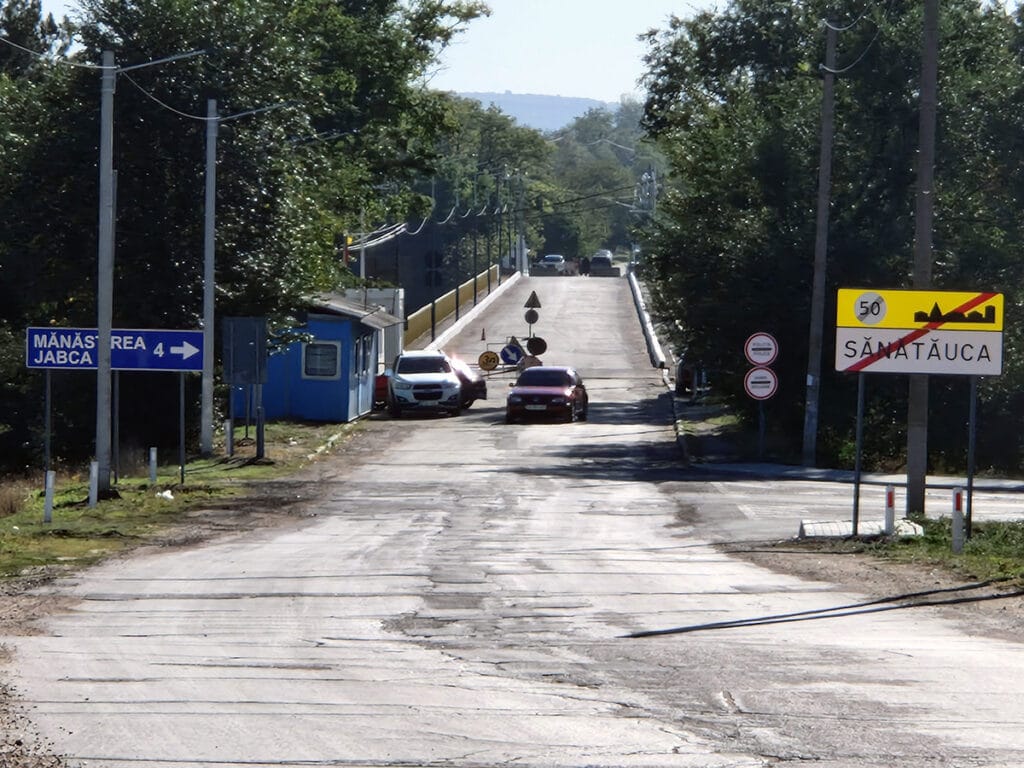
We set out from Sănătăuca, near the northernmost village on the border, which legend says was named after a group of plague victims who fled there and were miraculously healed.
Today it has around 2,000 inhabitants, and the number keeps falling as young people pack their bags, take Romanian citizenship, and settle in the EU. It’s no wonder that people here turn their backs on the Dniester and look the other way.
“What good ever came from the Russians?” a 71-year-old local asked us.
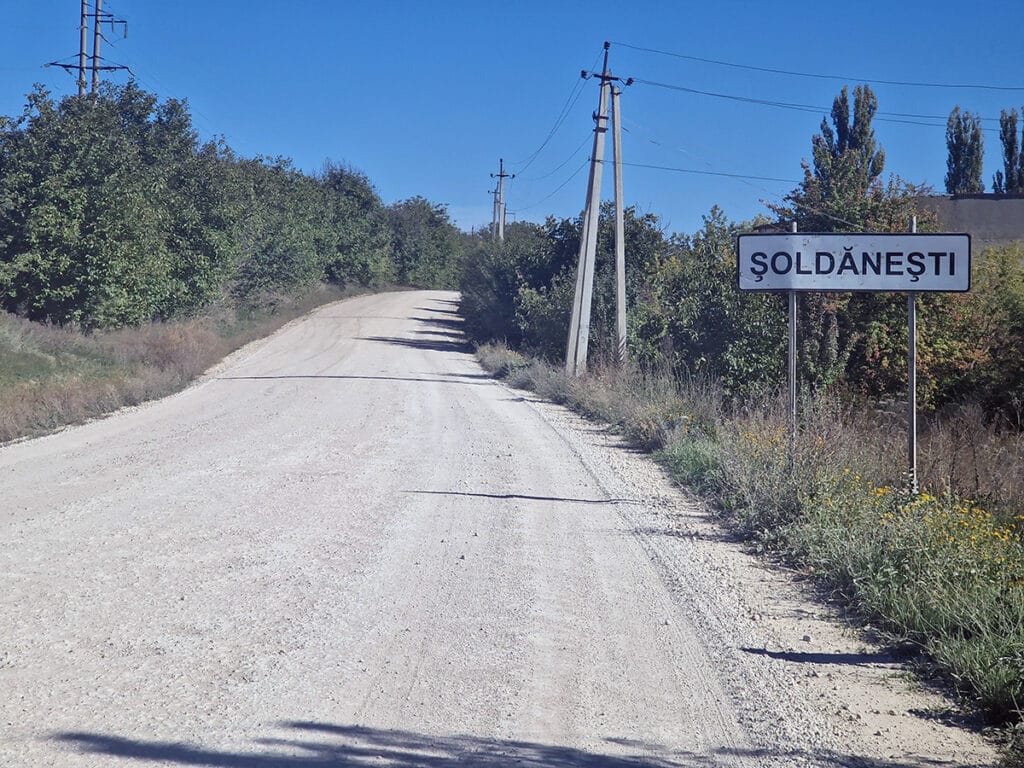
With that question – for which I didn’t search an answer and he didn’t expect one – we descended toward the first town on the road, Șoldănești, named after a boyar from an old family, said to date back to the very founding of Moldavia.
In the interwar period, a tobacco fermentation factory was established here; it reached its peak in the final years of communism, only to follow the path of all the other factories afterwards – straight into scrap metal.
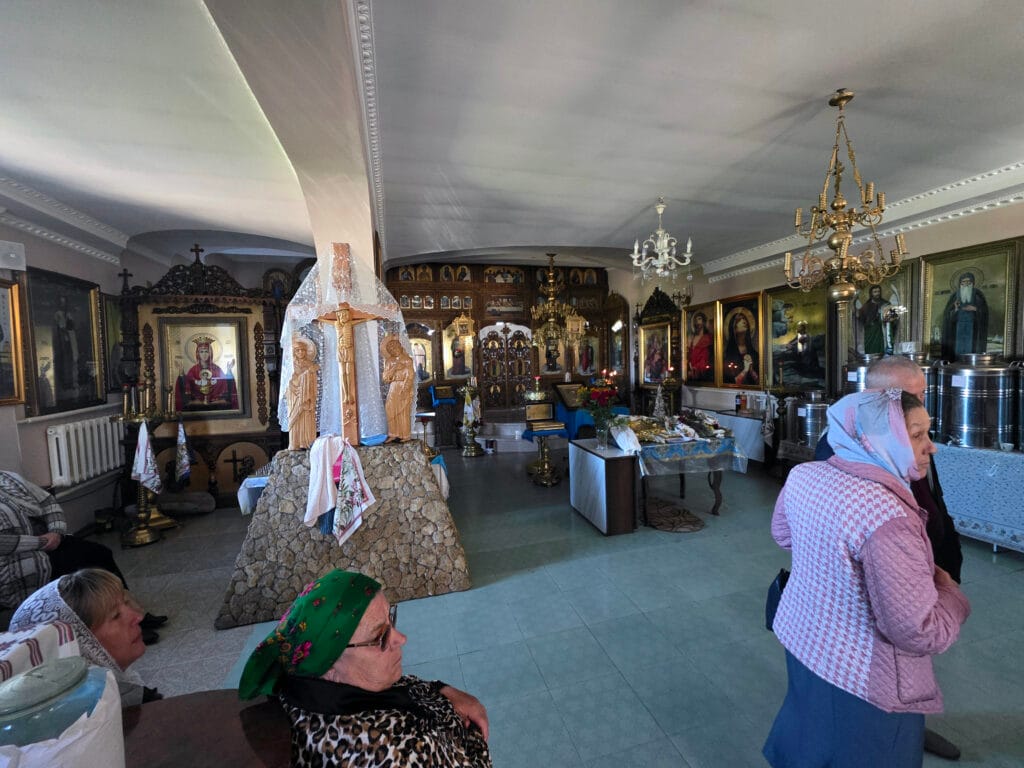
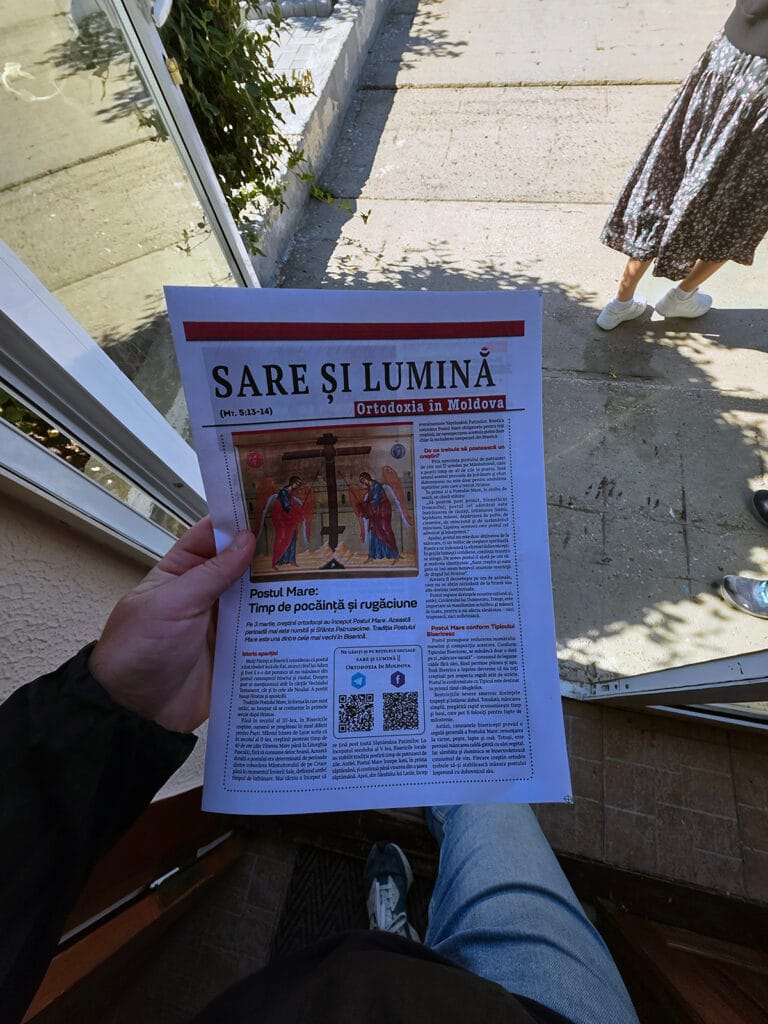
In a church in Șoldănești, I met people brought in by taxi from Transnistria seeking “healing” from the local “gifted” priests: people in wheelchairs, with disabilities, or with visible suffering, entering the church as if it were a sanatorium. Women bustled about hurriedly, crossing themselves all the way down to the asphalt, all in skirts and with their heads wrapped in scarves.
They were all worshipping the Russian god, for their priest recognizes only the Russian Church and spreads Kremlin propaganda through the pamphlet Salt and Light, linked to the fugitive Ilan Șor, which massively fueled anti-Western and anti-EU fake news during Moldova’s parliamentary election campaign.
One such fake story claimed that teachers were “encouraged to promote sex changes in children” and to give gender lessons from the first grades onward – something vehemently denied by Moldova’s Ministry of Education.
It was impossible not to think of our own Teodosie, the head of Russian propaganda back home in Dobrogea, who considers Putin a patriot and a holy founder of churches.
And of corpses.
Thinking about the Russians, we arrived in Rezina, one of the most populated towns on the border with Transnistria, with about 11,000 inhabitants.
From the north down to here, the communities are poor, but the influence of European money can be felt in the streets, in rehabilitated schools, and in people’s reactions when we ask them to choose between Russia and the EU.
“Europe, we want things better, not worse,” was the short, unpretentious explanation of a woman in her forties.
Waze doesn’t know geopolitics
By now we had nearly four hours of driving and another two on foot through the villages. We were starting to get tired, so we began to talk. Loudly. Over each other. The conversations in the car began to sound like lunch in a Greek family and, just a few kilometers later, like lunch in a large Italian family.
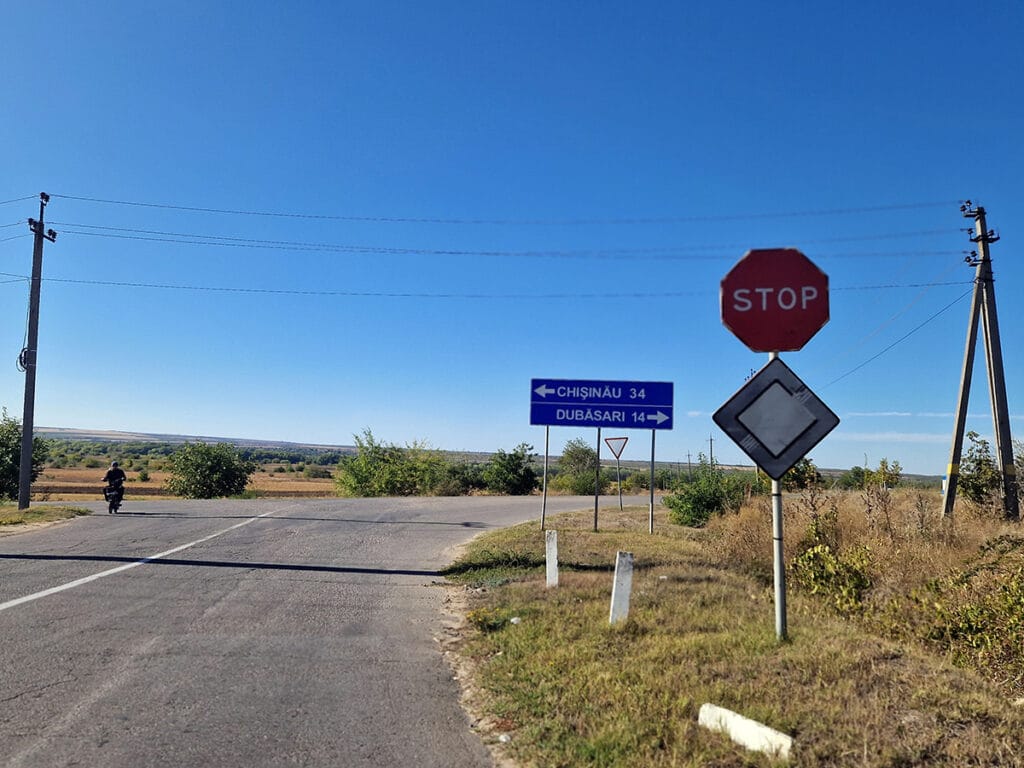
That was the moment when, almost without realizing it, we nearly drove straight into a checkpoint, and the only thing that stopped us was the rifle of one of the soldiers. It was enough just to see it for us to open our eyes to the signs perched on the poles. We were about to enter Rîbnița, one of the largest Transnistrian cities on the border, the counterpart to Moldova’s Rezina.
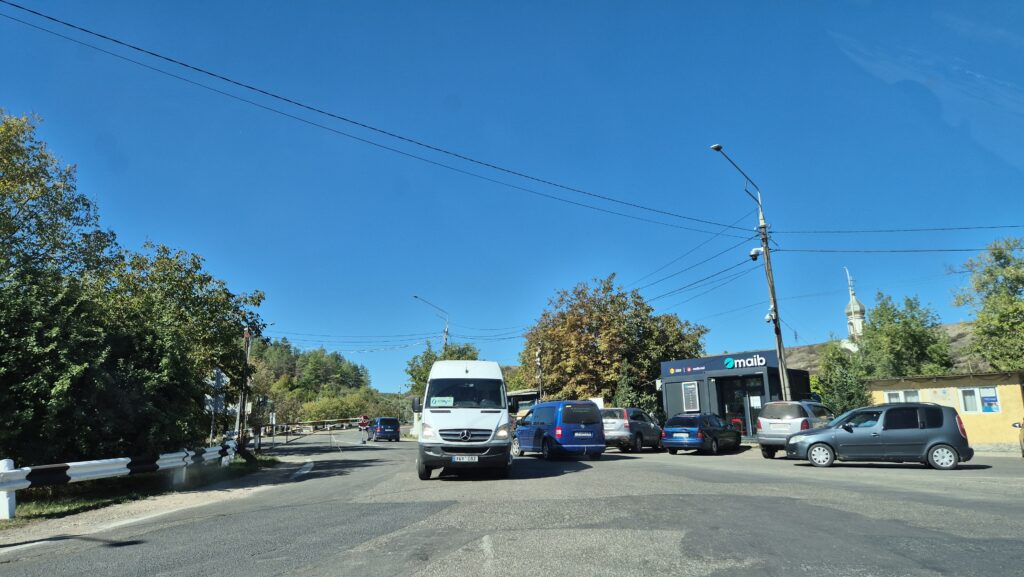
My colleague who was driving didn’t join in the shouting of the Italian-style lunch; he was paying attention to the app’s directions. But, what do you know — Waze doesn’t know geopolitics. It hasn’t heard of the Unified Control Commission or of the “peacekeepers”; it only knew the shortest route.
And, just like in life, sometimes the shortest route takes you through terror.
When luck and water were divided
It was after lunch when we reached Vadul lui Vodă, near Chișinău, where legend says that Stephen the Great once laid out a huge, rich feast and threw a celebration after a victory over the Tatars on the banks of the Dniester. Hence the name, “the ruler’s ford.”
Here is one of the trilateral checkpoints, where Russian, Moldovan, and Transnistrian soldiers wait to ferry you across the Dniester Styx.
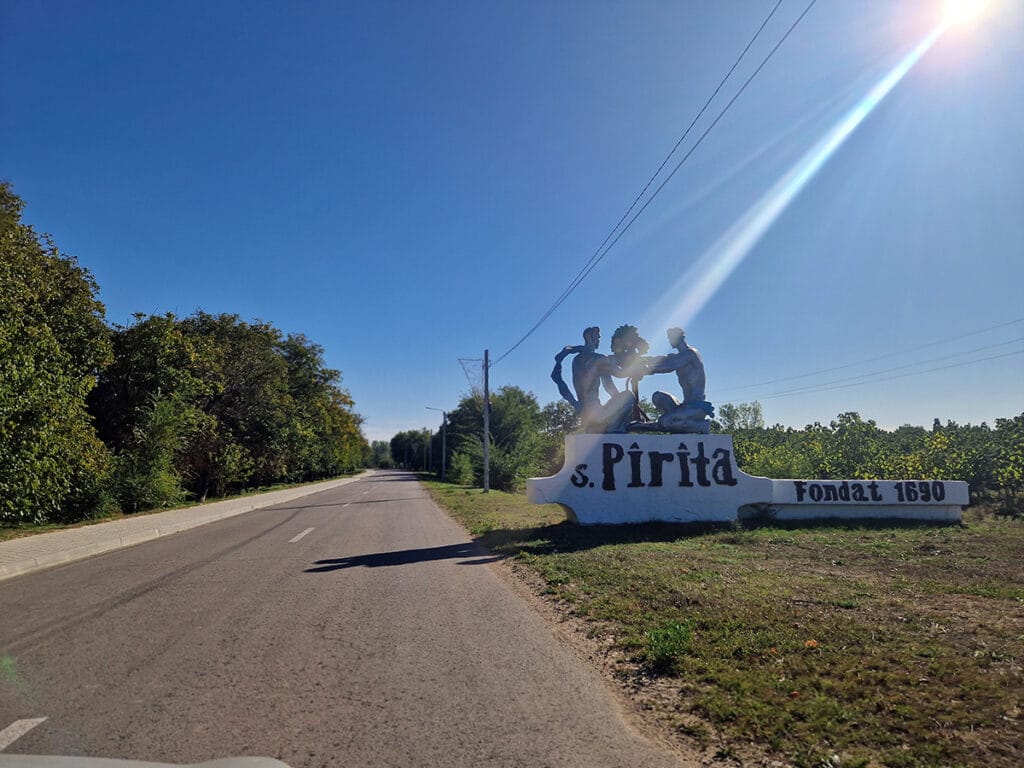
The press reported in 2012 how a Russian soldier at this checkpoint killed a young man from the village of Pîrîta – the first village you encounter after crossing the Dniester into the security zone – for allegedly failing to stop at the soldier’s signals. It was also here that a group of Transnistrian “peacekeepers” installed a barrier without the agreement of the Unified Control Commission, but the barrier was torn down by local villagers.
One of the roads leading from this checkpoint goes into a Moldovan “enclave,” like a string of communes where the Russians failed to impose their control, and the locals in this bend of the Dniester remained under Chișinău’s authority.
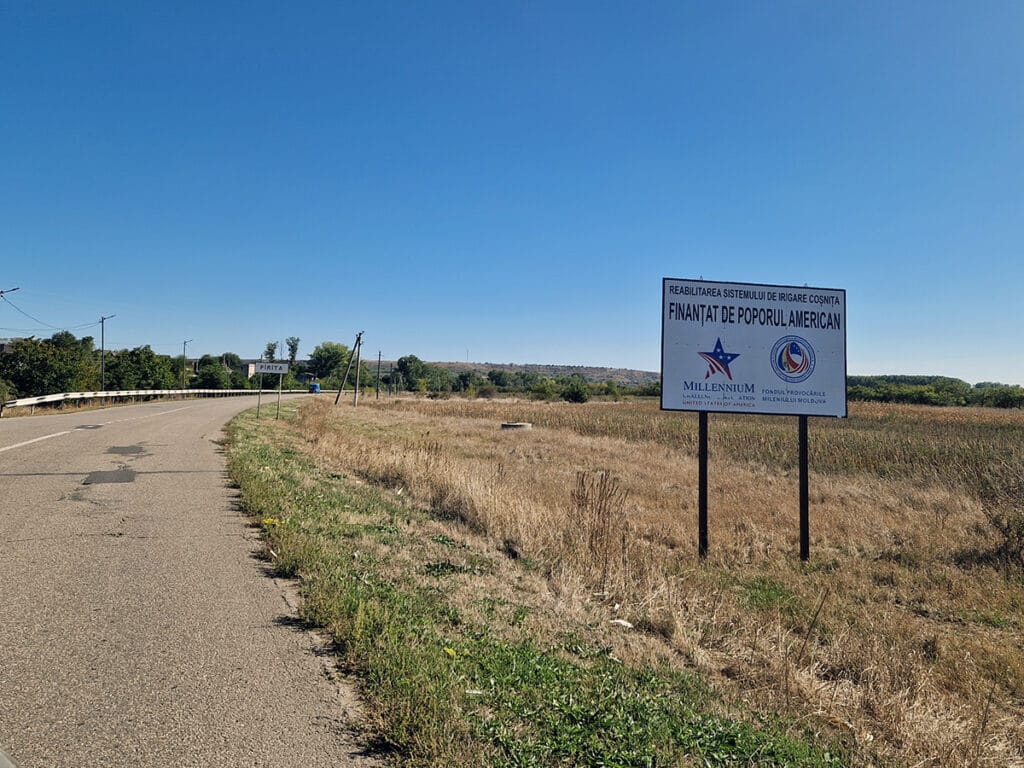
For example, the first message you see after passing the Russian machine guns and tanks on the bridge is a sign thanking the “American people”: “Rehabilitation of the Coșnița irrigation system, financed by the American people,” reads a huge billboard near the entrance to Pîrîta.
But it is precisely this broken puzzle that explains why in these villages the tensions never truly end, and why the conflict is not frozen but simmering, and often flaring up, because of places that seem crookedly laid out.
In this area, Carbon (2022) was filmed, a story about two young men who want to enlist and fight in the battles along the Dniester in the 1990s. It was Moldova’s submission for the Best International Feature Oscar. It wasn’t selected, but it became the most-watched Moldovan film ever, even more watched by Moldovans than Avatar.
Coșnița, the commune mentioned in the locals’ message of thanks to the Americans, comes right after Pîrîta. And here too, “decadent Western” money has flowed in: Pohrebea, one of Coșnița’s villages, has rapidly developed in recent years with Swiss funding. With a total budget of 5 million dollars for projects, locals and Moldovans who had emigrated opened restaurants and guesthouses and developed the village on the banks of the Dniester, in partnership with public authorities and private actors.
Even so, Moldovans from the villages across the Dniester remain wary of money coming from abroad. Their children are more likely to stay in the country, and they themselves are Euroskeptical, at least until their pensions reach EU levels.
Many are nostalgic for the USSR. They say that while money was scarcer back then, life was “better from a human point of view,” because everyone was equal, no one richer, no one poorer, and “nobody humiliated anyone.”
They claim to get along “very well” with their Transnistrian neighbors, with no conflicts, blaming politicians for the situation. They describe themselves as neutral, not with the EU, nor with Russia, just wanting a better life.
They are much less friendly toward cameras. They don’t want to be seen or recorded, and only start opening up once you put your equipment away.
Then they explain how it’s not so easy having Russians on their doorstep, but they have no choice, because they are patriots and won’t abandon their land. They need EU money, they’d like to live like in the West, but they don’t want strife with their neighbors.
Still, they say they would drive the Transnistrians out if they could, because that strip “they want to call a country” has disrupted their peace and routine.
Just days before the parliamentary elections, Chișinău authorities decided to move the polling stations from here to the Moldovan bank of the Dniester, citing bomb threats and provocations.
Meanwhile, Russia fueled a cult of fear and hatred with coordinated fake news spread on Telegram, including claims aimed at Romania, alleging that it would intervene militarily in Transnistria after election day.
“If I tell you everything I know, they’ll shoot me”
All in all, geography itself isn’t straightforward in all Moldovan communes across the Dniester, and this is another reason for the strained relations between the Moldovans there and the Transnistrians.
For example, Molovata Nouă belongs administratively to the Republic of Moldova, but its village Roghi falls under Transnistrian administration.
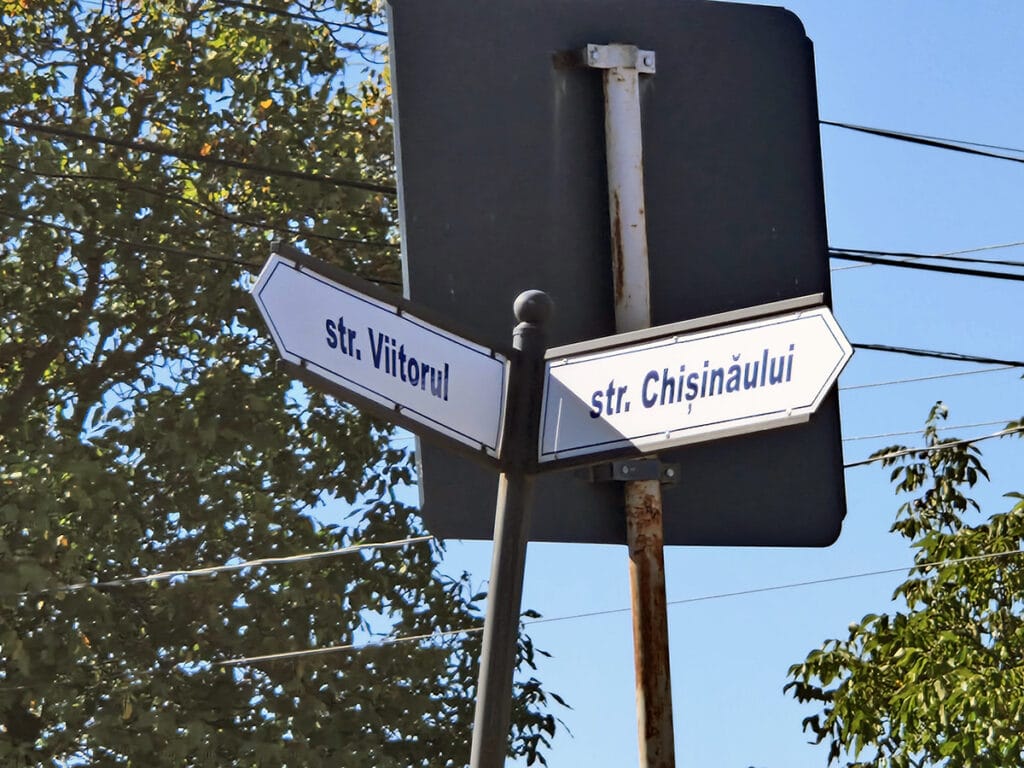
And in Droțcaia, we felt like we were at the end of the world as we tried to reconfigure our route, choosing only the streets that remained under Moldovan control and didn’t stretch into Transnistria.
Because yes, in the Romanian “enclaves” across the Dniester, the neuralgia of the territory runs so deep that the division wasn’t “one commune for you, one for me,” but rather one sidewalk with bushes and the other under tanks.
Yet the streets extending into Transnistria may also explain why this commune, with only 2,500 inhabitants, has restaurants, cafés, villas under construction, and luxury cars on its roads.
Locals say they believe Moldovan oligarchs and the Transnistrian mafia join forces in business, and that “smuggling from here to there and from there to here” has enriched not only organized crime bosses but also boosted local businesses in the villages scattered on both sides of the Dniester.
“But if I tell you everything I know, these guys will shoot me,” blurts out a man from the opposite sidewalk.
- Correspondence from the Republic of Moldova, also published in G4Media and Context.ro
With contributions from Cristian Andrei Leonte
PHOTO GALLERY
Ne bucurăm că ne citești!
Dacă vrei să ne și susții: